
The French Riviera is largely an artistic invention, a place of stolen kisses, moonlit dances, gamblers in tuxes and jewel thieves in shadows. Millions of tourists gather every year trying to capture a sense of glamour that was created, in large part, by writers. The name Côte d’Azur (the Azure Coast) was coined by a novelist, Stephen Liégeard, in 1887. Since then, generations of scribes have used the coast as both subject and sanctuary: somewhere to set novels, to write them and, in many cases, to disappear from public view in the company of lovers and far from the taxman.
Dante wrote about the landscape 700 years ago in his Divine Comedy, but the French Riviera as we know it today is a 19th- and 20th-century creation. Although many of the Riviera’s defining writers were French, Françoise Sagan above all, it was foreign authors who transformed the coast into an international fantasy. Fitzgerald gave it its Jazz Age glamour, Hemingway its romance and Agatha Christie its thieves and murderers aboard luxury trains.
Yet when we think about the French Riviera, we often think about its artists: Picasso, Matisse, Renoir. We remember cinema: Grace Kelly in To Catch a Thief, Brigitte Bardot in just about everything. But we also think of the feelings, the moods and atmosphere, which have all been conceived and perpetuated in literature. A teenage girl unhappy in love lying on a beach, long shadows cast by setting suns, espionage and seduction on sleeper carriages and in casinos, both diamonds and kisses stolen by smirking cads in tuxedos. Tourists may flock to the south of France, but so do writers and, as a result, millions of readers, in their imaginations. Here are just a few of the key books that helped define that magical coast in language.
The novels that defined the French Riviera
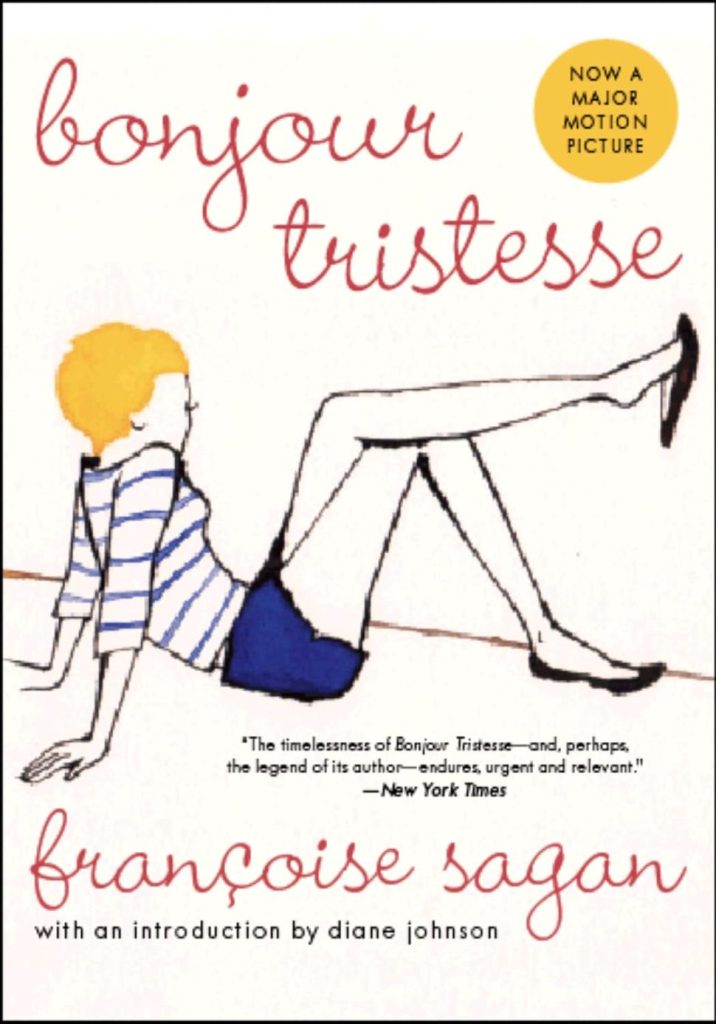
‘Bonjour Tristesse’ by Françoise Sagan
Sagan was only 18 when her first novel, Bonjour Tristesse, was published in 1954. Her coming-of-age story of Cécile both shocked and enraptured the French public, becoming an immediate bestseller. Set during a summer on France’s southern coast, the story centers on the 17-year-old Cécile, her widowed father and his young mistress. “It was dawning on me that I was better suited to kissing a boy in the sunshine than to studying for a degree,” Cécile says. Sagan is associated more than any other writer with Saint-Tropez; only Brigitte Bardot has done more to put the glamorous beach town on the map.
Bonjour Tristesse has since become synonymous with the erotic possibilities of the French coast, as well as an apt metaphor for youth’s innocence, the separation of pleasure and morality and the inevitable end of summer’s promise. “I lay full length on the sand, took up a handful and let it run through my fingers in soft yellow streams. I told myself that it ran out like time. It was an idle thought, and it was pleasant to have idle thoughts, for it was summer.”
Sagan’s next novel, A Certain Smile, published the year after Bonjour Tristesse, involves an affair between a young girl and an older man. At one stage, the couple spend a few days in Cannes, and again the Riviera setting is used to capture a freedom that ultimately proves temporary. “Happiness is like a flat plain without landmarks. That is why I have no processed memories of my stay in Cannes except those few unhappy moments,” Dominique, the book’s narrator, tells us in a moment of youthful wisdom typical of Sagan.
‘Bonjour Tristesse’ by Françoise Sagan.
Ecco
‘Tender Is the Night’ by F. Scott Fitzgerald
“On the pleasant shore of the French Riviera, about half way between Marseille and the Italian border, stands a large, proud, rose-colored hotel. Deferential palms cool its flushed facade, and before it stretches a short dazzling beach. Lately it has become a summer resort of notable and fashionable people.” F. Scott Fitzgerald’s 1934 novel about an American couple’s descent from glamorous partying into alcoholism and marital collapse is perhaps the most famous of all the Riviera novels.
The book is remembered in part for its blurring of fact and fiction, intentional or otherwise. Richard “Dick” Diver and Nicole Diver closely mirror F. Scott and Zelda’s incendiary relationship. Likewise, the novel’s hotel, Gausse’s Hôtel des Étrangers, is based on the real Hôtel du Cap in Antibes, where Scott and Zelda would socialize and drink in true Jazz Age style. F. Scott Fitzgerald would die after battling alcoholism in 1940, aged just 44.
Tender Is the Night is dedicated to “To Gerald and Sara / Many Fêtes” – Gerald and Sara Murphy were American expats who hosted writers like the Fitzgeralds. They were reportedly unhappy with the book, seeing it as a sort of betrayal. But Dick and Nicole more closely resemble the author and his wife than they do the Murphys.
Fitzgerald’s novel and, to some degree, the lives of the Fitzgeralds, capture the dark allure of the French Riviera: its promise of parties and pleasure, but with the knowledge that it can never last. “Later she remembered all the hours of the afternoon as happy—one of those uneventful times that seem at the moment only a link between past and future pleasure, but turn out to have been the pleasure itself.”
‘Tender Is the Night’ by F. Scott Fitzgerald.
Scribner
‘Akin’ by Emma Donoghue
“The whole point of travel is to learn there’s no such thing as normal.” From Emma Donoghue, writer of Room, which was adapted into an Oscar-winning film, Akin (2019) tells the story of a retired New York professor who takes his great-nephew to the French Riviera, and finds the past coming back to haunt him. Inspired by two years spent in Nice with her French partner, Akin is, in Donoghue’s words, “a sort of apologetic love-letter to the country that intrigues me so deeply, where I will always be a stranger.” So many of the books written about the French Riviera are from the previous century, but Donoghue continues in that tradition, bringing the French coast into the 21st Century.
‘Akin’ by Emma Donoghue.
Little, Brown and Company
‘The Mystery of the Blue Train’ by Agatha Christie
When luxury trains resumed service to the French coast after World War I, passengers quickly noted a change in appearance. The brown mahogany coaches had been replaced with dark blue steel and elegant gold lining. These carriages earned the nickname Le Train Bleu. The name stuck and was made official soon after. The Blue Train was a first-class-only service, collecting passengers from the Channel ferry and whisking them overnight to the Riviera. It’s an obvious setting for fiction, perfect for romance, intrigue and murder.
Agatha Christie’s The Mystery of the Blue Train (1928) sees a group of aristocrats, jewel thieves and, of course, Poirot en route to Monte Carlo, that “sunny place for shady people,” as W. Somerset Maugham famously described it. There’s a murder. The jewels are stolen. Poirot investigates. It’s a fairly standard whodunit, but Christie’s novel has helped shape the images we associate with the Côte d’Azur: diamonds, casinos and luxury sleeper trains, with criminals waiting for the opportune moment to strike.
‘The Mystery of the Blue Train’ by Agatha Christie.
William Morrow Paperbacks
‘The Garden of Eden’ by Ernest Hemingway
Fitzgerald may be more famously associated with the French coast, but he was far from the only American writer to be inspired by its setting. Hemingway started writing The Garden of Eden in 1946. He worked on it for the next fifteen years, and the novel wasn’t published until 1986, long after Hemingway’s death. It draws heavily on his time spent on the Riviera in the 1920s, particularly the summers he spent around Antibes with Gerald and Sara Murphy, the same couple to whom Fitzgerald dedicated Tender Is the Night. Befitting a novel set in the sensuous south of France, The Garden of Eden centers on a ménage à trois between the married couple David and Catherine and a young woman called Marita. The book is set in La Napoule, just southwest of Cannes, but, as with all of Hemingway’s novels, it contains wisdom beneath its simple prose that transcends location.
‘The Garden of Eden’ by Ernest Hemingway.
Scribner
‘Little Women’ by Louisa May Alcott
The sunny south of France may not be the first landscape we think of when we envision the March sisters. Snowy Massachusetts and smoggy New York City are more commonly associated with Alcott’s seminal novel. However, three years after visiting the city herself in 1865, Louisa May Alcott described Nice’s Promenade des Anglais in Little Women. The passage sees Laurie and Amy on their European sojourn, and is instantly recognizable to anyone who has walked down the famous promenade: “At three o’clock in the afternoon, all the fashionable world at Nice may be seen on the Promenade des Anglais—a charming place, for the wide walk, bordered with palms, flowers, and tropical shrubs, is bounded on one side by the sea, on the other by the grand drive, lined with hotels and villas, while beyond lie orange orchards and the hills. Many nations are represented, many languages spoken, many costumes worn, and on a sunny day the spectacle is as gay and brilliant as a carnival.” There are now iPhones and e-bikes but otherwise that description still rings true.
‘Little Women’ by Louisa May Alcott
Courtesy the publisher