
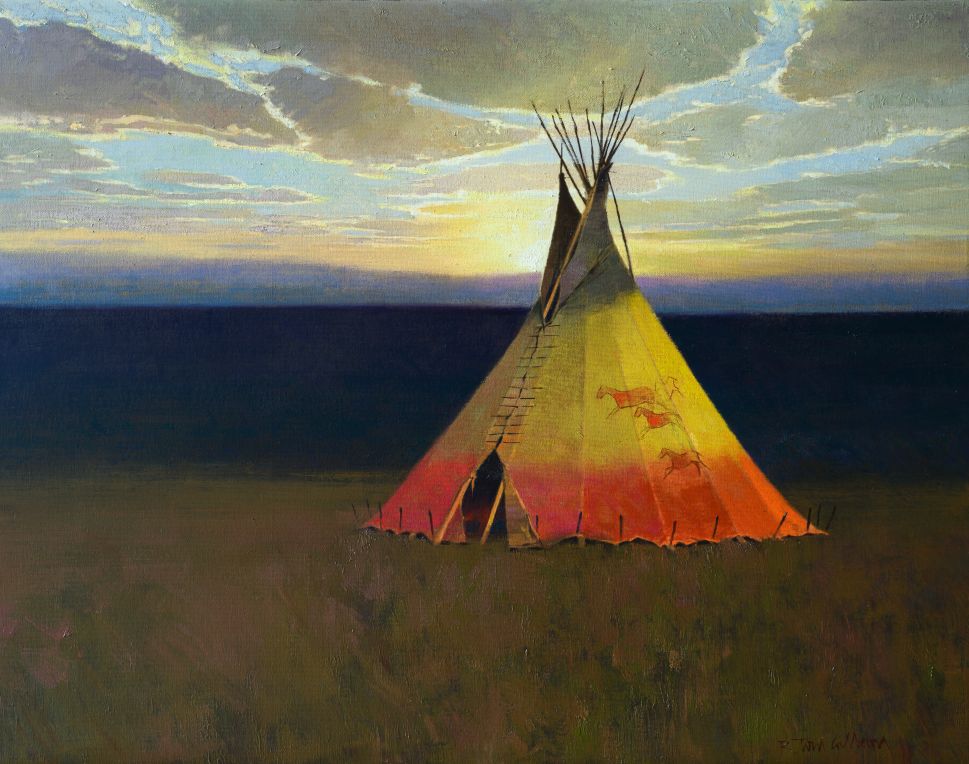
Artist Tom Gilleon is known for his depictions of American West motifs—teepees, lonesome landscapes and Native Americans—that straddle archetype and avant-garde. But describing him as a painter of teepees is a little like describing Rothko as a painter of rectangles. Gilleon is, with his chosen forms, doing something considerably stranger and more contemporary than one usually finds in what is limitingly called Western art but really ought to be called American art. Now in his mid-80s and still painting most days from his ranch in Montana, he has spent decades pulling the genre toward modernism with a rigorous focus on color, form and stripped-down compositions.
Diverting sharply from the work of ostensible forebears like Howard Terpning and Charles Marion Russell, most of Gilleon’s works strip out the sorts of things a traditional Western painting might include: drying racks, fires, horses, children, dogs. What remains, particularly in his paintings of teepees, are densely saturated blocked fields of color that seem lit from within. The best descriptor might be ‘maximalist minimalism.’ Each teepee is accurate in its specific tribal details, but “I don’t want to go back to the illustrative. Every detail that can be eliminated and still tell the story should be eliminated,” Gilleon says when we talk via Zoom.
That instinct for elimination came not from years of art school but from decades spent, ironically, working as an illustrator, first for NASA’s Apollo space program and then alongside Herbert Ryman and a roster of Disney’s top concept artists and architects to help bring not only EPCOT Center but also the company’s international theme parks to life. “I started out as a technical illustrator, doing how-to manuals, which taught me to eliminate as much detail as possible,” Gilleon tells me. “Then I became a concept illustrator with Disney Imagineering, so I was more of a storyteller at that point.”
On retainer, he moved from California to Montana in the early 1980s, first to a home on the Dearborn River and then a ranch near Great Falls, and began painting in the hours his contract left free. Inspired by the landscape (and his own background, having been raised by a grandmother who was a citizen of the Cherokee Nation), Gilleon experimented: “I had a little bit of spare time, I had a stretched canvas, and I drew a teepee and painted it. I thought no one in their right mind would want a big painting of a teepee. Well, it sold so fast it hardly had time to dry, and there were requests for more.”
He counts Rothko, Edward Hopper and Andy Warhol among his touchstones, and he applies the Pop Art figure’s provocation to his palettes. “I’m always going back to Warhol: ‘Art is what you get away with,’” he says. “And it’s the same with color; how far can you push this and still be true to art? How far can you push away from the traditional color scheme or theory and still make it work? I always try to push those boundaries.” His Sun Setting on the Red Man (2023), of a Native man on horseback in vivid blocks of red and blue, is particularly Warholian, illustrative and painterly at once.
His method is as unusual as his palette—every one of his oil paintings begins as a fully realized digital work. In Photoshop and then Corel Painter, Gilleon tests his compositions and colors. “It’s literally painted before I start painting,” he explains. By the time he puts brush to canvas, he’s polishing the work in a process akin to a flight plan: exhaustive preparation on the ground, followed by minor adjustments in the cockpit. “In the old days, you’d do maybe one study, possibly two, and then you’d do the canvas—and you’d be so invested in that study that you’d make it work on the canvas whether you really thought it was working or not. Whereas now I throw away 30 that I don’t think I like, and settle on another before I start the actual painting… I’ve increased the number of failures, but I’ve increased the number of successes when it gets to the canvas.”
Gilleon’s digital fluency has pushed him into some surprisingly radical virtual territory over the years. Alongside longtime collaborator Marshall Monroe, another former Imagineer, he has produced dynamic screen-based audio-visual works in which one painting dissolves into the next through layered transitions, generating unique compositions to tell the story of people and places. (The C.M. Russell Museum in Great Falls has one, as does the Booth Western Art Museum in Atlanta. Several collectors at the Yellowstone Club in Big Sky have them; one even had an architect design an entire room around a triptych.) Gilleon began experimenting with the underlying techniques at Disney in the late 1990s, anticipating the rise of digital art by decades. When he “saw the future of art being done on a computer,” he recalls, he sold a big collection of Native American artifacts to buy a top-of-the-line machine. “A few of the artists I was teaching would come up to my ranch here, spend a week, and we’d go on site and do plein air paintings. Several of them were also doing computer art. I got fascinated by what they were doing, and I said, well, I’m going to learn to do that. So I did.”
For an artist who first spent decades as an illustrator, recognition arrived quickly when Gilleon transitioned to painting. He was the featured artist of the 2009 Jackson Hole Fall Arts Festival, and in 2013 became the first living artist to receive a solo exhibition at the C.M. Russell Museum, titled “Let Icons Be Icons: The Art of R. Tom Gilleon,” following a 2012 solo show at the Booth Western Art Museum. More recently, Scottsdale’s Museum of the West opened a 90-painting career retrospective, “Inner Light: The Art of Tom Gilleon,” tracing his development from a childhood spent drawing to his current digital work, and including the world debut of Spirit Catcher, a 22-minute triptych referencing century-old photographs of Native Americans made by Edward S. Curtis. His paintings are in the permanent collections of the Denver Art Museum and many other institutions, as well as in the holdings of organizations as different as NASA and Universal Studios.
Even as Gilleon’s work might feel hyper-local in its references, it’s now galactic in its reach. He’s one of a handful of artists inducted as founding members of the Lunar Museum of Art‘s “First Artists” cohort: 15 digital reproductions of Gilleon’s paintings were launched into space and permanently archived on a lunar server after traveling to the moon on a SpaceX Falcon 9 rocket in March 2025.
As for the next evolution of Gilleon’s oeuvre, it would be banal—and inaccurate—to suggest the sky is the limit. For all the vastness of his subject matter, his whole world is the work. Asked what advice he would give young artists, Gilleon doesn’t circle back to color theory or compositions but rather suggests learning who you are as an artist before trying to sell anything: “Art is a spiritual practice. Creativity is a spiritual practice. You’d be there in your studio painting even if no one was buying.” Which is where you’ll find him on any given day. “I’ve always been this way,” he reflects. “As early as I can remember, drawing pictures in the sand. I think probably before I could speak well, art was my language.”