
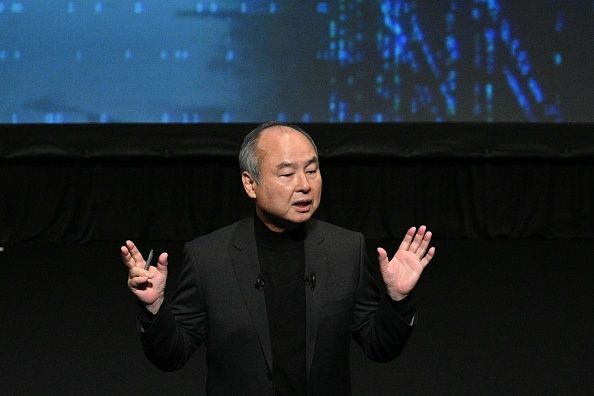
Masayoshi Son gestures with both hands raised as he speaks onstage in a dark jacket and black turtleneck.” width=”594″ height=”396″ data-caption=’SoftBank Group CEO Masayoshi Son addresses shareholders in Tokyo on June 24, 2026. In October, SoftBank used proceeds from a bond sale to invest another $10 billion in OpenAI, bringing its stake to about 13 percent. <span class=”lazyload media-credit”>AFP via Getty Images</span>’>
Masayoshi Son passed up a chance to invest in Anthropic because SoftBank had already started putting money into OpenAI, he told a Nikkei audience in Tokyo on Nov. 18. Anthropic began trading on Nasdaq on Nov. 19. On Nov. 20, as tech stocks fell across Asia, SoftBank shares closed down 14.5 percent in Tokyo. When the market reopened on Nov. 24, the shares regained 4.7 percent to close at 3,166 yen.
The SoftBank chairman and CEO paid the last installment on his $30 billion follow-on investment in OpenAI in October. Three $10 billion payments, in April, July and October, brought SoftBank’s cumulative investment in the ChatGPT creator to $64.6 billion and its stake to about 13 percent.
Son’s latest round of balance sheet gymnastics helped SoftBank raise $56.5 billion in the quarter ended Sept. 30, a company record. Some of that money refinanced earlier borrowing, while bonds and loans also funded new investments and expanded the firm’s liquidity.
Son can draw cash from those holdings without selling them outright. Intel shares back $7.4 billion in prepaid forward contracts, which provide cash now against a later settlement. He also increased Arm-backed margin borrowing by $5 billion and raised another $4.2 billion through asset-backed financing at SoftBank Vision Fund 2. Together, those transactions supplied $16.6 billion.
Financing the expansion
Another $39.9 billion came from debt financing, including $11.1 billion in foreign currency bonds, $6.9 billion in domestic bonds, an $11.9 billion senior term loan and a $10 billion loan referencing OpenAI’s preferred-share value. The last loan has cash collateral and a SoftBank Group guarantee. OpenAI shares remain unpledged. A significant fall in their value can trigger collateral requirements or mandatory prepayment.
The Arm-backed loan is different: shares are pledged as collateral. Its facility increased by $5 billion to $25 billion, with the maturity extended to September 2028. The borrowing can require cash collateral or prepayment if the pledged shares’ value falls. It is nonrecourse to SoftBank Group.
Son used some of the fundraising to refinance earlier borrowing. SoftBank repaid the $30 billion it had drawn under a $40 billion bridge facility by Sept. 15, then canceled the $10 billion undrawn portion on Sept. 30. Its final $10 billion OpenAI investment in October came from foreign-bond proceeds.
Son kept SoftBank’s adjusted loan-to-value ratio at 15.9 percent as of Sept. 30, below its policy threshold of 25 percent in normal circumstances. The firm reported a company-defined cash position of 5 trillion yen ($32 billion). That measure includes investments and undrawn borrowing capacity as well as cash.
Son’s expansion extends beyond the model developer. His firm completed its $3.1 billion acquisition of DigitalBridge, an asset manager focused on digital infrastructure, in September. At Sept. 30, before the last OpenAI installment, SoftBank’s $54.6 billion investment in OpenAI had a fair value of $99.6 billion. That is a paper valuation of the stake.
SoftBank also reported a 1.115 trillion yen ($7 billion) net loss attributable to shareholders for the quarter ended Sept. 30. It recorded a 597.2 billion yen ($3.7 billion) charge from revised power-equipment procurement plans, including losses on nonrefundable advances and contract changes. A 321.9 billion yen ($2 billion) derivative loss arose on Intel-backed prepaid forwards after Intel shares rose. The quarter’s net investment loss totaled 133.6 billion yen ($834 million).
A Nov. 12 update separates $9.5 billion in equipment advances made by Silver Bands 7, a different subsidiary from SB Energy, from the $2.9 billion loss on advances no longer in its procurement plans. Of the $6.6 billion balance, SoftBank expects to recoup $5.6 billion from the PORTS-Pike project: $3.4 billion in the near term and $2.2 billion by the end of 2027.
For his part, Son has made his infrastructure ambitions public. He attended the PORTS Technology Campus groundbreaking in Piketon, Ohio, on March 20. Seventeen SB Energy subsidiaries signed leases with an OpenAI affiliate on Aug. 17, each with an initial 20-year term, covering about 8 gigawatts of planned computing capacity.
Financing the next layer of A.I.
Son’s strategy of hitting the gas on A.I. has the potential to produce a more profitable next wave “if the companies at the top of the stack, the ones selling A.I. to businesses and consumers, turn usage into real profits,” Jim Neesen, managing partner at accounting advisory firm Connor Group, tells Observer.
Neesen expects profits to concentrate where there is pricing power, “which means the leading model companies with real enterprise revenue and the best chip and infrastructure suppliers.” Son’s enterprise push includes SB OAI Japan, SoftBank’s joint venture with OpenAI to sell A.I. tools to Japanese companies.
Michael Kleinberg, founder and CEO of A.I. management consultancy Mesh Digital, says Son has demonstrated SoftBank’s ability to mobilize substantial financing. “That is not the same as demonstrating that the underlying A.I. investments generate enough cash to fund their own expansion,” he tells Observer.
“Financing against an existing portfolio can create room to build the next layer of an ecosystem before its cash flows mature,” he adds. “Infrastructure can be financed ahead of adoption. Durable customer economics cannot be assumed into existence.”
“The operating question is whether customers can create enough real value during that time to support the expectations embedded in the investment,” Kleinberg says. With the OpenAI installments completed, Son’s capital now spans the model developer, chip design and the infrastructure intended to run its services.