
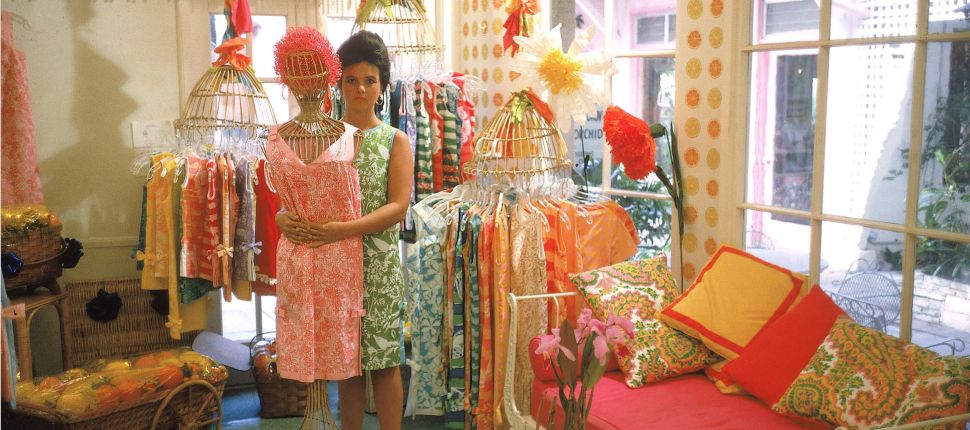
There was a time, not so long ago, when Lilly Pulitzer evoked images of sorority girls at Southern colleges wearing pearls and twinsets. Though the heiress behind the eponymous brand was a noted iconoclast, it seemed her legacy, at least over the past several years, belonged to the staid and subdued—the terminally basic. A scion of generational wealth, Pulitzer was part of the American aristocracy and stumbled into the world of fashion almost accidentally—or, perhaps, serendipitously. Though her name evokes whimsical prints of dancing monkeys and drinking frogs, Lilly Pulitzer’s initial motivations as a dressmaker were strictly practical.
Born in 1931 to Lillian Bostwick and Robert McKim, Lillian Lee McKim was a Standard Oil heiress who belonged to the rarified world of the East Coast elite, splitting time between family estates in Newport and Long Island and attending Chapin in New York City and then Miss Porter’s School in Connecticut, alongside Jacqueline Kennedy Onassis (then Jacqueline Bouvier). The future first lady would later be instrumental in publicizing the Lilly brand, but despite sartorial similarities, the former classmates differed greatly in public appearances and decorum. While Kennedy Onassis was famously reserved and fastidious, Pulitzer was free-spirited and always more of a wild card: she eloped with publishing scion Peter Pulitzer at the age of 21, and moved to Florida shortly thereafter.
The choice to live full-time in Florida was considered mildly improper, as members of high society were meant to winter in a tropical climate, not reside there year-round. Even more surprising was her decision to forgo a quiet existence as a housewife in favor of opening up a small juice stand in town, since most women in the 1950s stayed home every day with the children, especially among the upper crust.
Pulitzer reportedly felt she was on the verge of a nervous breakdown after the birth of her third child; her daughter later told Town & Country that she thought it was likely postpartum depression. The doctor’s orders were to find something to keep her busy and give her a sense of purpose. And voila: her juice bar was born.
Pulitzer used produce from her husband’s many Florida citrus groves to debut a roadside juice stand in Palm Beach in the late 1950s, and it quickly became a popular gathering spot. While her business was making a splash, so, too, was she: Pulitzer squeezed the fruit by hand, inevitably staining her clothes in the process. Ever the entrepreneur, Pulitzer commissioned a dressmaker to create brightly patterned, colorful frocks to camouflage any watermarks or discoloration. With a joie de vivre to match her attire, customers were continuously asking to buy the clothes, literally, off her back. She had a few more dresses made to sell at the stand, and eventually, found that she was selling more clothing than juice. She subsequently decided to focus solely on the fashion component of her new business, and by 1959, she had become president of her own company, Lilly Pulitzer, Inc., and her burgeoning clothing line soon broke through into mainstream stardom. Jackie Kennedy was photographed on the coast of Italy and in Palm Beach in one of the classic Lilly shifts, often accessorized with a pair of Jack Rogers, another enduring staple.
During the halcyon days of the 1960s, Lilly Pulitzer reached peak popularity, especially among socialites and the East Coast elite, who adopted the shift dress as a daily uniform while wintering in Palm Beach or summering along the Amalfi Coast. The brand remained a resort-wear staple in the 1970s and into the early 1980s. Alongside the 1980 release of The Official Preppy Handbook, the brand continued to soar. As fashion continued to change, however, Lilly Pulitzer’s signature effervescent style fell out of favor, and the brand declared bankruptcy and closed in 1984. About a decade later, the brand was purchased by Sugartown Worldwide, and Pulitzer remained involved as creative consultant. While the brand’s style wasn’t exactly on-trend with ‘90s minimalism, it experienced a resurgence decades later in the early 2010s, driven by the era’s revival of 1980s collegiate style: boat shoes, blazers, ribbon belts. It was the Jenna Lyons era at J.Crew, and let’s not forget about the wildly influential preppy fashion of the original Gossip Girl.
By the end of the decade, streetwear and athleisure rose in popularity, leaving the seahorses-drinking-martinis motif to gather dust in the back of the closet—that is, except for the true Lilly loyalists, for whom turtle prints and tropical flora never went out of style.
But fashion is cyclical, and what goes up must come down—and today, Lilly Pulitzer suddenly seems more popular than ever. The last time Lilly was a wardrobe staple was the 2010s, and the preppy style of that era has experienced a comeback: on-screen, of course, in 2023’s Saltburn, and on the runway in the double-popped collars of Jonathan Anderson’s Loewe Spring/Summer 2026 collection. The sartorial evidence is everywhere: the obsession with tennis-core aesthetics; the revival of ballet flats; the fetishization of luxurious loafers. This is also accompanied by a heavy nostalgia in the media landscape for the Palm Beach style of the 1960s, and of a Slim Aarons-style leisure class at play, from the elegantly (and deadly) bored vacationers on The White Lotus to the Nantucket summer residents on The Perfect Couple. For literal on-screen representation, look no further than the vintage 1960s Lilly Pulitzer shift dresses in Palm Royale, or the head-to-toe Lilly outfits on display in Sirens.
But how did Lilly manage to reemerge as a relevant brand amid the seemingly never-ending quiet luxury trend? By looking to the past, of course. Lilly’s 2024 rebrand unveiled a redesigned logo that was more of a tribute to the past than a modernization for the future—a 1960s-style typeface in the classic Lilly pink. Today, Lilly Pulitzer is stepping into its status as a 67-year-old heritage brand, embracing classic Americana à la Ralph Lauren. With this came a rollout across social and in-store, as well as through hotel and showroom collaborations, to put Lilly back on the map. The brand does leverage platforms like TikTok, but it’s not explicitly targeting Gen Z customers—though the viral Bama Rush videos provided massive amounts of unpaid advertising aimed at the younger crowd. Instead, Lilly is seeking to regain former customers, who’d retired their pink and green in the past decade or so. Consider it a return of the prep.
Lilly Pulitzer continues to unveil new stores, from Wilmette to Garden City to Cranston, Rhode Island, and is branching into men’s casual sportswear. While the resort-wear label has modernized some silhouettes, it has also leveraged its 1960s Palm Beach archives with a Vintage Vault collection showcased at last year’s New York Fashion Week. Other buzzworthy fashion moments included the Key West SS26 Homecoming Show and the Kips Bay Decorator Show House Palm Beach, along with collaborations like the Lilly Pulitzer-designed oceanfront suites at Casa Marina Key West.
Perhaps nothing heralds the return of Lilly Pulitzer more than this year’s publication of The New Preppy Handbook, written by Dozer Magazine founder Justinian Mason with a notably more New York-centric, inclusive vibe than the original. (Or, in the recent words of the New York Times: “Preppy attire without the cultural baggage.”) The discordant colors and vibrant prints of prep style were historically a means of signifying status and belonging, as if, by wearing the loudest possible colors, one was announcing a supreme comfort in one’s social position, unafraid to look ridiculous. “The pants had a go-to-hell air: checks and plaids of the loudest possible sort,” Tom Wolfe wrote of the denizens of Martha’s Vineyard in a 1976 article for Esquire entitled “Mauve Gloves & Madmen, Clutter & Vine.” By moving prep style from its original turf—country clubs, WASPy dinner parties, resort towns along the Eastern Seaboard—and situating it on the runway and city sidewalk, the aesthetic trend becomes more democratized.
Today, to wear Lilly Pulitzer is a choice to stand out from the crowd, from a sea of quiet luxury basics and a backdrop of millennial beige. At a tiki party I recently attended on the North Shore of Massachusetts, the outfits were accordingly flamboyant—WASPs gone wild in Farm Rio and Cara Cara. The best-dressed attendee? A guest in a vintage Lilly shift (pink with green monkeys), paired with flat gold sandals. Stylish, breezy and comfortable on a hot summer night, and decidedly effortless—just as Lilly herself had originally intended. Long live pink and green—a match made in cocktail party heaven.