
The Resnick Center for Herbert Bayer Studies opened in 2022 on the Aspen Institute’s Aspen Meadows campus to preserve and study the legacy of the pioneering Bauhaus artist and designer. A true gem, the center presents unexpectedly visionary works through rotating exhibitions that both illuminate Bayer’s fundamental role in shaping Aspen’s modern chapter and testify to the depth of the city’s cultural life.
Today, 80 known billionaires hold property interests in Pitkin County, according to data gathered by Aspen Journalism and Aspen Sojourner. Downtown Aspen, where both the Aspen Art Fair and Intersect Aspen take place, is home to one of the most expensive real estate markets in the United States, with median home prices now in the stratosphere. (In 2025, the median sale price for a single-family home in Aspen reached approximately $17.5 million, up 31 percent year over year, while total residential sales volume reached roughly $2.51 billion.) During fair week, hotel rooms rarely start below $1,500 a night, making Aspen a natural playground for a rarefied crowd that knows it will, for the most part, encounter only peers there.
As part of the art week celebrations, Observer attended an after-party hosted by the private aviation company Falcon at a recently completed property listed for $62.5 million with Sotheby’s International Realty. “There are very few properties like this, overlooking the valley with this much land and isolation, and complete with everything one could desire, including a pool deck and outdoor fireplaces,” Chris Klug, a partner at Sotheby’s International Realty, told us. He also noted that the county is beginning to impose more regulations on what people can build, which is making the property even more unique and desirable, justifying the premium price.
Still, money alone can’t build an entire art ecosystem—Aspen is now too expensive to foster anything resembling a community of local artists. However, the town’s cultural institutions and organizations continue to support the influx of artists and creative people that Paepcke first initiated. Anderson Ranch Arts Center‘s sprawling campus, for example, is a paradise of artistic experimentation and perhaps one of the country’s most distinctive models for combining social impact with extensive, multidisciplinary infrastructure that serves both the local community and the wider art world. Established in 1966 on a former sheep ranch associated with the Anderson family, the five-acre campus gradually developed into a workshop community encompassing ceramics, painting and drawing, printmaking, photography and new media, sculpture, furniture design, woodworking and digital fabrication.
Hosted in partnership with Christie’s, the auction raised more than $4 million to support the museum’s experimental exhibitions and educational programs, which remain free to the public. In alignment with the institution’s artist-centered foundations, participating artists who donate works retain a percentage of their auction proceeds. Their works often sell well beyond their estimates, thanks to the generosity of local collectors, turning the auction into an important moment of promotion and visibility for the artists as well. Indeed, many dealers were already in town to support the artists they represent, despite not participating in any of the fairs taking place that week.
Among the attendees at this year’s gala were some of the art world’s most recognizable personalities, including co-chairs Sarah Arison and Charlie Pohlad, as well as collectors and philanthropists Amanda Precourt, Barbara Bluhm-Kaul, Don Kaul, Veronica Grazer, Brian Grazer, Daniel English, Bernard LaGrange, Melony Lewis, Adam Lewis, Gael Neeson, Yana Peel, Gayle Stoffel, Cecilia Poma, Ernesto Poma, Amnon Rodan, Katie Rodan, Nancy Rogers, Allison Rose, Dan Rose, Jamie Tisch and Mary Zlot. Many artists were also invited and circulating around Aspen during those days, including Isaac Julien, Kelly Akashi, Ivan Cheng, Sayre Gomez, Irena Haiduk, Lyle Ashton Harris, Camille Henrot, Alex Israel, Aliza Nisenbaum, Okwui Okpokwasili, Ding Shilun, Hank Willis Thomas and Kennedy Yanko. At the opening of the Aspen Art Fair, we also spotted Cheryl Pope and Dustin Yellin, while Tomokazu Matsuyama had arrived earlier in the week. The omnipresent Hans Ulrich Obrist was there, too, along with Whitney Museum director Scott Rothkopf, Swiss Institute director Stefanie Hessler and Pioneer Works founding artistic and executive director Gabriel Florenz.
Seeing the city draw such a concentrated mix of collectors, patrons, artists and art professionals, we couldn’t help thinking of it as a kind of “summer camp for the art world,” which felt especially apt after reading a recent Economist article about the growing appetite for elevated summer-camp experiences for adults, an appeal rooted not simply in nostalgia but in the promise of structured, in-person connection at a time when adults are socializing less and finding it harder to form new relationships.
What people seemed to enjoy most in Aspen were the convivial, relaxed mountain environment and slower pace. Longer conversations and meaningful encounters unfolded alongside hikes and time in nature, instead of the usual sprint from one art event to another that defines so many other art weeks. Given the structure of both the AIR festival and the Aspen Art Fair’s VIP programming, as well as the compact scale of Aspen’s cultural ecosystem, it was almost impossible not to keep running into the same people throughout the week. The result was something closer to a temporary art community, with artists, dealers, collectors and professionals effectively camping together for a few days.
Among the ArtCrush gala attendees were Vincenzo de Bellis and Noah Horowitz from Art Basel, which this year organized its own VIP Aspen “summer camp,” a five-day immersive program created in partnership with the museum. The itinerary included visits to local collections, including those of Melony Lewis and Nancy Magoon, as well as Jorge Pérez’s new, sprawling 200-acre sculpture garden, along with private gallery visits and special talks, culminating in an “event finale” at ArtCrush. Registration benefited the museum, with Castle Peak membership set at $5,000 or Maroon Peak membership set at $10,000. It also included year-round curatorial tours, fair passes, collection visits and priority access to AIR and ArtCrush, which have similar “donation tiers” for access. When we saw De Bellis on the plane on his way out of Aspen, he said he was particularly satisfied with this first “art camping” trip in the Aspen mountains.
The concentration of prominent personalities drawn by ArtCrush has clearly become one of the factors behind the success of the Aspen Art Fair, held each year at the historic Hotel Jerome. Reporting sales figures in the millions and presenting an increasingly international gallery lineup, its third edition brought together 38 exhibitors, distributed between curated presentations in the hotel rooms and a more fluid, open-booth structure in the ballroom.
Bob Chase, the fair’s founder and a longtime Aspen resident who is also behind the local Hexton Gallery, described the fair’s timing alongside the Aspen Art Museum’s ArtCrush as mutually beneficial. “It has become a case of a rising tide lifting all boats. We bring people in, and they bring people in,” he said, confirming that the two organizations remain in conversation each year as they plan the week’s programming.
Several of the artists included in the ArtCrush auction were also featured at the fair, clearly benefiting from the momentum created by this dual local exposure. “If a gallery has an artist featured in the auction, it often makes sense to do something more in-depth while they are already here. That creates a great synergy,” Chase said. “Our audiences overlap almost completely. We bring people for them and vice versa, and it works very well.”
What is surprising, however, is precisely how much more natural and spontaneous the crowd’s interactions feel here, something we rarely see at other fairs in the United States or abroad. Women wander in from a casual walk dressed in Alo, with only a few diamonds hinting at their status. Many arrive alone and then return later in the day in the company of a relaxed, impeccably dressed businessman. Zegna apparently does big business here and is one of the sponsors of the Aspen Art Museum and its gala, perhaps carving out, in the mood of the mountains, some quality time from an otherwise busy city schedule.
“This place naturally makes people relax. It’s different from the Hamptons, where you’re only a couple of hours from New York, and you bring the city with you. Aspen is remote,” Chase explained. “It’s not easy to get here, and once you’re surrounded by the mountains, the fresh air, the outdoor lifestyle, the whole experience changes your mindset.”
Essentially, Aspen is something of a suspended dimension in which dealers can approach clients and build relationships at a different pace, making it fertile ground for those looking to generate business during the otherwise slower summer months. “Aspen is our home away from home. The intellectual rigor paired with the sheer beauty of this place is intoxicating, and there is no better place to present the beauty and ideas of our artists. Our Aspen community is bar none when it comes to curiosity and engagement, not to mention we have a lot of fun!” commented Kelly Woods, partner at Boesky Gallery.
Aspen’s audience, notably, does not necessarily gravitate only toward the more immediately enjoyable—let’s say decorative and derivative—art that has become increasingly predominant at Intersect. These are, more often than not, seasoned collectors or, in any case, culturally curious and globally minded individuals, many of whom own homes in multiple regions and travel enough to have developed far more international tastes. “Everybody loves this fair. The collectors here ask all the best questions and really get involved. The people that come to the fair are art lovers; they really spend time with you and enjoy their time here,” confirmed Teo Cohen, partner and director at the Mexico City gallery Proyectos Monclova, which debuted at the fair in a joint booth with El Apartamento from Cuba.
“They are still culturally forward and very involved in all the art happening here at the institutions and elsewhere,” Chase confirmed. “What I have found as a gallerist and fair operator is that Aspen has a national and international audience. It is not limited to one subject or sensibility. These are culturally curious people seeking discovery. Here, you can present an artist to a concentrated group of highly dedicated collectors from across the country and around the world.”
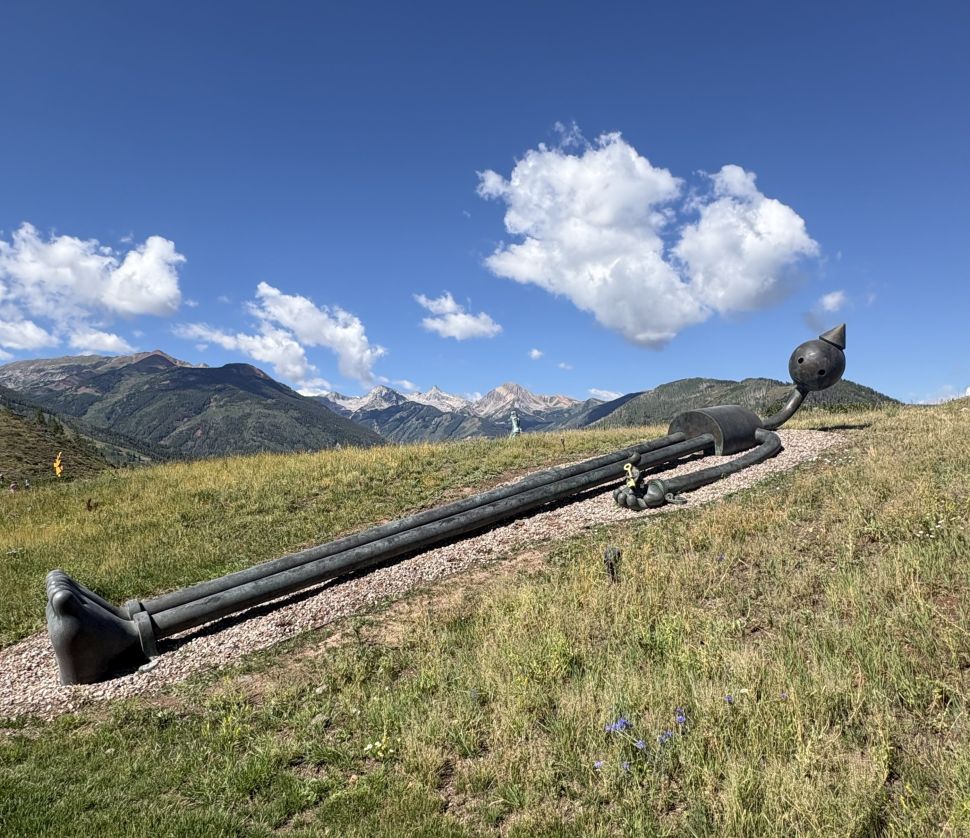
To give a sense of the profile of collectors attending the Aspen Art Fair, on opening day Jorge Pérez was seen moving through the booths and engaging personally with many of the dealers, without rushing or being constantly interrupted, as would likely happen in Miami or at other major fairs. During the week, he unveiled his ambitious 200-acre sculpture park, which features more than 50 large-scale works installed with little apparent concern for the logistical challenges or costs involved, the kind of undertaking only a visionary and highly ambitious collector would pursue. Set along the ridges against the spectacular, lush scenery of Snowmass Mountain were major works by artists including Fernando Botero, Gabriel Orozco, Jim Dine and William Kentridge, as well as by more recently established figures such as the Haas Brothers and Guadalupe Maravilla.
Unlike other centers of new wealth and art that emerged during the pandemic, Aspen’s influx of collectors has been unfolding for decades, Chase confirmed, accelerating only in the wake of major disruptions such as the 2008 financial crisis and COVID-19. Many of those who eventually became full-time or extended-season residents already had ties to Aspen before deciding to spend more time there or purchase property, suggesting a deeper, long-term commitment that differs from the more temporary migrations driven mostly by favorable tax regimes or other shifting conditions, as has happened in other cities and states since the pandemic.
Chase also emphasized Aspen’s ties to Denver and other institutions across Colorado. “We had a group of about 50 people connected with the Biennial of the Americas. Representatives from both museums—the Museum of Contemporary Art Denver and the Denver Art Museum—came up and spent the day with us,” Chase said, pointing to that as evidence of the potential for stronger regional institutional relationships and of the strength of the state’s cultural ecosystem, which likely deserves even more attention from the wider art world.