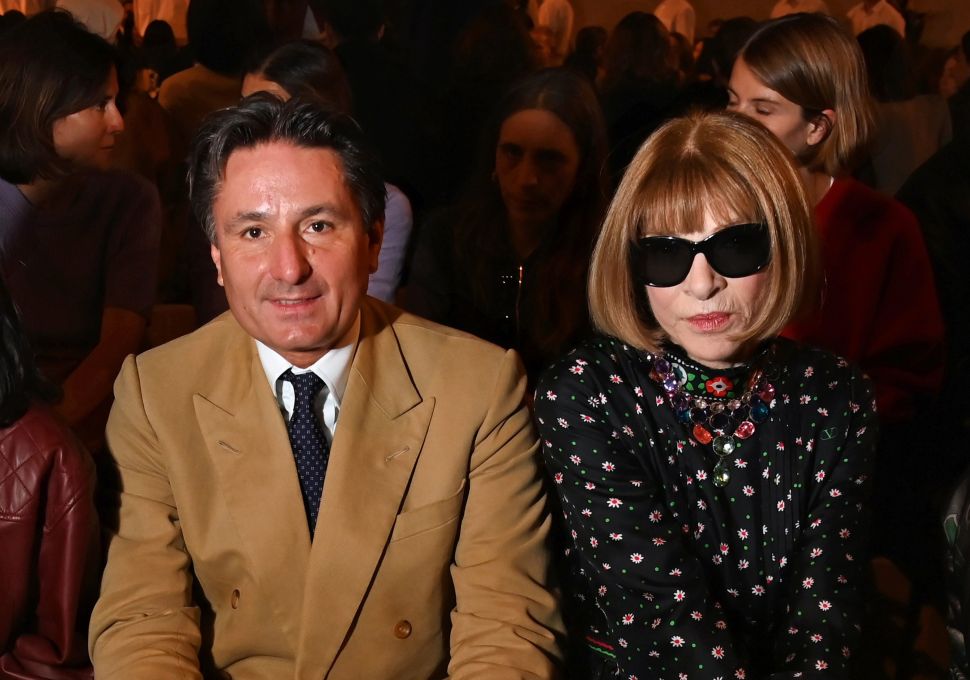
Axel Dumas and Dame Anna Wintour attend the Hermès SS26 Women’s Show on October 4, 2025 in Paris, France. ” width=”970″ height=”680″ data-caption=’Hermès CEO Axel Dumas and Dame Anna Wintour attend the Hermès SS26 Women’s Show on October 4, 2025, in Paris, France. <span class=”lazyload media-credit”>Dave Benett/Getty Images for Her</span>’>
On the heels of Hermès’ strong first-half 2026 results, it’s clear the French luxury house’s scarcity model and singular branding, built around icons like the Birkin and Kelly, have at least partially insulated it from the recent downturn in luxury spending. While ongoing Middle East conflicts and a lagging post-pandemic demand recovery in China have squeezed competitors like LVMH and Kering, Hermès’ distinct strategy shields both the company and the family that has led the brand for 179 years.
The Hermès family, comprising more than 100 heirs, ranks among the world’s richest, with an estimated combined fortune of $184.5 billion as of late 2025. They now stand as Europe’s wealthiest luxury dynasty. Last year, they overtook LVMH founder Bernard Arnault and his family as France’s richest, a title Arnault had held since 2017.
From January through June, Hermès saw revenue rise 6 percent to €8.2 billion ($9.4 billion), driven mostly by the Americas, Japan and Europe. Beyond these regions, China continued to grow, including with a new store in Beijing’s Sanlitun district in early April, contributing to a 2 percent revenue bump for Asia. Despite a 4 percent decline in the Middle East, recovery began by the second quarter, the company said.
“We have stability in our situation in China, but it still hasn’t recovered its past momentum,” Hermès CEO Axel Dumas said in a translated recording of the earnings call on July 29. “The Middle East was an area where there was double-digit growth, and there is now, of course, much less dynamic growth there. We do see, nonetheless, resilience in the Middle East.”
Hermès’ single, impactful brand contrasts sharply with LVMH, a conglomerate with 75 labels including Louis Vuitton, and Kering, which owns 30 brands including Balenciaga. LVMH’s revenue during the same period was up just 2 percent, with its Asia region seeing a 0.5 percent boost and the Middle East shrinking about 10 percent. Kering saw revenue increase 1 percent in total, with Asia and the Middle East shrinking 3.6 percent and 9.6 percent, respectively.
Hermès still faces market turbulence affecting the luxury sector, but its extreme scarcity model generates a consistent backlog of buyers, enabling the company to minimize the impact of broader consumer volatility. Production is inherently throttled by the company’s single-artisan model. Each Birkin bag, for example, requires upwards of 40 hours of craftsmanship by an artisan, with initial training taking 18 months. As a result, rapid expansion is practically impossible, but tactics like years-long waiting lists do serve as leverage for the brand in a fast-fashion world. In 2025, a Birkin bag sold for a record $10 million at auction.
Globally, Hermès continued to invest in store openings, renovations and production capacity expansions, with investments for the first half of the year totaling €344 million ($394 million, up nearly 9 percent year over year). Its flagship leather goods, saddlery, silk and textile products led demand while perfume, beauty and watch sales fell.
A family fortress against takeovers
Founder Thierry Hermès instilled the artisan practice as a core element of the business in 1837, a tradition that the roughly 100 heirs who have remained shareholders have carried into the modern day. These shareholders, divided between three branches of the family (the Dumas, Guerrand and Puech cousins), formed a family holding company, dubbed H51, in 2010 to take majority control of Hermès. The maneuver came in response to LVMH quietly building up a 17 percent stake in Hermès.
Today, H51 controls 50.2 percent of equity, and the sixth generation of Hermès heirs, collectively (including those outside the holding company), own a 66.7 percent stake and more than 76 percent of voting rights, giving them decisive control over governance and preventing a conglomerate takeover.
By consolidating control around uncompromising scarcity and independence, the sixth-generation Hermès heirs have built a structural wall against external takeovers and market turbulence unseen in expansion-focused empires.