
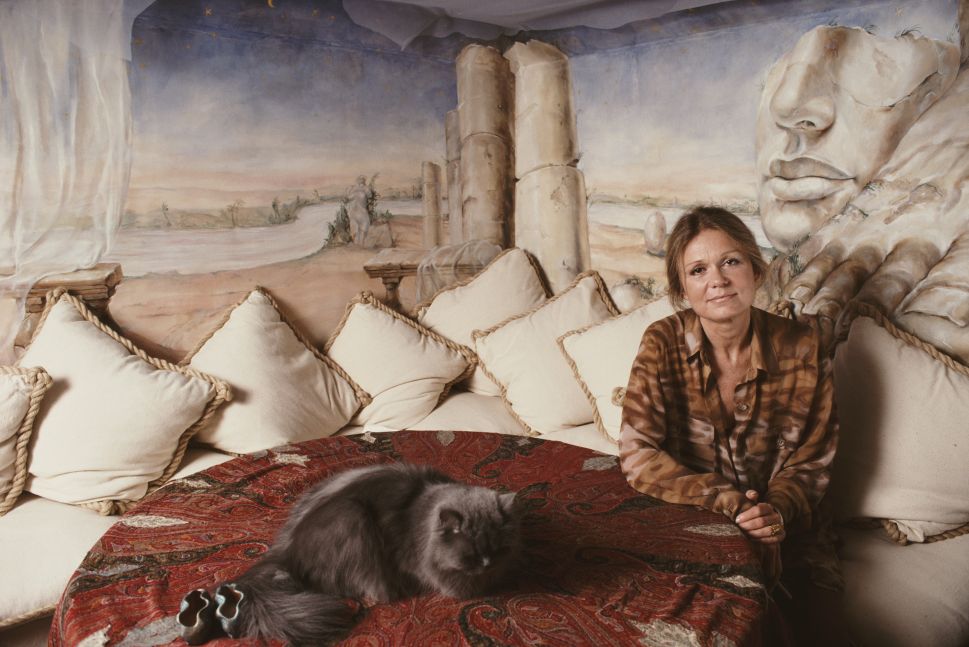
Gloria Steinem in her New York City apartment, 2nd November 1990. ” width=”970″ height=”647″ data-caption=’The most enduring lesson from Gloria Steinem’s life may be how deliberately she built a movement that could keep moving without her. <span class=”lazyload media-credit”>Photo by Barbara Alper/Getty Images</span>’>
The candles on the cake were for Gloria Steinem’s 91st birthday. No doubt she had dozens of birthday celebrations that year. But in this photo, we were sitting in her brownstone on the Upper East Side, where she lived for 60 years. There’s a lot to learn about her leadership style by looking at that brownstone and what happened inside it.
Gloria held her talking circles in the salon where there were more cushions on the ground than chairs. In Gloria’s world, there was always room for one more voice. Loose, ever-expanding circles were her theory of change. There was no head of the table. Because of that, there also couldn’t be one single point of failure. Gloria, even in the way she organized her living room, treated listening not as a courtesy, but as the first act of organizing. She said she learned more on listening tours than on lecture tours.
Many ideas and organizations were hatched on those cushions, from Ms. magazine to the National Women’s Political Caucus, almost always with partners. Ms. began with Gloria and Dorothy Pitman Hughes, with Patricia Carbine and Letty Cottin Pogrebin. The National Women’s Political Caucus was founded with Bella Abzug, Shirley Chisholm, Betty Friedan and Fannie Lou Hamer, among others. Nearly every organization she created had co-founders. Shared mastheads were her signature move. Many hands and minds shaped the ideas that turned into institutions from day one. She was quick to share the limelight with others and wouldn’t allow the media to call her the leader of women’s rights. She thought of herself as an organizer above all else.
Treasured objects from the extraordinary places she traveled lined the walls and covered the tables, especially elephants. Elephant herds are led by their oldest female. Years ago, I was in Botswana and watched a herd of elephants cross open ground in the late afternoon. In their path was a skull of one of their own, sun-bleached and half-sunk into the dirt. The matriarch did not walk around it. Instead, she lowered her head and ran her trunk over the bone from end to end. The next elephant did the same. And the one after that. Until every elephant in the herd stopped, including the calves, and touched the skull before moving on.
Gloria sensed history and connection the way the elephants do. In Gloria’s words, “We are linked, not ranked.” Many of us have perhaps thought since Gloria’s passing about how a movement carries forward when one of its most recognizable voices is gone. Movements don’t die at their defining moments. When the headlines move on, funding dries up and the people doing the hard, everyday work are left to improvise. Gloria understood this better, I think, than almost anyone. Her genius went into infrastructure and a message that transcended her life. She wanted the brownstone to remain what it always was, a gathering place, with the cushions still on the floor. Her last act of organizing was to make sure the room stays open.
That is the clearest role for business leaders and philanthropists. If we want to honor her, we will ensure there are gathering spaces. Fund infrastructure. Give operating support instead of restricted grants, because the organizers closest to the work listen and know better than any of us where the next dollar belongs. Offer convening space, patient capital and, more than anything‚ presence. In an age of Zoom, she believed in the power of all five senses. We were honored to support Gloria and her Foundation at Olivela, and the lesson we took from her was about posture as much as funding: business belongs in the circle as one more voice on one more cushion, not at the head of a table she deliberately never owned.
Gloria’s way of working holds lessons that reach well beyond philanthropy, into how any of us lead anything. Listen first. Share credit as strategy. Organize the way you want the world to look. Realize that the means are not separate from the ends. How we organize is what we build. The elephants in Botswana did not linger at the skull. They paused, touched and honored. Then they walked forward, trunk to tail.
Gloria built a herd of her own, vast and unruly, stretching across countries and generations, and she spent her decades making sure the herd knew how to walk without her. Now it falls to all of us‚ her co-founders, her readers, her funders, the lost twenty-somethings she took in as well as the leaders she made, to keep our trunks on the bone as we walk on.