
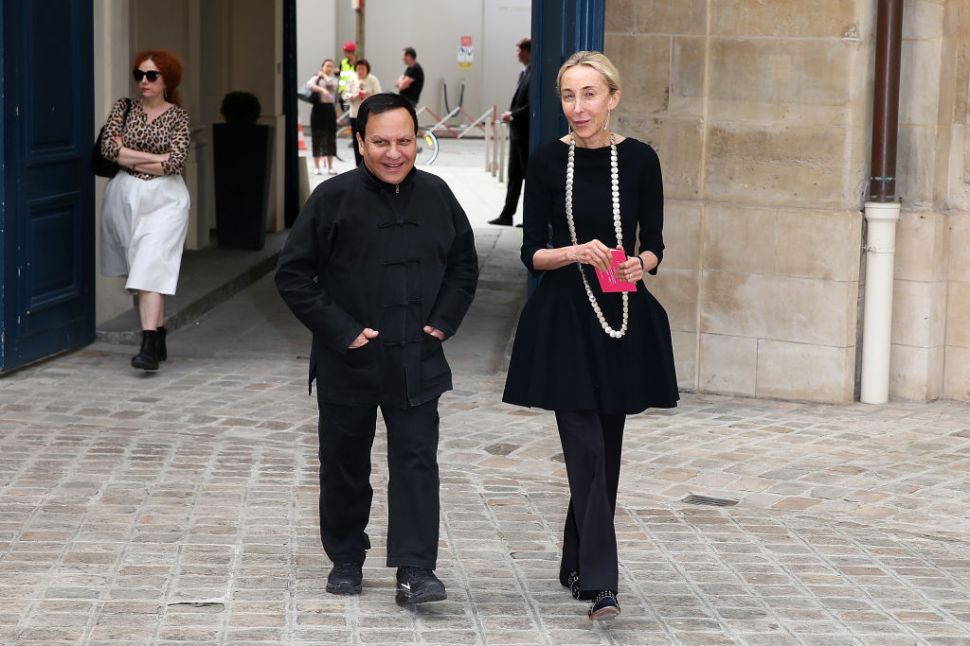
In spring 2008, Carla Sozzani traveled to Egypt with her close friend and collaborator, the French-Tunisian fashion designer Azzedine Alaïa. On Roda Island in the old part of Cairo, the gallerist and the designer ventured into a small white building surrounded by a lush garden and shaded by giant ficus trees. It was a museum devoted to Oum Kulthum, the legendary Egyptian diva, whose haunting melodies Alaïa had listened to raptly as a child growing up in his grandfather’s house in Tunis. “Oum Kulthum was Azzedine’s favorite singer,” Sozzani told Observer. “And this goes back to his childhood when on Thursday nights, he said that everybody was silent because the radio was playing Oum Kulthum. And even when he was working in his studio, it was all Oum Kulthum, and every video we ever did of Azzedine’s work, we always put Oum Kulthum in the background.”
In 2019, two years after Alaïa died of a heart attack, the Iranian artist Shirin Neshat’s exhibition “Looking for Oum Kulthum” premiered at the Fondation Azzedine Alaïa, a museum and art gallery housed in the designer’s former home and studio in the Marais neighborhood of Paris. Drawing on her signature focus on the pain and vulnerability of Muslim women, expressed through calligraphy and visual art, Neshat paid homage to Alaïa’s favorite singer with a series of videos and glowing digital portraits modeled on old Egyptian movie posters. The works depicted actresses portraying Oum Kulthum at various stages of her life.
“When Shirin Neshat did that series, I contacted her and said I would really love to show this in Azzedine’s foundation,” Sozzani said. “It was very beautiful to work together. We went to Tunisia together. She’s an amazing artist, but also very sensitive. It’s very good that she accepted.”
The art foundations of high fashion houses function as museums, galleries or both, often open to the public and ultimately enshrining the brand’s contributions to cultural heritage. Yet these same foundations also elevate artists through commissions and exhibitions, and they frequently collaborate with the art world at festivals and events. As art and culture lose public funding amid growing neoliberal privatization and the rise of tech oligarchies, fashion house foundations, many of which date to the ’90s and early 2000s, are stepping in to fill the vacuum.
“Cartier as a company is rooted in a philosophy of what in French is called ‘savoir-faire,’ or really values design and artisanal know-how, excellence in craft, but also as a cultural ethos values enormously the question of heritage,” Béatrice Grenier, an author and director of international programs at the Fondation Cartier, told Observer. “So it’s logical that a brand that has this kind of history and incredible reverence towards heritage would also want to support the creatives of our living times.”
Art and fashion have always been linked, of course. Many designers, like Elsa Schiaparelli and Paul Poiret, moved in avant-garde circles; but even those who didn’t often looked to the art world for ideas. Schiaparelli and Salvador Dalí collaborated on a surrealist white gown emblazoned with a crimson lobster, famously worn by Wallis Simpson. More recently, Marc Jacobs borrowed the Japanese artist Yayoi Kusama’s kitschy polka dots for a Louis Vuitton collection of bright yellow heels, handbags and clothing popping with whimsical dots. And Daniel Roseberry cites ancient Egyptian figurines and the work of Les Lalanne as inspiration for his dramatic, hyperreal ensembles.
“Schiaparelli, Poiret, Saint Laurent, they were all influenced by art,” Sozzani said. “Art is an inspiration and couturiers need to be inspired. It’s not only about technique and shapes and forms, but it’s about culture. And art has always been influential in all centuries of reality.”
Today, fashion houses are at the forefront of providing prestige, funding and space to both established and emerging artists, and this patronage stretches back decades. Miuccia Prada launched the Fondazione Prada in 1993 with her husband, Patrizio Bertelli, citing “the urgency of ideas” as her motivation and framing the foundation as a way to serve the public through culture. Since then, the foundation has showcased work by a range of artists, including Mariko Mori and Louise Bourgeois, as well as a video installation by the Oscar-winning filmmaker Steve McQueen. Currently, an exhibition of multidisciplinary work by Arthur Jafa and Richard Prince is on view at the Fondazione Prada’s Venetian palazzo, amid 18th-century frescoes swirling across the walls.
Similarly, the Fondation Cartier, housed in a regal building next to the Louvre, has a history of investing in experimental trailblazers. These include the avant-garde Japanese photographer Daido Moriyama, known for his gritty, lush black-and-white images of Tokyo, and Huang Yong Ping, a Chinese artist who settled in France after the Tiananmen Square massacre. The Malian photographers Seydou Keïta and Malick Sidibé, whose glamorous portraits captured identity and dignity after Mali’s independence from France, were likewise celebrated at the luxury jeweler’s foundation.
“We don’t view it as our position or our responsibility to historicize the career or the body of work of artists because in France we have amazing institutions that are working on this academic mandate,” Grenier said. “We try to propose ways of seeing the work of artists, self-trained artists or creatives who aren’t considered artists and offer a platform that can disrupt the disciplinary boundaries with which we usually regard the work of an ‘artist.’”
At a time when civic funding for artists is dwindling or hard to come by and traditional nonprofit funding is notoriously competitive and mired in bureaucracy, culture funds from European fashion houses offer a trove of resources for emerging artists. Every two years, the Chanel Next Prize awards 10 artists €100,000 each. The Fondazione Prada distributes an annual endowment of €1.5 million to 14 projects in independent cinema alone, to say nothing of the visual and material arts.
And because these foundations are run by the highest-grossing luxury houses in the world, their endowments are, unsurprisingly, substantial. LVMH, for example, contributed €863 million to its art foundation over 10 years. A 2003 French law granting tax breaks of up to 60 percent to companies that support the arts has also helped relieve financial pressure on privately owned art foundations.
Notably, the Max Mara Art Prize for Women awards an early- to mid-career artist a six-month residency in Italy. After 20 years in partnership with the Whitechapel Gallery in London, the prize has gone “nomadic,” prioritizing countries with lesser-known art scenes and scant financial resources. The Indonesian artist Dian Suci won the latest edition and is now working on a project examining how the mainstreaming of industrial capitalism has eroded spiritual artisan traditions in Italy and Indonesia.
“It’s really an instrument, a tool for cultural diplomacy and building bridges with other countries,” Sara Piccinini, director of the Collezione Maramotti, which is owned by the family behind Max Mara, said of the prize’s new direction. “All these themes are less known from a Western point of view. So we thought that the encounter with Italian culture and reality may bring something interesting and fresher, and really a new perspective for the artists winning the prize. And also for ourselves, because we may discover a scene in a country in a way we didn’t expect.”