
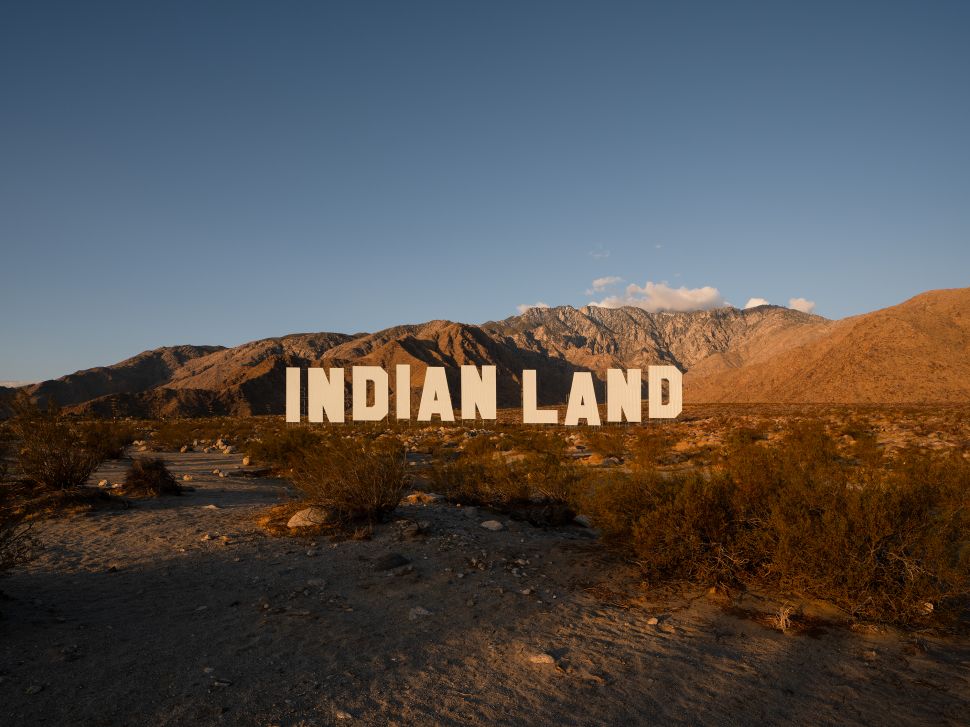
Curating an art exhibition in the desert requires radical site- and context-specific thinking—one that can align art-making with the rhythms of nature and harmoniously and sustainably integrate those interventions within the existing ecosystem. In its nine editions so far, Desert X has mastered this approach, one that is arguably extremely different from the anthropocentric foundations that have historically defined the Western sculptural tradition. At Desert X, it is the desert that ultimately ends up curating the show, as its artistic director, Neville Wakefield, loves saying.
This deep engagement with the desert’s climate and ecology has always been at the core of the Desert X format, confirms executive director Jenny Gil, who spoke with Observer ahead of the expanded 10th-anniversary edition set to open in October 2027 in the Coachella Valley. Running approximately three times the length of previous iterations, it will remain on view across multiple sites through May 7, 2028. Curated by Artistic Director Neville Wakefield and Kaitlin Garcia-Maestas, who joins the organization as Curator, the edition will build upon almost ten years of experimentation and knowledge creation around how art can respond to—and reshape—territories, histories and communities while entering into deep connection with the land.
“Since the very beginning, we wanted to invite artists to come out and experiment in this very specific and very hard environment for art, which is the desert,” Gil tells Observer. This environment, she says, imposes some very specific challenges, not only because of its scale but also because of conditions that the curators, artists and organization don’t control, including its shifting light, climate and ecology. At Desert X, the works emerge, change and dissolve in tandem with the land itself, foregrounding diverse perspectives and embedding sustainability as a core curatorial principle.
The works at Desert X are presented in the landscape, in areas that are not necessarily thought of, prepared or established as places where contemporary art is presented or experimented with. This becomes a highly experimental proposition for artists: to propose projects that can sustain the conditions while also making sense and remaining relevant to the space.
Artists must adapt their works to the context. “They really have to work with the elements in order to present their works, adapt them and make them accessible,” Gil notes, explaining how the works are installed to highlight a particular community, landscape or situation.
The temporary aspect, however, is key. The works are ultimately deinstalled in a way that leaves no trace other than the memory of the artwork presented at that location. That is somewhat different from the traditional model of massive Western land-art works, which were meant not only to work with nature but to integrate permanently into it, Gil points out.
At Desert X, environmental impact is therefore considered from the engineering stage onward. Even when a work requires foundations, they are designed to be fully removed without leaving cement behind, Gil confirms. The team also consults local tribal cultural advisers before entering or developing a site, with the goal of avoiding areas containing culturally sensitive materials or histories and respecting issues connected to Native American land ownership.
Nonetheless, for many of the participating artists, the works they produce for Desert X often become the most ambitious they have ever created, both in terms of scale and the complexity of their interactions with their surroundings. “It’s a rare opportunity to work outside the white cube or the walls of the museum, but even outside the walls of public art, which is usually presented in squares, roundabouts or areas already prepared for contemporary art to be shown and for visitors to see it,” she notes.
By experimenting outside those walls, Desert X is also experimenting outside financial walls and the access structures of galleries, fairs and museums. “There is no prescriptive sense of direction as you would have in an exhibition in a museum. You can start from any point. You can visit one exhibit or you can visit all of them in a day. It depends on how everybody wants to go about it,” Gil explains.
With its radically different format, Desert X has also been creating experimental audiences for contemporary art, Gil notes. “People who would not necessarily go into a museum or take their families to an art fair or gallery do come and visit Desert X because it is so accessible. There are no architectural or financial boundaries. The works are also very compelling and interactive, with many different ways to approach them.”
In many ways, Desert X extends a traditional aspect of land art in which the journey becomes part of the encounter: visitors use a map, choose their own route, drive into unfamiliar parts of the landscape and sometimes get lost along the way. In designing the exhibition experience, a central concern is limiting disturbance to the surrounding flora and habitat.
In this way, even local residents may find themselves traveling down roads they had never previously had reason to take, rediscovering their own land and appreciating the territory and its complex, rich ecosystem differently. “Suddenly, you see the place where you live through a different lens,” Gil says, noting how this also creates educational opportunities to raise awareness. “People think the desert is an empty space and there is nothing there,” Gil says, pointing instead to the wide variety of this ecosystem.
The organization offers guided tours involving experts on the Coachella Valley environment. These aim to introduce people not only to the sensitive flora of the valley but also to its geological histories—histories that go back thousands of years and have shaped the land where the exhibition takes place.
Accessibility remains a primary concern, although in California, experiencing the exhibition generally requires a car because visitors must drive between sites. Desert X supplements the physical experience with documentation, archival materials and video interviews that make the artists’ thinking available to a wider audience. It also organizes ADA access initiatives, including designated opportunities to bring visitors with mobility needs closer to certain works.
At the same time, Gil acknowledges that the Desert X formula fits naturally within the destination-driven dynamics of today’s experience economy, attracting visitors from outside the Coachella Valley who encounter the place through a totally new and experimental lens and discover new histories or narratives of the space through the artworks and what the artists propose for each exhibition.
Since Desert X opened in 2017, the organization has counted more than 2 million visitors and produced more than 140 site-specific commissions across the Coachella Valley and AlUla.
Yet although Desert X can draw visitors and contribute to the region’s tourism economy, Gil says tourism-industry support accounts for less than 10 percent of the organization’s funding. Much of that support is in kind: Palm Springs hotels and businesses provide rooms for artists and teams during site visits and production periods, as well as food, beverages and assistance with fundraising events.
Desert X operates as a California 501(c)(3), and approximately 70 percent of its funding comes from individuals. Gil says this funding model has existed since Desert X’s beginnings, when private supporters with ties to the Coachella Valley backed the idea of an international biennial-scale exhibition in the region. Still, given the initiative’s clear impact at multiple levels, Desert X today also receives support from local cities, the tourism board, grants and corporate sponsors.
Importantly, Desert X’s relationship with the Coachella Valley is not limited to the exhibition period, as the organization aims to balance its ability to serve as a tourism driver with a deep commitment to local engagement. Public programming remains free, and the organization runs a year-round arts-education program with local middle schools, high schools, school districts and educators.
The valley has a pronounced economic divide between wealthy seasonal residents and year-round communities. Roughly 60 percent of the Coachella Valley population is Spanish-speaking, and Gil says access to contemporary art in many public schools is extremely limited. For this reason, Desert X has maintained its school programming since 2017, directing support toward educators, docents and program costs. Meanwhile, the organization also works to support the local artistic and cultural community: invited artists conduct workshops with students and teachers, while local artists are hired for educational programs, host children in their studios and introduce them to different artistic practices.
Because the commissions are temporary, documentation has become Desert X’s principal archive. “We have been consistently photographing all the projects since we first started. We have also been collecting video interviews with the different artists we work with, as well as podcasts and other interviews, so the artists can talk about the works in their own words,” Gil says, describing the organization’s archival efforts. Although Desert X has produced some publications, since the pandemic it has prioritized free online video to extend access beyond the exhibition’s physical and temporal limits.
In 2020, Desert X launched a new Saudi edition in AlUla, applying its successful model developed in the Coachella Valley and adapting it to a radically different landscape. For that edition, almost one-third of the artists were Saudi, with the rest equally split between artists from the wider MENA region and international artists. Held under a title inspired by the poetry of Kahlil Gibran, “Space Without Measure,” the show aimed to trigger new imaginaries and utopian visions through the desert’s historical fascination, combining 10 site-specific and temporary installations with public and educational programming.
“We took what worked well in the Coachella Valley and replicated it in AlUla, with the obvious difference that the landscape is very different and the artists focus on the specificities of that place,” Gil explains. What successfully transferred was not a particular aesthetic but a method: taking art outside institutional spaces, asking artists to work directly with a desert landscape and commissioning temporary projects that respond to the specificities of place.
Gil confirmed that there is a plan to continue Desert X AlUla and expressed hope that the organization will expand to additional destinations in the coming years. At the same time, she emphasized that Desert X remains a small and relatively young organization. When asked what Desert X has learned most fundamentally during that period, Gil returned to the need to let the desert “do its thing and do its work.” Equally important, she said, is pushing artists to genuinely understand the places and communities where they work. That remains one of the most difficult aspects of the Desert X model, but also the most rewarding.