
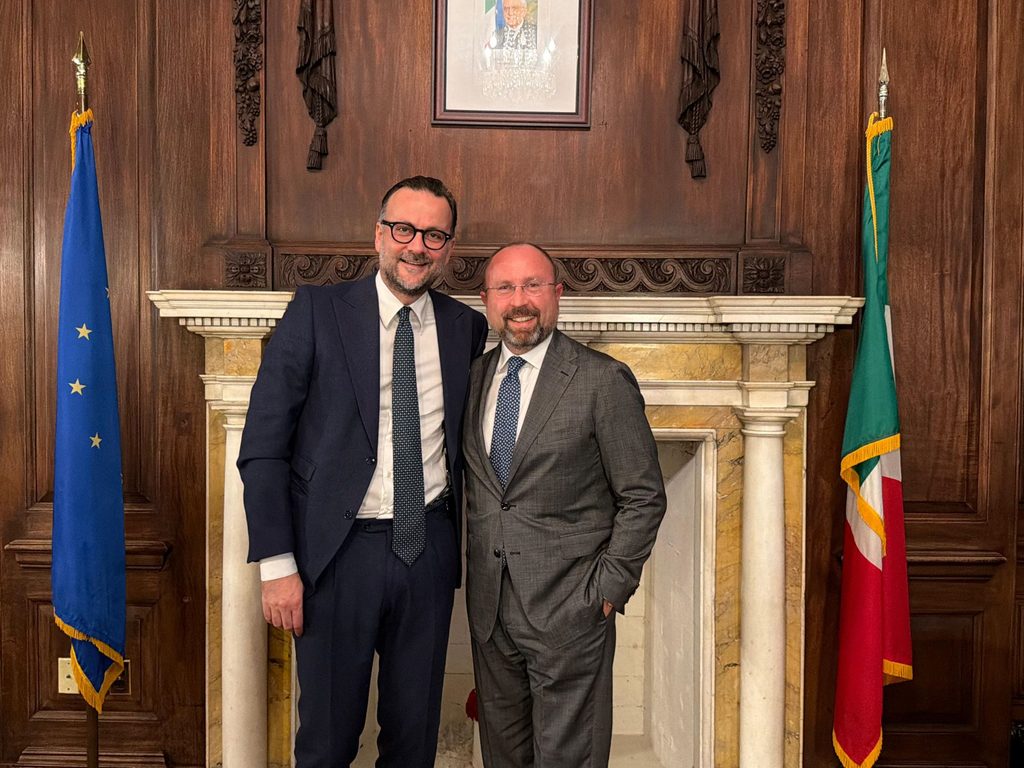
Italy’s economy relies heavily on small and medium-sized businesses, many of them family-owned and closely connected to the communities where they operate. But as international competition intensifies and new technologies transform entire industries, these companies face growing pressure to invest, innovate and expand their reach. For Fausto Bianchi, vice president of Confindustria and president of its Small Industry division, their ability to remain competitive will increasingly depend on how effectively they work together.
During an interview with our colleagues at ilNewyorkese, Bianchi explained why he believes the size of a company is not necessarily a measure of its strength. Italy’s industrial system, he noted, has developed through networks of specialized manufacturers, suppliers and businesses whose combined expertise supports some of the country’s most successful industries.
The automotive sector offers a particularly clear example. Behind the production of a single vehicle are dozens, sometimes hundreds, of companies, each contributing specialized components or services. According to Bianchi, these businesses do not all need to become large corporations to succeed. What matters is their capacity to innovate, cooperate and compete in international markets.
The challenge becomes more complicated when small businesses attempt to operate independently. Limited financial resources, insufficient expertise and unfamiliarity with foreign markets can create obstacles that larger organizations are better equipped to overcome. Bianchi believes that business networks and shared initiatives can help smaller companies access opportunities that would otherwise remain out of reach.
He discussed these issues in New York, where he attended the second season of The Perfect Pitch, a television series connecting Italian startups and innovative companies with American investors. The project is promoted by RetImpresa in collaboration with Italy’s Ministry of Foreign Affairs and International Cooperation and ilNewyorkese.
For Bianchi, initiatives of this kind give young entrepreneurs an opportunity to understand how business development works outside Italy. The United States, with its established venture capital industry and extensive innovation ecosystem, offers a different approach to growth, investment and risk-taking. Exposure to that environment can help Italian companies reconsider their strategies and ambitions.

Entering the American market, however, requires more than a competitive product. Bianchi warned that many businesses underestimate the complexity of operating in the United States, where commercial practices and market conditions can differ substantially from those in Europe. Even companies with successful products may struggle to identify potential customers, establish distribution networks or organize a local presence.
To address these difficulties, Confindustria and RetImpresa are considering establishing a permanent support desk in New York. The initiative would help innovative Italian businesses engage with local companies, investors and potential partners, providing assistance beyond individual promotional events.
Another major concern is the adoption of artificial intelligence. In 2025, only 16.4 percent of Italian companies with at least ten employees used AI technologies, with the figure falling to 15.7 percent among small and medium-sized enterprises.
Bianchi acknowledged that the technological transition presents particularly difficult choices for smaller businesses. Introducing new systems requires investment, qualified workers and specialized knowledge, all of which can be expensive or difficult to obtain. For a company employing ten or twenty people, committing significant resources to technological innovation may mean reducing spending on other immediate priorities.
Yet postponing those investments carries its own risks. While smaller businesses hesitate, larger competitors are already adopting technologies that improve productivity and reshape their operations. Bianchi warned that the longer this imbalance continues, the more difficult it will become for smaller companies to close the gap.
He therefore called for stronger institutional support, including measures to facilitate investment, improve access to technological expertise and develop shared resources. In his view, expecting each small company to manage the entire digital transformation independently is unrealistic.
These concerns will also feature in the Small Industry Forum scheduled for November 13 and 14 in Rome, dedicated to businesses that contribute to Italy’s growth. Bianchi wants the discussion to move beyond short-term economic measures and address the structural conditions that affect business development.
He argued that small companies play a role that extends beyond employment and production. In many Italian communities, they support local economies, maintain industrial expertise and contribute to social stability. Their difficulties can therefore have consequences for entire territories.
For this reason, Bianchi believes economic policy needs a longer-term perspective. Investments in innovation, employee training and generational transitions require planning over several years, while political debate often remains focused on immediate budgetary concerns.
The question of generational change is especially important for family-owned businesses. Many Italian companies face uncertainty when younger family members decide not to continue the activities established by their parents or grandparents.
According to Bianchi, older generations sometimes place too much emphasis on the responsibilities and sacrifices involved in running a business, without adequately explaining the opportunities it can offer. Younger people need to see a professional future that reflects their own ambitions rather than feeling compelled to preserve a family tradition.
When the next generation chooses a different path, he believes companies should consider alternative solutions, including mergers, outside investment or changes in management. The objective is to preserve businesses that continue to create employment and economic value, even when family succession is no longer possible.
Bianchi also offered a different perspective on Italy’s longstanding concern over young people leaving the country. He considers international experience an important opportunity for personal and professional development. Studying and working abroad can provide skills and knowledge that benefit both individuals and the wider economy.
The problem, he argued, arises when young Italians cannot find sufficient opportunities to return. Improving career prospects and strengthening the country’s productive system are therefore essential to ensuring that international mobility does not become a permanent loss of talent.
Alongside these economic issues, Bianchi recalled his experience running the New York City Marathon several years ago, shortly after completing his term as president of the Young Entrepreneurs of Lazio.
What stayed with him was the encouragement offered by spectators, who cheered not only professional athletes but also ordinary runners struggling to reach the finish line. Wearing a shirt bearing his name and the word “Italia,” he found himself supported by strangers throughout the race.
Bianchi sees similarities between that experience and the daily responsibilities of running a business. Entrepreneurs must make difficult decisions, manage uncertainty and continue working toward their objectives even when circumstances become challenging.
His broader argument is that Italian businesses should not have to face those challenges in isolation. For a country whose industrial strength depends on thousands of smaller companies, improving cooperation and access to resources may be just as important as increasing the size of individual businesses.
As artificial intelligence, global competition and generational change reshape the economy, Bianchi believes the ability of Italian companies to work together will be central to maintaining their position in international markets.