
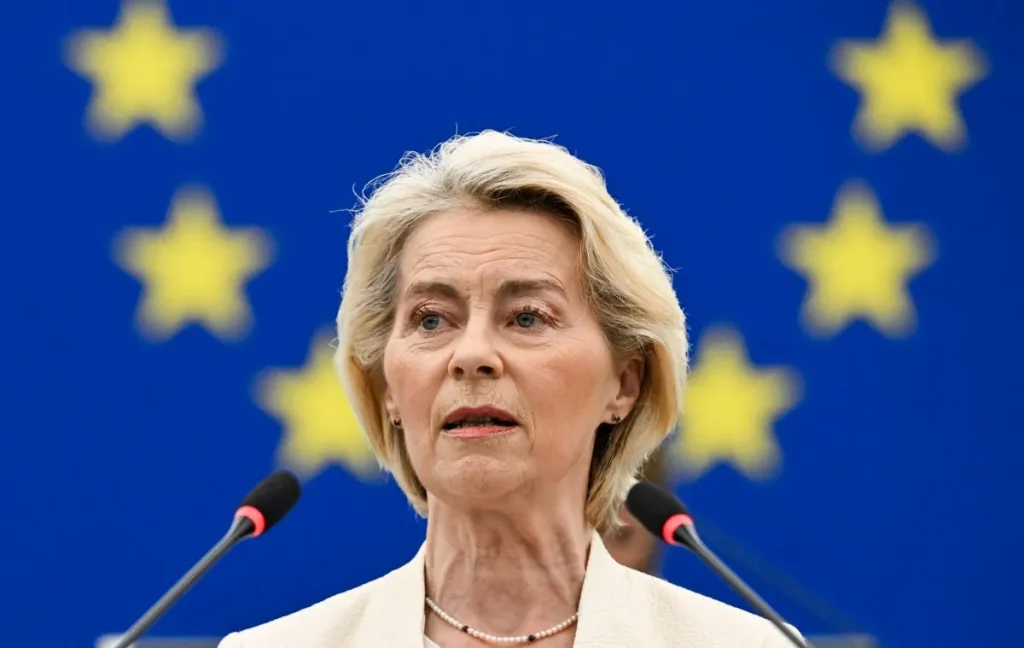
EU chief Ursula von der Leyen said on Wednesday the bloc would propose an emergency tool for countries to better deal with mass migration movements following the deadly rush to the Spanish territory of Ceuta.
Addressing EU lawmakers in Strasbourg, the European Commission president credited recent laws with reducing irregular migration, with arrivals dropping by 55 percent over the past two years.
But the Ceuta crisis in July showed that new mechanisms were needed to deal with emergency situations, von der Leyen said in her keynote annual speech to the European Parliament.
“Europe needs the means to protect its borders at all times. Especially in scenarios when mass movements are engineered and weaponised. This is why we will propose a new European Emergency Response Framework,” von der Leyen said.
The 27-nation bloc’s leader said the emergency framework will only be triggered “under a strictly defined set of criteria” and “allow for time-limited and strictly defined flexibility in standard procedures” — neither of which she defined.
“The message from Europe is clear: we will always comply with our values and fundamental rights. But we will never compromise on protecting our borders,” she said.
“It is we, Europeans, who decide who comes to our union and under what circumstances. And not the smugglers and the traffickers.”
More than 70,000 migrants crossed into Ceuta from Morocco on July 30th and 31st in a rush that left scores dead, most by drowning as they tried to swim around a breakwater.
READ ALSO: Why are there still thousands of migrants in Spain’s Ceuta?
The majority of those who entered the Spanish territory returned to Morocco within hours of their arrival. Several thousand, however, remain in Ceuta.
Migration has become a hot button issue across Europe in recent years, with a hardening of public opinion that has fuelled far-right electoral gains.
Alongside the emergency framework, von der Leyen also pledged to strengthen the EU’s border agency, Frontex, to speed up deportations and improve Europe’s “early warning systems” including in partnership with third countries.
READ ALSO: Can Spain’s Sánchez survive Ceuta migrant crisis?