
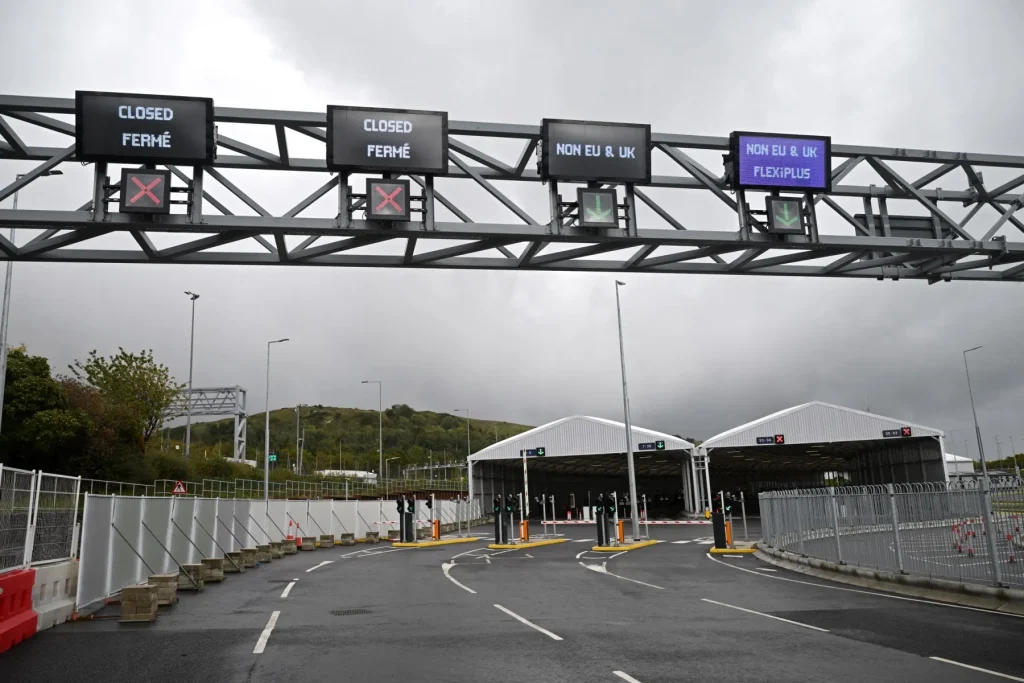
The operators of Eurotunnel say they have achieved a ‘breakthrough’ deal with the EU to allow airport-style checks to prevent travel chaos with the full implementation of EES passport controls at Folkestone and Calais.
The departure points of Le Shuttle at Folkestone and Calais are among several on the UK-France border where the new EES passport checks have still not been fully implemented because of fears of travel chaos.
Despite the EU’s new Entry & Exit System officially coming into full effect in April 2026, France has not fully rolled it out at key crossing points including the Eurostar, Port of Dover and Eurotunnel because of technical faults and the fears of long delays.
However, this week Yann Leriche, CEO of Getlink, which owns the Channel Tunnel, announced a ‘breakthrough’ deal with the EU to use an airport-style camera system at Le Shuttle’s departure points, to avoid drivers having to get out of their cars to complete the fingerprinting and facial scans that are necessary for EES registration.
In the coming weeks, Leriche will meet UK and French authorities presenting a 40-page proposal to allow Eurotunnel to become a “laboratory” for an “intelligent border” using emerging tech and lessons learned from the US and Singapore.
If they approve, the cameras will be used for a two-year trial period for travellers departing from Folkestone or Calais on Le Shuttle.
Instead of getting out of the car and getting biometrics taken at a terminal building, holidaymakers and business travellers will now be greeted with special drive-through terminals in Folkestone and Calais.
Kiosks – looking roughly similar to the order point at a drive-through – will be placed at each side of the vehicle for drivers to complete their registration, passport scans, fingerprinting and facial scans.
This replaces the time-consuming and resource-heavy system in which a police officer or border control agent has to be present to pass a tablet computer around the passengers of each vehicle.
Leriche told UK media: “We told the authorities: it is going to be a mess. Many people are going to the wrong place, and you can’t have police jumping from one place to the next to solve the issues. It would also mean customers would have a bad experience, particularly at peak time.
“This is not something people in airports experience, but nobody approached this before, thinking we could have an airport experience at the border here. But we said: why not?”
If it works, the system could also be used at the Port of Dover, although the port is further constrained by a lack of space on the site for new facilities.
It would not be applicable for foot passengers on the Eurostar.
READ ALSO: Travellers accused of overstaying EU’s 90-day rule after being caught in EES chaos
EES has still not been fully introduced for passengers on the London-Paris route of the Eurostar, or for cross-Channel ferries or Eurotunnel.
Leriche told UK newspaper The Guardian that he has “no idea” when the system will be introduced by France.
“It has been delayed and delayed and delayed, but our kiosks are there, they can function, but the connection with the French system is still not working. It is a question we are asking all the time.”
This week it emerged that the EU had filed a lawsuit against IBM and two other companies involved in the implementation of EES over the technical issues with the new system.
READ ALSO: UK-France travel: The latest on EES at Eurostar, Eurotunnel and Dover