
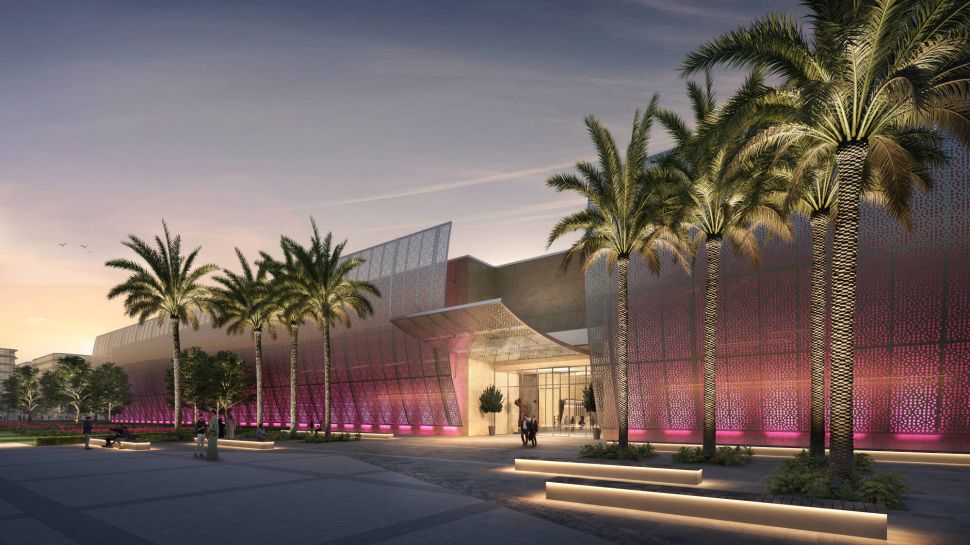
Undeterred by ongoing tensions in the region, Frieze Abu Dhabi is moving ahead as scheduled this week, opening to VIPs on Nov. 18 and to the public the following day at Manarat Al Saadiyat, in the heart of the Saadiyat Cultural District. Organized in partnership with Abu Dhabi’s Department of Culture and Tourism (DCT), this edition of Frieze builds on the legacy of Abu Dhabi Art, which spent 17 years developing an international platform for modern and contemporary art in the emirate. As Dyala Nusseibeh, who directed Abu Dhabi Art and now leads Frieze Abu Dhabi, put it, this first edition is not a departure from the past. It is the next chapter in an ecosystem shaped over decades by museums, foundations, institutions, galleries and Abu Dhabi Art itself.
“There has already been a great deal of knowledge production, research and critical thinking happening and developing on the ground,” she told Observer a few weeks before the opening. “Through the Frieze global network, we hope to amplify that work internationally and integrate the market globally, in ways that are clearly beneficial for everyone in the region.”
What Frieze adds, she explained, is international visibility and access to a global network spanning its fairs in Seoul, New York, L.A. and London, connecting the regional market more closely with galleries, collectors and arts professionals worldwide. And as with every Frieze fair, the Abu Dhabi edition aims to stay anchored in its context, balancing international participation with the wealth of talent, past and present, that the region has to offer. The inaugural edition brings together 89 exhibitors from 37 countries, with a strong emphasis on the MENA region and a key role for artists and galleries from Abu Dhabi and across the U.A.E.
Pioneering figures from West Asia, North Africa and South Asia (WANASA), such as Farideh Lashai (Leila Heller Gallery), Abdullah Al Saadi (Aisha Alabbar Art Gallery), Mounirah Mosly (ATHR Gallery) and Samir Rafi (ArtTalks | Kanafani Gallery), will be spotlighted alongside leading international artists such as Sheila Hicks (Galerie Frank Elbaz) and Emily Kam Kngwarray (Pace Gallery).
Some international galleries may be newcomers to this market, Nusseibeh noted, but they have been in conversation with the region’s museums for a long time. She cited Victoria Miro as an example. The gallery had never taken part in a fair in the region, yet it will present works by Yayoi Kusama at Frieze Abu Dhabi; it also sold a work by Kusama to the Guggenheim Abu Dhabi ahead of the museum’s opening this December.
The growing strength of the region’s institutions is one of the key factors drawing international participants, and “the fair is deeply rooted in its ecosystem, and more is being built on that foundation, exponentially,” according to Nusseibeh. Frieze arrives in the U.A.E. after years of rapid cultural expansion: the Louvre Abu Dhabi opened in 2017, the Guggenheim Abu Dhabi is about to open and teamLab’s dedicated space opened last year. The second iteration of the Public Art Biennial runs concurrently with the fair, alternating each year with the Manar Light Festival.
Today, 45 percent of regional art sales occur in the U.A.E., and there is plenty of data on the changing profile of buyers. “Historically, the fair has always had very established collectors with significant collections. What is new is a younger generation that now has disposable income and an interest in acquiring art,” Nusseibeh added. Last year, 33 percent of buyers in Sotheby’s Modern and Contemporary Middle East sales were new to the auction house. More broadly, its 2025 global results show that buyers under 40 accounted for 17 percent of fine-art buyers and 29 percent of luxury buyers.
At Sotheby’s inaugural Abu Dhabi Collectors’ Week in December 2025, bidders came from 35 countries, with nearly a quarter based in the U.A.E. and almost a third under 40. “Many people first came to the fair when they were young and are now becoming the young collectors of tomorrow. There is already a lot of growth happening in the U.A.E.,” Nusseibeh said, pointing to the influx of high-net-worth individuals into Abu Dhabi in recent years as the city grows into a significant global financial hub.
She sees potential for the Frieze network to introduce more collectors to the region. Recent editions of Frieze Masters in London have paid greater attention to overlooked figures of Arab and North African modernism. Frieze Abu Dhabi will offer a prime stage for their stories, giving their estates international visibility.
Curated by Marika Sardar, Frieze Masters Abu Dhabi takes the Indian Ocean as its point of departure, exploring it as a historic crossroads of trade, innovation and cultural exchange. Spanning antiquity to the early 20th Century, the section brings together rare books, manuscripts, maps and artifacts tracing the movement of people, objects and knowledge among West Asia, East Africa and South Asia. Among its highlights is Portrait L, presented by ArtAncient, which is one of the oldest surviving painted portraits in the world and is being shown in the Middle East for the first time since leaving Egypt in 1888. Other presentations, from Daniel Crouch Rare Books’ historical cartography to Peter Finer’s arms and armor, illuminate the circulation of artistic techniques, materials and ideas across continents.
The section’s curatorial approach resonates with the vision of the Louvre Abu Dhabi, which has consistently challenged conventional geographical divisions by tracing a syncretic history of civilization. Its current exhibition, “Spices and Wonders: Sailing the Indian Ocean,” which runs through Feb. 14, 2027, connects directly with Frieze Masters. Organized with the Musée national des arts asiatiques–Guimet, it follows a millennium of maritime exchange across the Indian Ocean, including the circulation of spices, objects, people and ideas between Africa and Asia.
Nusseibeh described this alignment as an example of institutions and fair organizers thinking in connected ways about art histories that have not always received sufficient attention. “When we talk about the Indian Ocean and trade, we do not always think about what has happened over hundreds of years between the Arabian Peninsula and India. We tend to think more in terms of its modern history. These are interesting correspondences,” she explained.
Established and recently rediscovered names will also feature in the main Galleries section. Vigo gallery will present eight works from Ibrahim El-Salahi’s Tree series, and ATHR Gallery will devote a presentation to the pioneering artist Mounirah Mosly, bringing early works to light for the first time in years. Leila Heller Gallery will stage a retrospective of work by Farideh Lashai (1944-2013), tracing more than five decades of the Iranian painter’s groundbreaking, expansive visual universe across media, including a darkened space for her projected moving-image works. While her work remains closely tied to Persian culture, especially miniatures and the Iranian calligraphic tradition, it fluidly blends in elements of European culture she absorbed while studying German literature in Frankfurt.
Nusseibeh describes Frieze Abu Dhabi as a platform for these intercultural exchanges, particularly as it brings regional artists into dialogue with international curators. Artist Dala Nasser, for instance, was selected by Nabila Abdel Nabi, senior curator of international art at Tate Modern, as the recipient of the inaugural Frieze Abu Dhabi Artist Award, which supports a new commission for the Atrium at Manarat Al Saadiyat. Taking its name from Qubbat Duris, a 13th-century monument near Baalbek in Lebanon’s Bekaa Valley, her installation will respond to space, place and the region’s history. “Nasser looks at the destruction of history, the environment, the landscape and archaeological sites, but also at processes of remembering and recollection,” Nusseibeh said. “What is tangible about memory, and what can we capture of these moments of destruction and their meaning to us?”
Nasser will also show with Commonwealth and Council in the Focus section. The section is dedicated to younger international galleries presenting artists from the region and beyond who explore the timely themes of migration, belonging, land and memory, offering new perspectives on the social, cultural and political forces shaping the world today. Other highlights include Thuy Tien Nguyen’s presentation with L.A.-based Solo, featuring three sculptural works built around automated music-box mechanisms inspired by the furnishings of the former Republic of Vietnam’s Independence Palace and the visual language of contemporary corporate interiors. From Peru, W-Galería will present Chonon Bensho, whose multidisciplinary practice draws on Shipibo-Konibo knowledge and cosmology, exploring the interconnectedness of human, animal, plant and spiritual worlds.
New York gallery Management will introduce new textile and installation works by Tahir Karmali, who will turn the booth into a work site in progress, where dyed fabrics and bodily forms emerge from construction mesh. Through these materials, the artist examines migration, labor, exploitation and belonging, as well as the precarity of the built environment. Patel Brown, for its part, will present new ink drawings, Capiz shell sculptures and figurative paintings by Filipina-Canadian artist Marigold Santos, informed by Filipino mythology and diasporic experience. Central to her visual language is the aswang, a shape-shifting figure from Philippine folklore, which the artist reclaims to explore transformation, cultural inheritance and the complexities of diasporic identity.
The fair’s other curated section, Global Futures, centers on similar questions of place, identity and memory. It was conceived by Tarini Malik, a London-based curator and writer who has held curatorial roles at the Royal Academy of Arts, Whitechapel Gallery, Hayward Gallery, Serpentine and Frieze Projects and served as associate curator of the British Pavilion at the 2024 Venice Biennale.
The section comprises eight solo presentations by artists whose work engages with histories, materials and experiences that resonate across the U.A.E. and the wider region, often revealing striking parallels in symbolism and sensibility with other parts of the world. Highlights include Ala Younis (Taymour Grahne Projects), who revisits Abu Dhabi’s modernist architecture through handmade mosaics using materials sourced from Jordan; Emirati artist Abdullah Al Saadi (Aisha Alabbar Art Gallery) presenting new works from his longstanding Naked Sweet Potato series; and Mohammed Joha (Zawyeh Gallery), whose textile and paper collages explore displacement, memory and the meaning of home. Arshi Irshad Ahmadzai (Chatterjee & Lal) draws on literature, philosophy and poetry through works on fabric and papier-mâché, while Tania Candiani (Vermelho) translates the invisible networks of plant roots into intricate embroideries. Seta Manoukian (Marfa’) will pair her 1990 painting Willing to Begin, which evokes the experience of exile, with works made since her return to painting in 2016, after a decade devoted to Buddhist practice.
Asked about the decision to go ahead with the fair even as tensions in the region persist, Nusseibeh stressed the cultural mission Frieze Abu Dhabi has in the country and the broader region. “Culture is important, even more so in challenging times, and people’s cultural lives are vital. Even now, we have to support artists, galleries and the cultural ecosystem,” she said, adding that any change in the safety assessment would be communicated transparently. “Otherwise, we wouldn’t be telling people to come.”
Above all, the priority is the fair’s long-term impact: “We are thinking about the afterlife of the fair—not just what happens this November, but what continues to happen afterward: the relationships collectors build with galleries, the relationships artists build with curators,” she said, and the first edition is just one chapter in what the organizers envision as an ongoing story of collaboration and dialogue. “Looking ahead, we hope to create opportunities for artists, galleries and cultural producers from the region to engage meaningfully with global counterparts, to develop the market in the region, to build on the incredible work that has already taken place, and to share it with colleagues globally. I think it is a very long horizon. It is not something we expect to be concluded at the end of November. It is an opening, not an end.”