
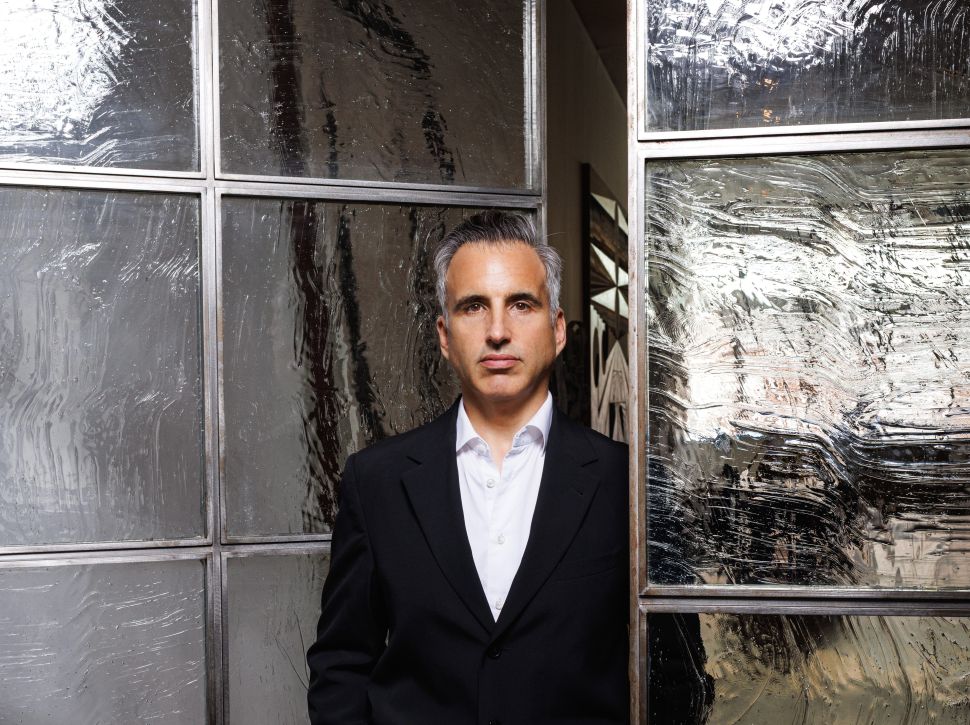
Last month James Cohan Gallery announced that it would become Norr Cohan, with longtime senior director David Norr assuming sole ownership, though James Cohan will continue working with artists and collectors on a smaller scale. Founded in 1999, the gallery moved from 57th Street to Chelsea, where it built long relationships with artists including Fred Tomaselli, Yinka Shonibare and Tuan Andrew Nguyen, to Walker Street in Tribeca. It now represents about 40 artists. Norr arrived in 2015 from the Wexner Center for the Arts and the Museum of Contemporary Art Cleveland, was made a partner in 2018 and a co-owner in 2021, so this is less a handoff than the last step of one that has been underway for years. We caught up with Norr to hear about what a curator brings to the dealer’s side of the table in the current market.
There’s been a lot of dark talk about the primary market lately, but taking over a gallery is a long-term bet. Why are you optimistic?
There are always ups and downs and shifts in market attention. As much as the art world likes to imagine it runs on its own internal logic, it’s deeply connected to the real world, and right now global conflicts, anxiety about A.I. and stress on our democracies have created a lot of uncertainty. But I’d flip that around. The conditions that create that anxiety are the same conditions that make art necessary.
My bias is that art brings meaning, it opens minds and hearts, and it enriches lives. I’m a true believer. Leading with that ethos, with the conviction that art’s value extends far beyond its sale price is what keeps the gallery focused and what keeps me optimistic.
The gallery model bends and adapts. Its lasting strength comes from embracing those fluctuations rather than fearing them. Our charge is to help the artists we work with build long, productive, meaningful careers, and to gather a community of collectors, curators and writers around that work. Careers and communities are patient projects, built over decades rather than quarters.
What’s going to change at the gallery with this transition?
Over the last 11 years, the gallery has grown from 20 artists to 41, moved from Chelsea to Tribeca, and our team has grown alongside that. Change may be the only constant in this business. Through that evolution, our approach has always been to make smart, long-term decisions rooted in our values, and that won’t change.
You came to the gallery in 2015 from the Wexner Center and MOCA Cleveland. What can a former curator do as a dealer that someone who came up on the sales floor cannot, and what did you have to learn from zero?
I never anticipated becoming a gallerist, but I never anticipated becoming a curator, either. I was trained as an artist and then taught, before entering the museum world. My background perhaps stubbornly privileges the relevance of an artist over the price point of their work, and I think that differentiates my approach as a dealer.
One of the things I enjoy most as a gallerist is having longstanding, committed relationships with artists. I have the opportunity to think in decades about an artist’s career. Curators have steamy affairs with artists that last a year or two, but typically do not have the opportunity to engage in long-term thinking about an artist’s trajectory.
You’ve had a front row seat to the development of The Campus. What do you think resonates with people about that project? Are there lessons in it for the New York gallery scene?
The magic of The Campus is the collaboration we’ve built with our peers Bortolami, kaufmann repetto, Anton Kern, Andrew Kreps and kurimanzutto. It was a magnificent idea that Andrew Kreps brought to all of us, and I’ve been proud to be part of it from the start. It’s a real asset for every partner gallery, and it keeps opening up forms of community that remain elusive for those of us working on our own.
For this year’s exhibition we invited eight galleries from the U.K., among them Thomas Dane, Emalin, Lisson and Modern Art, with artists as varied as Hurvin Anderson, Sarah Lucas, Tschabalala Self and Keith Haring presented across a 78,000-square-foot former public school. The building remains in its found state, so artists respond to the architecture, and projects unfold room by room as you move through the school. It’s an ambitious undertaking that no single gallery could mount alone.
You live a block from the gallery and have said Tribeca feels more human and welcoming. How does Tribeca avoid becoming what Chelsea became?
We left Chelsea because the owner of our building wanted to develop it into a tower. That never actually happened, and our old space is now a lounge for Lamborghini owners.
Tribeca has a character and a sense of community that really differentiate it from Chelsea. The cast iron facades, the historic architecture, the restaurants, the artistic history, all of it gives the neighborhood a charm and an authenticity that makes people want to live and spend time here. Chelsea was a place you visited. Tribeca is a place where people actually live, and you feel that every time you walk down the street.
You told ARTnews this transition has been “a wonderful exercise to think about growth and positionality.” It sounds like you’re saying declining to expand into other cities has helped the gallery weather this moment. Is that the case?
Expansion has a way of becoming its own justification in this business, and its costs tend to arrive well before the decision begins to pay dividends. We’ve resisted growth for growth’s sake and have tried to remain precise about our scale, focusing on the quality of our program and the service we give to our artists and our clients.
We’ve also continued to invest in New York. And after eight fast-moving years in Tribeca, we’ve been working with the architectural studio Ideas of Order to renovate and expand our exhibition spaces at 48 and 52 Walker Street. The gallery will reopen in early September under its new name: Norr Cohan.
Jim and Jane are some of the most beloved people in the art world on a purely interpersonal level. Why do you think they have so many friends? Did you learn anything from them about that part of the job?
It’s safe to say I would never have entered the commercial world had it not been for Jim and Jane. I met them in 1999, the year Jim opened the gallery. Trenton Doyle Hancock had been my roommate in graduate school at Tyler, and he remains one of my dearest friends. Fred Tomaselli introduced Jim to Trenton’s work after a studio visit, and I met Jim at Trenton’s first show, at the 57th Street space. Jim wore a bowtie in those days, and he was curious about everything. What struck me then was the environment he and Jane had created around Trenton and all of their artists. I knew right away it was something special.
As my career moved into curating, I got to see behind the curtain at a lot of New York galleries, and I learned quickly that they are not all created equal. Jim stayed a friend and a real mentor through those years. We had many candid conversations about art and life and work, and it was that trust, more than anything, that eventually drew me to the business.
What sets Jim and Jane apart is that they built rigor and kindness into the gallery at the same time, and those two qualities are rare partners. Building a business that reflects how you actually want to move through the world is a real achievement, and they never lost sight of what mattered to them while doing it. I’m proud to be part of what they built and proud to carry it forward.
You’ve named Frenchette the best bar in the neighborhood. Where else do you like to hang out, post-openings?
There are so many great spots now. But I spend most of my free time in the neighborhood toggling between Happier Grocery and Rigor Hill Market and taking long walks along the piers on the west side highway, especially at sunset.