
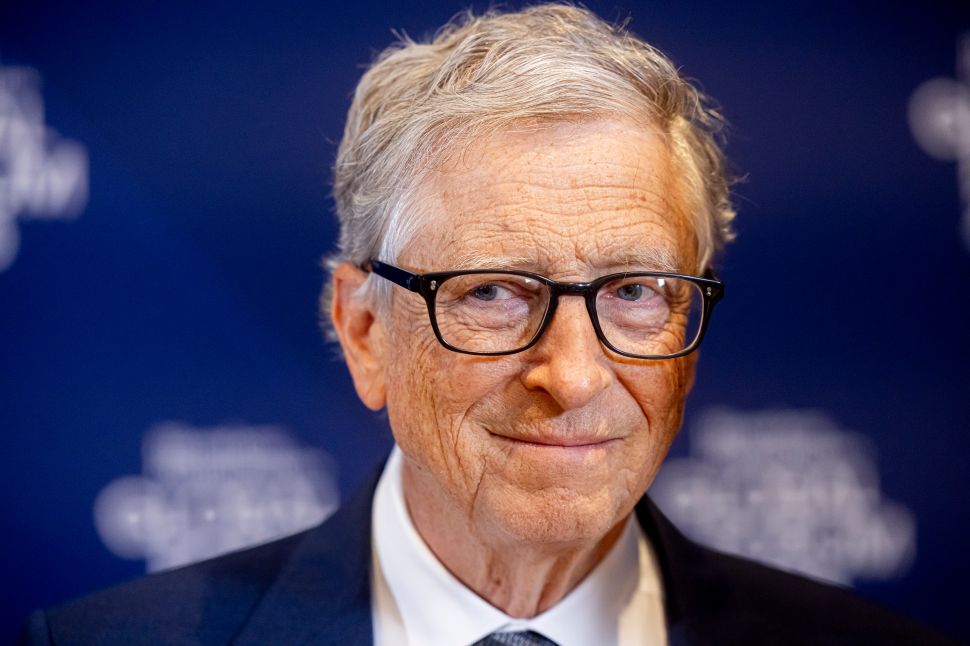
A.I. may be advancing at breakneck speed, but Bill Gates worries its most powerful tools are reaching the wealthiest people and countries first. To help counter that, the 70-year-old Microsoft co-founder is committing at least $1 billion through his private foundation, trying to push the technology into the clinics, classrooms and farms that Silicon Valley might otherwise overlook.
Backed by a trust that held a $92 billion endowment as of June, the Gates Foundation is one of the world’s largest private foundations. Over the next two years, it plans to spend at least $1 billion on A.I., with roughly 40 percent earmarked for health care, 40 percent for education and the remainder split between agriculture and digital infrastructure, including local-language datasets. This year alone, it has partnered with OpenAI, Anthropic and Google on major A.I. initiatives.
In September, the foundation unveiled the $1 billion commitment alongside this year’s Goalkeepers Report, its annual assessment of how the world is progressing in areas like health, poverty, education and inequality, using the U.N.’s sustainable development goals as a benchmark. Left to market forces alone, Gates wrote in the report, the most capable A.I. tools are likely to reach the people and institutions most able to pay for them. “A.I. could be a great equalizer—or widen the gap,” he wrote.
The Gates Foundation is working to connect the companies building A.I. with the world’s governments and nonprofits that could really use it. Gates brings money and decades of relationships; OpenAI, Anthropic and Google bring the technology and computing power. That could help A.I. reach places Silicon Valley might not otherwise prioritize; it also gives a handful of tech companies an early role in shaping which tools, datasets and standards take hold as A.I. spreads.
Anthropic offers one of the clearest examples. In May, the company and the Gates Foundation unveiled a four-year, $200 million partnership spanning health care, education, life sciences and economic mobility. The money includes grants, Claude credits and technical support; the projects themselves will help researchers make sense of vaccine and public-health data, show teachers where students are falling behind, and give farmers locally relevant advice in their own languages. Anthropic says the effort is meant to expand A.I.’s benefits into areas where, as the company put it, “markets alone will not.”
Google is pursuing a similar strategy in agriculture, with ambitions to reach a much larger population. In September, the company and the Gates Foundation expanded an initiative backed by $100 million in combined funding, plus technical support. The goal is to reach 200 million smallholder farmers across sub-Saharan Africa and South Asia. In practice, that means more precise weather alerts for farms, A.I. tools that identify crops and map small plots from satellite imagery, and agricultural advice delivered in farmers’ own languages.
Google says many farms are so small and irregular that conventional satellite imagery struggles to identify them. The project is using A.I. to map field boundaries at sub-meter resolution and monitor crops through the growing season. “No matter where they farm, people deserve access to the weather, crop, and soil information that can mean the difference between a good harvest and a failed one,” Mark Suzman, CEO of the Gates Foundation, said in a statement. The effort also directs funding and computing resources to local organizations, including India-based Wadhwani AI, which builds tools for farmers, health workers and students, and Digital Green, whose FarmerChat A.I. assistant gives small-scale farmers advice in their own languages.
OpenAI is tackling a different bottleneck: a shortage of health care workers. Sub-Saharan Africa faces a shortfall of roughly 5.6 million, according to OpenAI. In January, the company launched Horizon1000 with the Gates Foundation, a $50 million initiative starting with a primary-care pilot in Rwanda. The goal is to reach 1,000 clinics and surrounding communities across Africa by 2028, using A.I. to help frontline workers navigate medical guidance and spend less time on paperwork.
Much of the attention around medical A.I. has focused on discovering new drugs. Gates sees another opportunity in simply helping more people get health care. “I would say it’s even more important that A.I. will be used on the delivery side,” he said at the World Economic Forum earlier this year.
The pitch comes as traditional development funding is shrinking. Goalkeepers organizers pointed to figures showing that 26 of the world’s 34 wealthiest nations cut aid to poorer countries last year. Meanwhile, the U.N. says progress toward its sustainable development goals remains “uneven and insufficient.” A.I. will not replace that money. But Gates argues that better tools could help overstretched clinics, schools and farms get more from the people and resources they already have.
More than 90 percent of the data used to train early large language models came from English-language sources, according to the Goalkeepers Report. Leading speech-recognition systems make errors less than 6 percent of the time in English, Gates wrote, but more than 60 percent of the time in Yoruba, a language spoken widely in Nigeria and other parts of West Africa.
Language is only part of the problem. An A.I. tool advising a farmer in Ethiopia needs to understand local crops, pests, weather and prices. One tool helping a health worker in Rwanda needs to know which treatments are actually available there. That requires local data, but raises questions about who can use it and who decides how it is shared.
Last month, the Gates Foundation joined 59 other organizations, including Google, Microsoft, Nvidia, Anthropic and the OpenAI Foundation, in a five-year effort aimed at an estimated 3.4 billion people whose languages are poorly represented in today’s models. The coalition plans to create openly licensed language datasets and tools that other A.I. developers can use, though its governance and structure are still being worked out.
For Gates, the larger point is that communities should have a say in the systems being built for them. Countries, he wrote in the report, should be able to decide how their data is stored, protected and shared.
“The goal is not for A.I. to be designed somewhere far away and handed to communities to figure out,” he wrote.