
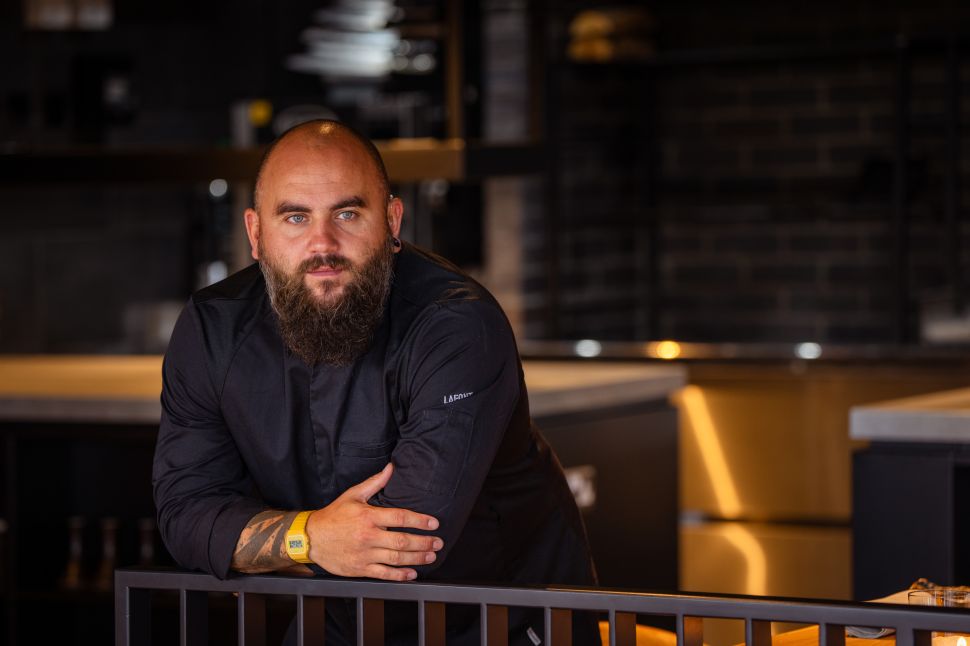
A meal is always better eaten by the sea. On the Channel Island of Guernsey, that sentiment is taken to the extreme. The small, self-governing island, located between England and France, is home to Vraic, a one-Michelin-starred restaurant helmed by Welsh chef Nathan Davies. The restaurant is found along Guernsey’s sandy coast at Chouet Bay, where seaweed rolls in with the tides and cows stand on the overlooking green hills—the sort of picturesque sensibility so perfect it almost feels manufactured.
But Vraic is as authentic as it comes. And despite being located across the English Channel, the restaurant is only a short flight from London. So short, in fact, that it’s possible to fly to the small island just for lunch—something I discovered on a recent Friday in May when I caught an early flight from Gatwick to Guernsey Airport. The taxi driver described the restaurant as “as far from the airport as you can be,” which ended up being only a 20-minute drive, a distance worth venturing for the island’s most notable dining establishment.
Vraic opened last July after an extensive renovation of the existing building. It was formerly a tea room and then a seaside bistro, but it had been empty for 18 months before Davies agreed to take it on alongside his wife, Hollie Davies, Vraic’s operations manager. When it received its Michelin star in February, Vraic became the first restaurant on the island to hold that distinction since Christophe at Fermain Valley Hotel closed in 2009. It took a huge leap of faith for Davies and his family to relocate from Wales to Guernsey, a place where the culinary scene isn’t particularly renowned.
“At the time, there was no Michelin Guide here,” Davies tells Observer. “There was nobody else doing it. There wasn’t really a model that you could look at for reference. We just thought, ‘Well, if we did it, what would it look like? How do we do it the way we want to?’ And it could have gone really badly.”
Davies previously helmed the Michelin-starred SY23 in Aberystwyth, Wales, which closed in December 2023. He wanted to keep the team from that restaurant intact if he went elsewhere. So after a few exploratory trips to Guernsey, he convinced several former staff members, including head chef Kuba Biskup and sous chef Max Davies, to take the leap as well.
“Without the team, this restaurant doesn’t exist,” Davies says. “I might write the menus, but without all the other incredible people who were willing to come and take a chance with us, it couldn’t have happened. We brought in a culture straight away. We didn’t have to waste time talking about standards. The restaurant gained three or four years of operational experience overnight by bringing the right people in.”
Davies and his wife, who have two young children, had previously spent time on the neighboring Channel Island of Jersey. But he didn’t realize just how different the two islands would be. Guernsey, as I discovered on my recent trip, is compact, with a population of only around 65,000, and has an eye on the past. On the day I visited, the island was preparing to celebrate its annual Liberty Day. Vestiges of the German occupation during World War II, like bunkers and batteries, cover the island, and the French influence—Guernsey is only 30 miles from the French coast—is apparent in the architecture and street names. Its rolling hills are lush and green thanks to the moderate climate. There are cows everywhere, a visual reminder of the famous Guernsey dairy.
“It’s not behind the times; it’s just stayed how it is,” Davies says. “People from Guernsey are definitely from Guernsey. They’re a bit like the Welsh—very proud. The island is a very beautiful place to live, but no one takes it for granted. Sometimes when you go to a beautiful place, everybody just thinks it’s normal. Here, they appreciate it. Jersey has more of a culinary tradition, but this felt like a challenge, which was part of the appeal.”
When the team arrived on Guernsey, they had no local contacts. Davies and his family moved in April 2025, a few months ahead of opening, and he quickly began learning about what the island has to offer. The chefs did a deep dive into seaweed, local produce and Guernsey dairy.
“The ingredients here have really surpassed expectations on what we were expecting to find,” Davies says. “We knew there was a lot to give in terms of different varieties of seaweed. The waters here are very special. The tidal range is huge. But we were constantly trying to gather information on what we could do with it.”
Currently, Guernsey’s seaweed is showcased at Vraic in a dish consisting of several types of foraged seaweed. A selection of seaweed, each with a different texture, is served in a rich, umami seaweed broth—one of the menu’s most memorable inclusions. Each day, there are eight to 10 different varieties in the dish, all of which are foraged daily. The dish, consumed in only a few bites, represents hours of work and a vast amount of acquired knowledge.
“As a guest, you’re coming in for something you wouldn’t do yourself,” Davies says. “And it should feel like we did ridiculous work for the sake of work. We want you to sit there and enjoy it without us shouting too much about it. But, yeah, the work that goes into that dish is extreme. It’s the equivalent to us having the farm. Instead, we’re blessed with a beach.”
Even more surprising than the array of seaweed is what is grown on Guernsey’s land. “The island doesn’t freeze, and there are old glass houses everywhere, so you find limes, lemons, grapefruits, oranges, yuzus, finger limes, melons, chilis, tomatoes,” Davies says. “It was eye-opening. The difference in quality and taste, with it having not been stored or traveled, is amazing. It’s literally picked in the morning, and it comes to us in the afternoon, and it’s good to go.”
At SY23, the general concept was to use only local ingredients—the restaurant’s name referred to Aberystwyth’s postcode. At Vraic, Davies has a similar philosophy, although it’s less rigid. Coffee, chocolate, soy and spices are necessarily imported, but the key ingredient in every dish comes from the island. That focus has led to dishes that are more thoughtfully developed, with flavors and textures unique to Guernsey.
“We knew the dairy would be really good, because it’s world-renowned, but we didn’t realize how good,” Davies says. “When we started cooking, it pushed us to evolve. We were making ice creams with it, and we were having to change our ice cream recipes because there was so much creamy fat. It was so much richer than we were used to.”
Vraic’s 10-course tasting menu costs £155 for lunch and dinner, with the option to add a cheese course. Everything is served in unison for the entire dining room, and some of the primary ingredients are served twice in different ways—a clever way of emphasizing the restaurant’s sustainability efforts. When I dined, the lobster arrived first in a bowl accompanied by black garlic and soy, and then as a prawn toast-style addition. The turbot, which Davies prefers to cook whole over an open flame, was presented as a fillet adorned with seaweed and plankton broth. Davies then crisped the skin into a cracker and offered it alongside caviar, sour cream and smoked eel.
“The fact that the ingredients are so much harder to get makes you question how much you should be using,” Davies says. “Inevitably, we’re never going to be a zero-waste restaurant. What we are is very waste-conscious. When we pick our seaweeds every morning, we’re always conscious that we only pick what we need. Serving the lobster in a few different forms is interesting for a guest. You get different experiences of the same product, but it also means we don’t waste anything.”
The menu changes dynamically with the seasons, often evolving based on what suppliers have available. Strawberries, for instance, recently came into season. “We know we’re not locked into a particular dish, but we are locked into strawberries until they go out of season,” Davies notes. “Lobster is available all year, but we might completely change the dish. Or change the garnish or the presentation.”
Although Vraic’s primary focus is showcasing Guernsey, Davies hasn’t forgotten his Welsh roots. He was born in Wolverhampton, England, but grew up in the village of Llangrannog. He’s spent the majority of his cooking career in Wales. He went to culinary school there and met Hollie while working at a country house hotel in Powys. He later worked for Stephen Terry at The Hardwick in Abergavenny, but his most significant experience was at Gareth Ward’s acclaimed restaurant Ynyshir, where he was head chef for four years.
“It was great,” he recalls. “I thoroughly enjoyed my time there. It was fucking hard. It was like being in the SAS of kitchens at the time. But I enjoyed it. After that, though, I wanted to do my thing and really focus on local ingredients. It’s something I’ve always been passionate about. At Ynyshir, I learned how to cook outside the box and maintain exacting standards, but when I left, I was ready to do my own thing.”
Davies opened SY23 in December 2019, focusing on using 85 percent local ingredients. In the early years, the chef refused to serve vanilla or chocolate or spices because they had to be imported (he still doesn’t use vanilla). It was there that he connected with his current grain supplier, one of the only items he has flown into Guernsey. Vraic’s bread is made using a historic Welsh grain called hen gymro, which the team mills and then bakes. It’s served with cultured miso butter and beef drippings.
“That’s where Wales meets Guernsey,” Davies says. “It’s where the old makes the new. We have these heritage Welsh grains we’ve been using for the last decade. And then the new side of it is the Guernsey dairy that goes into that butter we make ourselves. The beef dripping is from the Guernsey cows. One half is as Welsh as it gets, and the other half is as Guernsey as it gets.”
For Davies, receiving a Michelin star at Vraic was “more relief than anything else.” Moving his wife and kids to Guernsey and convincing three other staff members to join them was a risk. Being recognized by Michelin only seven months after opening felt vindicating.
“Thank God we got that, because otherwise we would have looked stupid,” Davies says. “It felt like we’d made the right decision. We all stepped away from our families to live on a rock in the middle of the Atlantic, and if it didn’t work, that would have been really hard. There was a huge level of pressure. We didn’t really have any days off for the first few months. None of us left a stone unturned.”
This year marked the Michelin Guide’s first time recognizing Guernsey (Michelin previously recognized the location with designated stars, but didn’t have a complete guide on the island). Vraic currently holds the only star, and Alba, located in St Peter Port, has the only Bib Gourmand. Although the ingredients and desire are plentiful, the culinary scene is still developing. About 60 percent of Vraic’s customers are local, while the rest are visitors, either on a longer vacation or as a day trip just to enjoy a meal.
Next, Davies wants to push for two stars.
“I don’t feel embarrassed to say it,” he says. “And I don’t think that it’s just around the corner, but we’ve got to have goals that feel a little bit unrealistic. Like moving to Guernsey and winning the Michelin star. That was a crazy thing to do. The next goal for us should be something that’s fucking crazy. And in two or three years, if we still don’t have two stars, we haven’t lost because we’ve continued to build and grow. It’s not the only goal, but it’s the next one that you can actually put on the wall.” He adds, “We might never get there, but you’ve got to put a carrot on the stick, right?”
If Vraic’s impressive approach is anything to go by, that carrot may be closer than he thinks.