
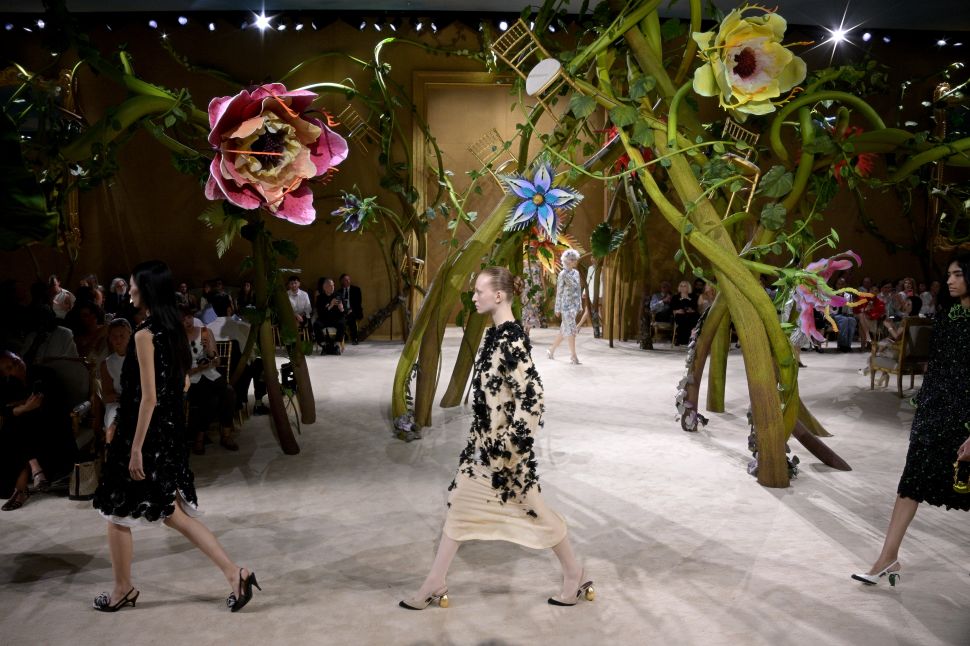
Chanel Haute Couture Fall/Winter 2026/2027 show as part of Paris Fashion Week” width=”970″ height=”647″ data-caption=’From Hermès to Loro Piana, the luxury industry is confronting a new question: can the story behind a product justify the price on the label? <span class=”lazyload media-credit”>Photo by Kristy Sparow/Getty Images</span>’>
Paris Fashion Week is, among other things, a referendum on what luxury is supposed to mean. This week, the world’s most powerful fashion houses are competing for attention with new collections, celebrity front rows and elaborate spectacles. Beneath the choreography lies a key question: When a luxury object can cost thousands of dollars, what convinces a customer that it is actually worth that price?
Luxury is undergoing a change in what constitutes status itself. For decades, the logo did much of the work. It announced price, access and membership in a recognizable club. But logos can be copied instantly, trends now circulate globally within hours and a luxury purchase no longer guarantees either rarity or quality. Recognition alone begins to lose its power.
The more interesting question is becoming: Why is it worth that? For a growing number of affluent consumers, the answer lies in craftsmanship, provenance, durability, design and the integrity of the product’s supply chain. These qualities provide something a logo cannot: evidence. They show where an object came from, who made it, how it was made and whether the quality justifies the price.
That shift matters at a moment when luxury is under pressure ot prove its value. McKinsey and The Business of Fashion found that more than 80 percent of luxury market growth between 2019 and 2023 came from higher prices rather than increased volume. That strategy works only as long as customers continue to accept price as a proxy for value. In a slowing market, they are interrogating the relationship between the two. McKinsey’s 2026 research finds that high-net-worth consumers are citing product quality and craftsmanship among the factors that would encourage them to buy more from luxury brands. Higher prices, therefore, only work when the product gives consumers a compelling reason to accept them.
During Paris Fashion Week, the spectacle is still essential to luxury: desirability, cultural relevance and the ability to create a moment remain enormously valuable. But the product has to survive once celebrities leave the front row and the social posts dissipate.
When the product becomes the signature
This shift is happening as the luxury fashion market splits into two. Consumers under pressure are trading down to value-led retail, while the strongest houses still command extraordinary prices because they deliver products, experiences or cultural cachet that customers consider genuinely distinctive. In between sit brands whose prices say luxury but whose products, stories or cultural relevance do not always convincingly justify the premium. For years, the sector could disguise that weakness with price increases. That strategy becomes harder to sustain when customers start interrogating the relationship between price and value.
The divergence is already visible within Kering. The French luxury group reported that its comparable revenue fell 10 percent in 2025, while Gucci’s revenue declined 19 percent on the same basis. Yet Bottega Veneta, part of the same group, grew 3 percent. Bottega’s appeal is not built primarily around making its name visible from across a room. Its intrecciato leatherwork allows the object itself to communicate the brand. The product is the signature, and the craft is part of the brand language.
Hermès offers an even clearer expression of the same principle. Hand construction, specialist artisans and repair services give the premium a tangible foundation. The price is not merely asserted; it is explained. The company says 55 percent of its objects are made in-house or in exclusive workshops, and it operates 12 regional Ecoles Hermès des savoir-faire in France to develop and transmit artisanal skills. In 2025, the brand generated €16 billion ($18 billion) in revenue while maintaining a 41 percent operating margin. Its scarcity is supported by an intelligible story about material, skill and time.
That distinction matters because today’s affluent customer is often paying for emotional value as much as function. Emotional value is sometimes treated as a vague marketing phrase, but it is quite concrete. It is the feeling that an object connects you to a tradition, embodies a point of view or will acquire meaning through years of use. It is the confidence that the quality matches—or exceeds—the promise. A logo can attract attention, but it cannot manufacture that attachment indefinitely.
Provenance becomes part of the product
Provenance has therefore become an economic signal, not simply an ethical preference. Knowing where a fiber was grown, who made a garment, what techniques were used and whether it can be repaired conveys information that the customer can use to distinguish expense from value. The material is not the entire argument; it is one form of proof. Natural fibers such as wool, linen, hemp, silk and organic cotton fit into this story because their character can deepen with wear and, in many cases, they can be repaired or biodegrade at the end of their useful life.
When a brand can connect its materials to a credible story about quality, origin and stewardship, provenance becomes part of the product itself. The reverse is also true: when the story of craftsmanship is exposed as less substantial than the marketing, the cost is not only reputational. It strikes at the justification for the price.
Paris offers a useful lens for understanding this. The city’s luxury houses have spent decades turning craftsmanship into institutional infrastructure. Chanel’s Métiers d’art ecosystem, for example, includes 11 specialist Maisons at its le19M creative hub, including Lesage for embroidery, Maison Michel for millinery and Massaro for shoemaking.
The approach is also relevant beyond the traditional maisons. During this year’s Paris Fashion Week, Designer Laduma Ngxokolo’s Maxhosa Africa became the first South African brand to present a full runway show on the official calendar. The collection uses locally sourced wool and produces garments in the brand’s two knitting factories based in Johannesburg and East London, making the value proposition inseparable from where the materials come from, who makes the clothing and the cultural history they represent.
When the story breaks
Loro Piana is a revealing example. The house built its desirability around rare fibers, Italian expertise and quiet, almost logo-free refinement. But in July 2025, an Italian court placed the company under judicial administration after an investigation found that it had failed adequately to monitor suppliers and that some of its production had been indirectly subcontracted to workshops accused of labor abuses. Loro Piana said it had been unaware of the unauthorized subcontracting. The court lifted the oversight early in April 2026 after the company carried out 2,400 supplier audits, severed relationships with more than 100 non-compliant suppliers and sub-suppliers and strengthened its supply chain controls.
The episode matters because the gap between the retail price and the conditions under which an item is made changes how the customer perceives the object. If a brand’s value rests on the idea of exceptional craftsmanship, customers reasonably expect exceptional stewardship of that craft and of the people performing it. “Made in Italy” cannot function merely as a geographical label or advertising shorthand. It has to describe a system worthy of the prestige attached to it.
The same scrutiny follows raw materials to their source. Questions about who benefits from the collection of rare vicuña fiber in Peru show why transparency must extend beyond a house’s direct employees. A company cannot sell provenance while treating knowledge of labor conditions as somebody else’s responsibility. Traceability is increasingly part of what customers believe they are buying.
From conspicuous consumption to connoisseurship
This is not evidence that consumers have suddenly become uniformly virtuous. Luxury has always been a social language, and status remains central to it. What has changed is the message that the most sophisticated consumers want their purchases to send. A loud logo says, “I can afford this.” A beautifully made, responsibly sourced object with a credible history says, “I understand why this is valuable.” It signals connoisseurship as much as wealth.
That creates an opening for emerging designers. Smaller brands cannot compete on advertising spend, retail footprints or celebrity ecosystems of the largest houses, but they can offer a genuine point of view, direct relationships with makers and a committed community. In a market trading down on the undifferentiated and up for the exceptional, being smaller can be an advantage when it makes value visible and claims verifiable.
The future of luxury will not be logo-free, nor will craftsmanship alone rescue every brand. Cultural relevance, design, fantasy and desire will remain essential. But the next decade is likely to move the industry further from conspicuous consumption toward connoisseurship. The winners will be the houses able to connect price to proof: exceptional materials, human skill, transparent origins, repairability and a product that earns an emotional place in its owner’s life. When that happens, the most powerful status symbol is no longer the name printed on the object. It is knowing precisely why the object deserves to exist.
Sara Bell is the founder and CEO of RIISE.world and author of the new book It Starts With You, published by RIISE Publications. The book is out now and available to buy on RIISE.world.