Reggie Burrows Hodges isn’t the first artist to find inspiration in Malta. Four centuries earlier, in 1607, Caravaggio, on the run from a death sentence after killing a local gangster in Rome, arrived in Valletta via Naples. Despite being wanted for murder, the tempestuous painter was welcomed into the Knights of the Order of St John. The respite wouldn’t last long. More violent outbursts would see him run away from Malta just a few months after joining the Order. But during what would be a short period in Malta, he painted a masterpiece, Beheading of St John the Baptist, the largest painting he ever produced and the only one to bear his signature.
Hodges’ largest painting to date was inspired by Caravaggio’s Beheading. Mamajamma is visible from all four floors of MICAS, Malta’s contemporary art gallery, which is located within walking distance of St John’s Co-Cathedral where Caravaggio’s painting hangs, and audiences can view the work from several angles as they make their way through “Mela,” Hodges’ solo show currently on at the gallery. The subject is far removed from 17th-century violence; Mamajamma depicts people playing water polo, a popular sport in Malta. But like Caravaggio, Hodges’ principal color is black, and as with all of the paintings in “Mela,” Mamajamma is rooted in darkness. There is lineage to Hodges’ acknowledged inspirations, like David Driskell, but Hodges has created a series of work entirely his own: inspired by Malta, but through his own dreamlike gaze, informed by history and power, seen through the eyes of a foreigner.
“Mela“
Artist: Reggie Burrows Hodges
Venue: MICAS
Address: Ospizio Complex, Bieb il-Pulverista, Triq Joseph J. Mangion, Floriana FRN 1830, Malta
Through: August 30, 2026
Originally from Compton, Hodges stayed in Malta for a year preparing for “Mela.” During his extended stay, he produced a series of works with a rate of productivity that is simply astounding. Since opening in 2024, this is only the gallery’s sixth show and Hodges’ first in Europe. MICAS is trying to face in two directions at once: it wants to attract international artists (and thereby international audiences) while also staying true to its Maltese location. Since opening, the gallery has exhibited works by Joana Vasconcelos and Milton Avery, but Hodges’ exhibition is in direct response to his time on the small archipelago between Italy and North Africa. Each of the paintings contains the Maltese cross, usually at the edges of the frame.
For centuries, artists have tried to capture the azures of the Mediterranean. There’s a splattering of Cézanne in some works, but Hodges’ Mediterranean is entirely his own. It is more akin to imagination than reality, but where impressionism broadly attempted to capture the experience of a location, Hodges paints experience as it is remembered and filtered through historical and social memory.
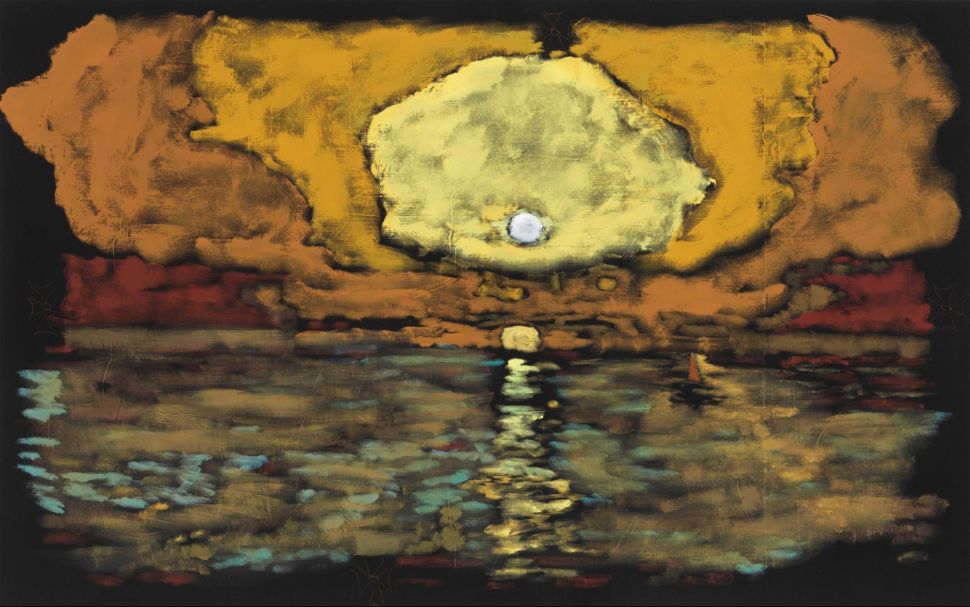
Considering that one is never more than five miles from the sea in Malta, it’s no surprise that water features heavily in “Mela.” There are echoes of Turner in the blurring of sea and sky, but Hodges’ painterly style is far from Victorian. The Buoy – Phoenix, for instance, is a typical sea scene, but the divided clouds and black base lend the painting a modernist, ambiguous air. From afar, the Mediterranean sunset resembles an atomic mushroom. There are multiple readings of Hodges’ paintings, particularly in the more abstract works like Limoncello. Unlike in traditional travel painting, scenery here is suggested, and is imbued with deeper meanings that connect with Hodges’ previous works.
When humans do appear in the work, they are both subtle and evocative of social standing. The figures are shadows on top of colors, negative spaces in dreamy hazes. All of the works in “Mela” are new and are inspired by Malta, but several feed into Hodges’ wider body of work. He continues his “Labor” series of works, in which Hodges explores those who toil but do not benefit from their work. It’s in these paintings that the human form comes through most clearly and delicately, such as in Poem of The Seabed. With just a few brushstrokes, Hodges signals the hunch of a back, the tiredness of a body. We learn so much without seeing a face.
It’s glib to describe the space as being part of the show, but MICAS literally is part of “Mela.” One painting, Labor – Place of Honey, contains the crossed ceiling of MICAS under which the painting is suspended. The entire show feels expansive: the gallery is built in 17th-century fortification walls, and audiences walk through several levels within the large open space. While visiting last month, I viewed the show twice, once in the evening and once in the morning. The work was the same, but the experience felt different depending on the time of day. MICAS lets in a lot of light from outdoors, and while the morning light is clearer, walking around the space during sunset lent the exhibition a nostalgic quality. It’s obvious that these works were produced with this setting in mind. The show isn’t on for very long, it closes at the end of August, but those in Malta should definitely see it while the works are there. Each painting is captivating, but they were made to be seen together.