
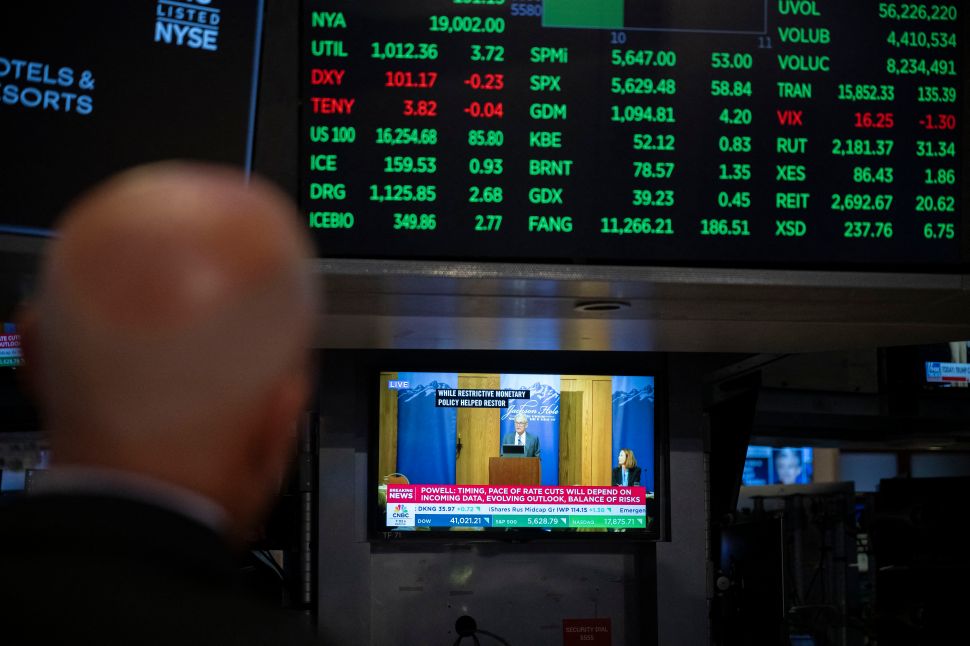
On Friday, Kevin Warsh will step to the lectern in Grand Teton National Park and deliver his first address as chair of the Federal Reserve. The setting is, as always, almost defiantly analog. The Kansas City Fed’s Jackson Hole Economic Symposium is invitation-only, deliberately small, held far from any trading floor and conducted at the considered pace of people who have the room to think. It is one of the most closely watched communications events in global finance, and almost nothing about how it is staged resembles the financial system that will receive it.
That is the mismatch worth sitting with. The Fed sets no interest rate at Jackson Hole. Its instrument there is language. A chair chooses words, and markets parse them for signals about what comes next. For most of the symposium’s history, the model assumed a particular kind of audience: one largely concentrated in a few time zones, made up of humans who would hear a speech, weigh it and position themselves accordingly. Each of those assumptions is now eroding. For a new chair whose every phrase is being scrutinized for the first time, that matters more than usual.
Many major American stocks that anchor most portfolios now trade around the clock in tokenized form, alongside derivatives that track them. When Warsh speaks, the response will not necessarily wait for New York to open. It can begin immediately, everywhere, across venues that never close. This is not a projection. Over the weekend of Jul. 13, significant geopolitical news broke while U.S. exchanges were closed, and on the platform I run, Bitget, tokenized stock trading rose to more than ten times its typical weekend level. Investors were repricing their exposure to major American companies on a Saturday, while the primary venues where those companies list stayed shut.
Bring that dynamic to a Fed chair’s words, and the consequence sharpens. The interval that once sat between a speech and the market’s verdict has largely collapsed. The hours in which a phrase could be read in context, compared with previous statements and digested are disappearing. The words now land in a market that is global, continuous and ready to respond. Interpretation happens in real time.
This cuts two ways at once, and both should concern a policymaker. On one hand, it makes central-bank communication more consequential than ever: every clause can be priced almost instantly, with no cooling-off period in which a careful qualification can do its work. On the other, that same speed manufactures noise. A hedged sentence, read literally and at machine pace, can move prices before anyone has had time to weigh what it actually meant, producing volatility the chair neither intended nor, in substance, caused. The market’s reaction time has become shorter than the time it takes to understand what was said.
Markets have always outrun the institutions built to watch them. The ticker tape outran the messenger, electronic trading outran the floor and automated systems outran the human eye long ago. Each time, the surrounding architecture—the rules, the oversight, the plumbing—caught up years later. What is new is where the speed now bites. Not only on how fast a trade clears, but on how quickly a sentence can be interpreted, translated into a signal and acted upon.
Increasingly, the first reader of a central banker’s words is not a person. A growing share of trading now runs through automated tools that parse language and, in some cases, act on it directly. Such a system does not wait for the morning or for anything. It reads the sentence and moves. It also reads literally, which is precisely the difficulty for an institution whose communication depends on nuance, sequencing and deliberate ambiguity. Human listeners can distinguish a passing qualification from a change in policy direction. A system trained to identify signals may be optimized to detect a change and trade on it. A market that is always open is the only market such a system can fully exploit, and the audience a Fed chair now addresses includes, in part, software that responds in milliseconds and does not do subtext.
None of this makes Jackson Hole obsolete. The price of money still matters more than almost anything traded against it, and a room of serious people thinking hard about it is no bad thing. But the model of communication built around that room will have to evolve.
The Fed has adapted its communications before, adding press conferences, economic projections and plain-language summaries as its audience widened. The next adaptation is for an audience that never logs off and increasingly reads for the literal, machine-detectable signals: clearer, more continuous communication that is less reliant on the slow human digestion the annual-speech format quietly assumes.
Some of that reckoning has already begun. In the U.S., securities regulators are weighing rules that would give tokenized, around-the-clock versions of U.S. stocks a clearer regulatory path. Beneath that technical debate sits the same question a Fed chair now faces: Who is really listening when the market never closes?
For now, tokenized versions of traditional assets are a rounding error, a fraction of a percent of the markets they mirror. I expect that to reach close to 10 percent within five years. In dollar terms, that would mean trillions of dollars of stocks, funds and commodities trading whenever their owners—or their owners’ software—decide to, rather than whenever a traditional institution opens its doors. That would change the audience for monetary policy. Warsh’s address on Friday will matter, as it should. But he will be speaking into a financial system that no longer waits for the opening bell and increasingly does not wait for a human to decide what his words mean.