
At the height of its industrial power, Pittsburgh was also one of the country’s key cultural centers. Today, the Carnegie International and the programming at the Carnegie Museum of Art and Andy Warhol Museum are a testament to the cultural and artistic heritage of the Pennsylvanian city. In terms of contemporary art, the Mattress Factory is probably one of the most interesting spots in Pittsburgh, embodying both the city’s rich industrial heritage and its push toward modern creativity. It was founded in 1977 by tenacious sculptor, designer and visionary Barbara Luderowski “for artists by artists.” Over the years, the artist-centered museum and international residency program has built a reputation for supporting artists in the production of new work—frequently ambitious, site-specific installations responding to the space’s architecture and the societal and economic history it embodies. There are very few limits imposed on what artists can produce here; the aptly named former mattress factory now serves as a stage for new forms of storytelling and imagination.
“Artists need spaces to show their work, so no offense to institutions that simply organize exhibitions,” Anthony Elms, who as artistic director oversees artistic programming, tells Observer, but artists also need space to think, and “partners, places to try things out, time for questions, support to find where they don’t know they need to go.” For Elms, it’s about being with and working alongside artists rather than focusing on past results and adjudicating new ones. “It is the importance of asking ‘what if’ and seeing a difference tomorrow. All visual arts institutions present culture; we equally or even more so make culture.”
The Mattress Factory’s public facilities encompass three buildings in the Mexican War Streets neighborhood of Pittsburgh’s Northside. According to Elms, what makes the Mattress Factory such a unique but also challenging venue for exhibiting work is that the spaces are not generic—even when the walls are white, this is no white cube. “They are old, lightly refurbished, lived in, raw at the edges. Grizzled even,” he says. “The three buildings and multiple spaces of Mattress Factory are best for people who want to work with a space and really think about where they are and how. There’s no one answer to how an artist can or should respond to the architecture or history of both the building and the institution.”
With its invitation-based selection process, the Mattress Factory seeks out artists willing to lean into this challenge. “We are looking for artists who can ask new questions of us as individuals and institutions in the same way that we are always looking for artists who are asking questions of their world,” Elms explains. “We build the work together.”
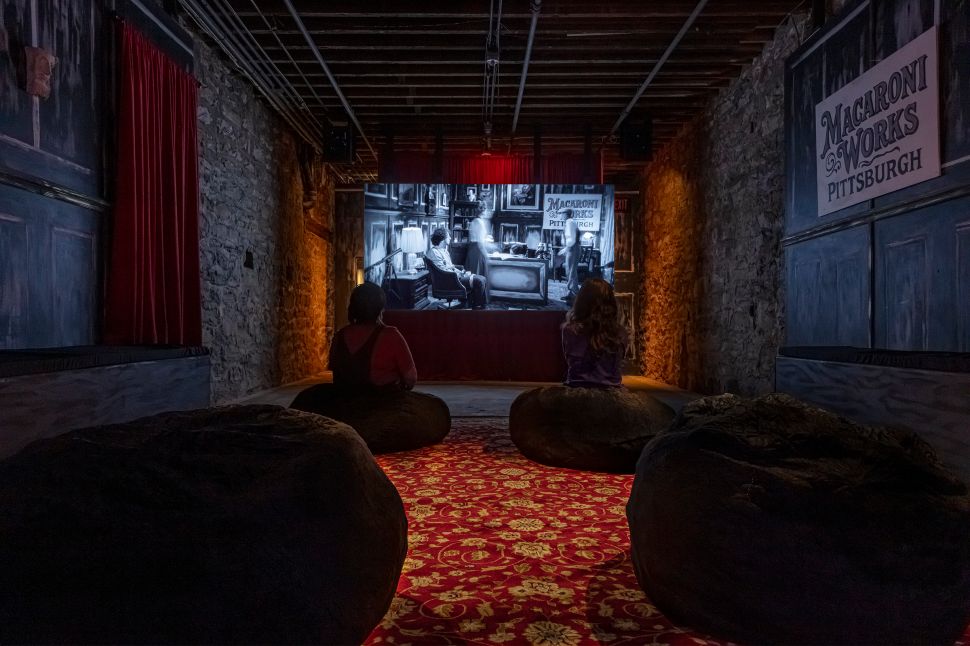
One of the most remarkable interventions in this year’s Carnegie International, which runs through January 3, 2027, is Arturo Kameya and Claudia Martínez Garay’s takeover of the Sampsonia Way space. Through layered, tactile and evocative storytelling, the artists build a mythology of degradation and consumption that exposes the contradictions of Peruvian society while extending them toward a broader, recurring history of power and economic dysmorphia, one that many societies end up producing, particularly in moments of major cultural, technological and productive transformation. It is a very ambitious context-specific installation, involving the knocking down of walls and the exposure of debris and degradation in a fictional domestic environment.
Elms describes the opportunity to work with Martínez Garay and Kameya on their installation, as well as with curator Danielle Jackson, as exciting and rewarding, and as a chance to have the conversation with the duo as he envisioned. “Locally, on an institutional level it is great to once again collaborate and help build this important and storied exhibition series decades after our last collaboration,” he says. Martínez Garay and Kameya didn’t just bring their visions to the three-story rowhouse. “The artists ripped open a series of time-space encounters with histories and geographies that allow visitors to encounter ghosts and unfinished stories. These encounters help us to imagine a future that can grow from the ashes of multiple disparities. They help to see something beyond the current horizon of unfolding cataclysms.”
The Mattress Factory is entering its 50th year, and its funding and sustainability model is not very different from that of nearly every mid-sized arts organization in the United States—it relies on a combination of private and public support. “The fiscal viability of cities and cultural institutions is under question and volatile nationwide, maybe even globally,” Elms says, acknowledging how, in this context, it was particularly exciting to find a vibrant partner in the Carnegie. Together, the institutions were able to mount a more ambitious installation than either might have accomplished alone.
Elms sees Pittsburgh’s contemporary art scene as vibrant but also in need of more collaboration and greater visibility. The Mattress Factory is one of several civic-minded cultural organizations in the city designed to serve as a bridge between the local community and the international art world. “We bring artists to Pittsburgh, introduce them to the city and other organizations and artists. We also routinely engage Pittsburgh artists and work with them, offering them equal footing as those artists we bring into town,” he clarifies. “Pittsburgh is emphatically a part of the conversation. Artists and organizations always need friends in other zip codes. We put the stamp on the envelope.”
Or to put it another way, the Mattress Factory is closing some of the distance between Pittsburgh’s institutions and local talent and the rest of the world. Asked to look ahead, Elms says a project with Los Angeles-based artist Amanda Ross-Ho is coming soon, followed by an exhibition with Afro-Creole artist Akea Brionne in October, the latter in collaboration with Pedantic Arts Residency. He says they are also looking to develop public exhibitions and events to mark the museum’s 50th anniversary and usher in the next 50 years.