
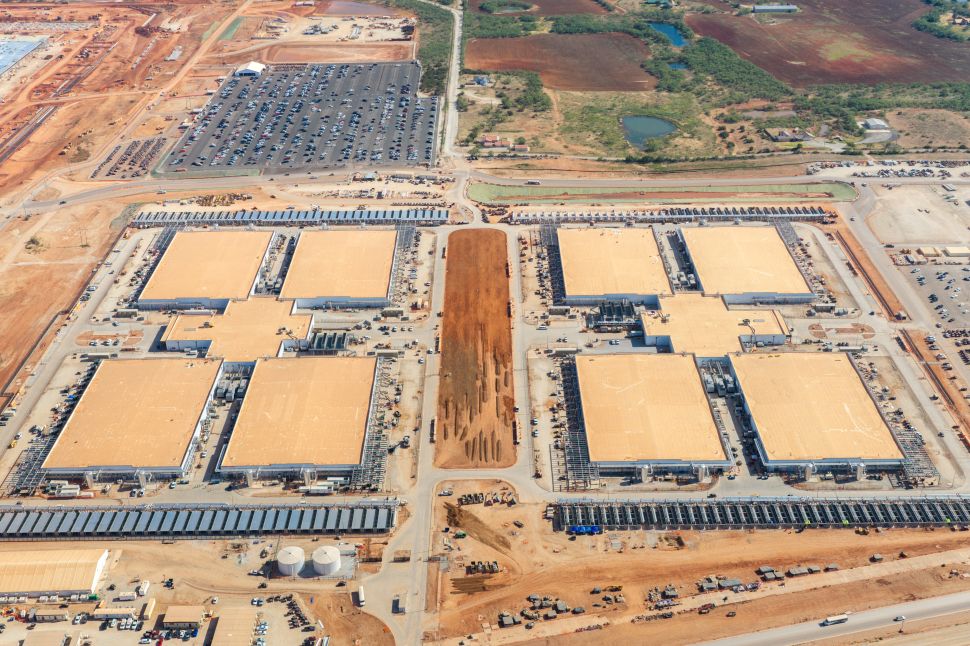
According to a recent poll, at least seven in 10 Americans would oppose a data center being built near their home, with community opposition rising substantially in just nine months. The NIMBY (“not in my backyard”) movement has stretched coast to coast, and the taboo of inviting data centers has taken a front-row seat in political debates from Maine and California to Texas and Utah. At a moment when Americans seem to agree on little, resistance to data centers has emerged as one of the few issues on which a clear majority can agree.
Data centers can consume enormous amounts of electricity and, depending on their design and location, can put pressure on water supplies, roads, transmission infrastructure and local communities. But the question facing the U.S. is not whether data centers should be built. It’s how, where and under what conditions.
Moratoriums are spreading
Politicians are responding. Moratoriums, characterized as “pauses” rather than longer-term prohibitions, have recently been enacted or proposed throughout the country. New York state has a ban on construction for facilities of 50 megawatts or more for the next year. Texas’s Gov. Greg Abbott has ordered a pause on new interconnections into the state’s electricity grid. Arizona has approved a moratorium on sales-tax exemptions. Illinois and Ohio are also pausing some incentives. Florida, typically averse to regulation, now requires hyperscalers to bear their own electricity costs. Virginia, home to the world’s largest data center hubs in its Data Center Alley, has adopted a new electricity tax. And Maine voters recently approved a moratorium, which Gov. Janet Mills vetoed. There are also more than two dozen local moratoriums and prohibitions in Michigan alone, with local actions in more than a dozen other states.
This populist surge has also reached the Western United States, where water can be scarce, land is plentiful and electricity has historically been relatively inexpensive. Arizona surpassed one gigawatt (GW) of data center consumption and has recently passed the 2 GW mark. Nevada is approaching a gigawatt of capacity. Utah continues to look attractive to data center developers even as one ambitious project has been scaled back by 75 percent, amid calls for greater transparency, impact reviews and protection from rising electricity rates.
The moratoriums reflect a sense that data center developers are moving faster than communities can assess the consequences and that the A.I. boom fueling much of that growth may promise job displacement and other social costs alongside economic opportunity.
Real power constraints
There are also real constraints on providing the electricity that the next generation of data centers will require. IDCA Global Data Center Report (2026) research shows that the U.S. now devotes 6 percent of its total electricity grids to data centers. Should A.I.-driven growth double or triple its current usage, or push demand substantially beyond that, the pressure on the grid could shift from unacceptable to unsustainable without hundreds of billions of dollars in investment in new energy infrastructure. There are already serious strains in several U.S. data center hubs, with waiting lists for new connections to local and regional electricity grids stretching out to 2032 in Virginia, other Southern states and the Midwest.
According to the same report, those constraints are changing the traditional relationship between data centers and utilities. Rather than acting as large utility customers, some data center developers are exploring their own power operations and generating electricity on-site. Some initiatives plan to use large natural-gas turbines to meet that demand, but the larger imperative is to develop new, sustainable energy resources capable of supporting the A.I. data center buildout. Nuclear energy is part of that mix. Although it is not a renewable, it is a low-carbon source of electricity because it produces no operational greenhouse gas (GHG) emissions.
The problem is timing. The U.S. added slightly more than 50 GW of new renewable energy to its grids in 2025, representing about 10 percent of its total electricity consumption. China, by comparison, added almost 450 GW of renewable capacity, roughly equivalent to the entire electricity consumption of the U.S.
The U.S. is simply not moving quickly enough to develop new energy resources at a scale that A.I. demand could require. Nuclear ambitions may be growing, but it has been decades since a traditional nuclear plant went into operation. Newer small modular reactors, which are planned to produce several hundred megawatts compared with roughly two gigawatts for a traditional facility, are not expected to come online until 2028 at the earliest.
There is some progress, of course. Google has signed agreements for nearly 35 GW of new sustainable energy over the past 15 years, with efforts accelerating last year and into 2026. Microsoft is also working to restart a nuclear plant in Pennsylvania, specifically to support its A.I. data center initiatives. At the same time, data center technology is becoming more efficient. GPUs from Nvidia and its competitors are delivering more computing power per watt. Facilities can operate at higher temperatures, and high-performance closed-loop liquid cooling is becoming more common in new facilities.
But technological progress does not erase the underlying tradeoffs. The fact remains that the U.S. still needs to accelerate renewable-energy development. Nuclear facilities require substantial amounts of water for cooling. Even natural-gas turbines are seeing demand outstrip supply. And every solution creates its own tradeoffs. Water-efficient cooling can increase electricity consumption. On-site natural-gas generation can avoid waiting years for grid connection, but can dramatically increase emissions. Renewable-energy contracts can add clean generation to the grid without necessarily delivering clean electricity to a particular community at every hour of the day. There is no frictionless way to power the A.I. economy.
Constraints create an opportunity
The result of these hard engineering realities may be that community pushback is, ironically, less effective than its organizers realize. The energy industry itself is the bottleneck, and the growth of U.S. data centers and A.I. hubs may ultimately be slowed more by a lack of available power than by local legislative sentiment. The virtual moratoriums imposed by energy bottlenecks carry a great opportunity for all parties to catch their breath and take a reasoned look at what data centers are, what A.I. means for the economy and where development makes the most sense.
Responsible engagement by communities and the developers requires looking beyond a single metric, such as annual water consumption or renewable-energy purchases. It requires evaluating the entire infrastructure and energy ecosystem: peak electricity demand cycles, transmission requirements, backup generation, water sources and quality, emissions, local noise and heat generation, land use, road and drainage systems, workforce development and local economic benefits.
Cheap land and tax incentives are often cited as primary criteria for data center site selection, but they are only part of the equation. Loudoun County, Virginia, is a good example. The county, on the western side of the Washington, D.C., metro area, is home to Data Center Alley, the world’s largest data center hub. Land in this area was never the least expensive in the state, and today it can sell for an astounding $6 million per acre for development. Even then, many parcels cannot be made data-center ready until 2032 due to power constraints.
Historically, incentives have not been the primary draw for developers in Loudoun County. Site selection there, and throughout the U.S., involves a complicated mix of available power, transmission capacity, fiber connectivity, land characteristics, cooling requirements, permitting taxes, workforce considerations, security, economic predictability and the ability to expand. Today, power availability is becoming an even more decisive factor. Some developers are considering acquiring or developing their own generation, including power generated “behind the grid,” separate from local grid connectivity.
Although there is interest in developing data centers in some rural areas of the Southern states and more remote areas of the American West, developers remain cognizant of local infrastructure, available workforces and the ability to attract requisite talent as development plans play out. The best sites are found where existing physical infrastructure is already adequate, sufficient water is genuinely available, new power generation can be added proportionally, connectivity is strong and the land-use consequences are compatible with the surrounding community. In other words, the best data center strategy is to find the right ecosystems.
Transparency is not a checkbox
Whether a data center company plans to renovate an existing site or develop a new facility, the lesson is clear: transparency cannot be a checkbox or public-relations exercise. The notion must be baked into a new initiative from conception. A good example comes from Joliet, Illinois, where Hillwood, led by Ross Perot, Jr., thoroughly engaged the local community before winning approval for a project that calls for eventual consumption of 1.8 GW. That kind of engagement is significant because communities are deciding whether to accommodate an entirely new industrial and digital ecosystem and whether the economic benefits justify the demands it places on local resources.
Beyond transparency, the bigger picture is that data centers and planned digital hubs are laying the foundation for 21st-century digital economies. The think tank I lead, the International Data Center Authority (IDCA), has found a strong correlation in its research between strong data center foundations, supporting digital infrastructure and positive economic development. That relationship extends across income levels and geographies, from Scandinavia and the U.S. among developed economies, to Brazil and China among large emerging powers, to Rwanda and Costa Rica among developing nations.
Approving new data centers can therefore mean giving a green light to a more modern economy. But the modernizers must fully engage with the communities in which they are building and which they must serve. The best moratoriums will be pauses, not prohibitions. More importantly, they should be used to answer a better question: Under what conditions will a new data center best benefit our community?
A key economic enabler and community builder
Data centers are the backbone of the modern economy. IDCA’s Digital Economy Report (2026) attests to that. Without them, there would be no email, online banking, Netflix, ChatGPT or Google search. Across the nation, the very communities that use social media and digital enablers to fight data centers are empowered by them. And many communities, including Loudoun County, are built and enriched by the economic merits of data centers.
The reality is that our world today, especially the U.S. economy, is heavily dependent on data centers. The continued growth of our digital economy is even more reliant on the consistent, sustainable expansion of data centers. However, the country cannot afford to develop data centers as a series of ad hoc, isolated projects. It needs to think at the level of digital ecosystems.
Our resources and focus must be on master-planning environmentally, technically and economically viable digital hubs in multiple regions of the country, particularly where power, connectivity, water, land and human capital can be brought together. Concentrating development in well-planned hubs can create economies of scale, make infrastructure investment more efficient and allow communities to understand and manage the cumulative effects of development.
The question America should ultimately be asking is not whether we want data centers, but where they belong, what resources they require and what communities should receive in return. These digital hubs will collectively deliver not just space for building data centers, but also depict a grander picture of a cohesive, unified ecosystem that fosters growth and plays a vital role in the economic value chain of our world.
Mehdi Paryavi is the CEO and founder of the International Data Center Authority (IDCA), the world’s leading Digital Economy think tank.