
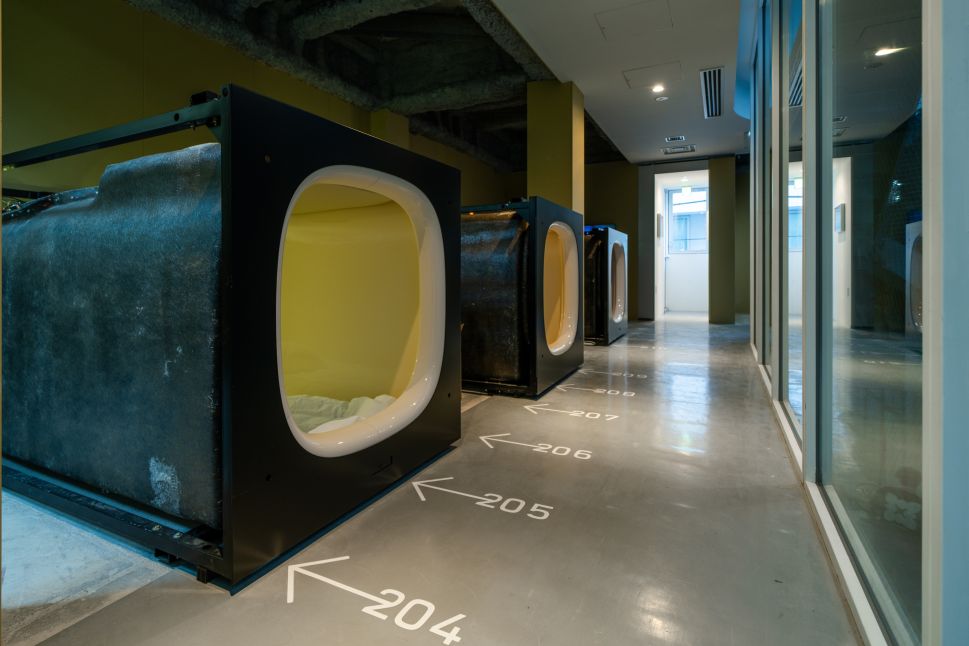
Boutique, curated and contained fairs, often dealer-led and housed in hotels, are becoming a fixture of regional art weeks, as younger dealers and curators look for alternatives to a model that increasingly feels broken. For its fifth edition, Art Week Tokyo has Tokyo Jazz Club, which runs through Nov. 8 across all eight floors of a former capsule hotel in Kanda-Nishikicho, near the historic book district of Jimbōchō.
As Tokyo’s art scene grows increasingly international, this new fair, modeled on Basel Social Club, gathers more than 60 galleries, including local establishments such as SCAI The Bathhouse and NANZUKA; international exhibitors with longstanding ties to Japan, including kurimanzutto and Sadie Coles HQ; and regional players like Blindspot Gallery from Hong Kong and ROH Projects from Jakarta.
With its varied and dynamic constellation of artistic languages, mediums and rhythms, the new alternative art fair takes its inspiration from Japan’s rich jazz culture. “For us, jazz isn’t a genre so much as a method,” co-founder Robbie Okuda Fitzpatrick, who also founded Fitzpatrick Gallery, told Observer. “There’s the obvious link to Japan’s listening culture—the jazz kissa, the record bars, the art of listening closely—but what we really borrow is the mindset: improvisation, collaboration, breaking convention, finding harmony inside a bit of chaos.”
As he described it, the project was built voice by voice, rather than via a fixed plan. Just as musical improvisation relies on listening and empathy to create new harmonies, Tokyo Jazz Club is shaped by a collaborative improvisation in which artworks find their own place within a larger composition, somewhere between structure and emotional spontaneity. “Even the structure follows the metaphor—eight floors, eight notes, eight days, each floor its own rhythm, all of it one composition,” Okuda Fitzpatrick added. Each day unfolds differently, leaving room for surprise.
What drew him and co-founder Yael Salomonowitz (both of whom were involved with the launch of Basel Social Club) to the building was its complexity and the contradiction inherent in its former function. “A capsule hotel was made for solitude and sleep, little cells to withdraw into, and we were turning it into a place for people to come together,” Okuda Fitzpatrick explained. “Rather than smooth over its quirks, we built the concept around them: the narrow corridors, the capsules, the climb through the floors. You can almost read the building in cross section, catching glimpses of each floor at once. A space designed for sleeping is now very much alive.”
The extensive programming has artists intervening in various ways throughout the week and into the after-work hours (the club is open from 5 to 11 p.m.). Highlights include a conversation between Theaster Gates and Arthur Jafa, José Parlá’s vinyl presentation and a listening session curated by Jafa. It makes for a rare meeting point between contemporary art and music, where the two disciplines are allowed to inform each other.
“We’d love people to leave feeling they discovered something, rather than having been shown something,” Okuda Fitzpatrick said when asked what kind of experience they hoped to design. Visitors might come for the art and end up spending an hour with the records, or arrive for a performance and stumble on an unfamiliar artist in a shower stall, he noted. “That sense of accidental discovery matters to us; it’s a place where you can take the art seriously without taking yourself too seriously.”
Observer visited on Culture Day, just before the official Art Week Tokyo program kicked off. Outside, people of all ages gathered in the streets below the capsule hotel for the national holiday celebrating freedom, peace and the advancement of culture. Inside, Tokyo Jazz Club felt like a natural extension of that spirit: a gathering of international and globally connected creatives and art professionals eager to explore imaginative possibilities and experiment with new ways of making exhibitions and fairs.
The curatorial process was inspired by the architecture, Okuda Fitzpatrick explained. In particular, how to organize the space over eight separate floors. “We conceived of them as eight distinct social contexts, beginning with a floor where we returned the sleeping pods to their original setting, then a vinyl listening lounge, a floor given over to moving image, a game floor, a sound bar as a space to gather, and so on,” he said. From there, they consulted with the galleries. “Some we approached and some who came to us, explaining the curatorial vision and deciding together which artists from their programs made sense in our context. Many were inspired enough by the space to propose site-specific works, Yoko Terauchi among them.”
Compared with other experimental and site-specific fair formats, such as Paris Internationale or smaller hotel-based initiatives like Minor Attractions, Tokyo Jazz Club stands apart because it doesn’t even nod to the conventional fair format. Instead, it unfolds like a site-specific group show. There are no booths; the works are in direct dialogue with the architecture, occupying disconnected rooms, floors and niches that once housed hotel guests and extending into the showers and bathrooms.
Filipino-born Vietnamese-American artist Lydo Le’s new four-channel video installation The Weight of Nothing, presented by ROH, feels tailor-made for its pod, which becomes a space machine in which intermittent images offer up an abstract landscape of sensations. The sound artist and underground techno DJ first made a name for herself in the New York and Southern California electronic scenes, and her work bridges electronic club music—she has performed at legendary venues such as Berlin’s Berghain and Boiler Room—and multimedia sound and light works like this one. Across the fair’s programming, several more artists make music and DJs make art, probing just how connected those creative worlds are.
On Tokyo Jazz Club’s first floor, Jan A. Eckert’s sound installation Perhaps Silence offers another kind of listening experience: a three-part composition that combines field recordings from Kyoto with electrical impulses from microorganisms, plants and soil, as well as machine-learning processes. This encounter between organic life and technological systems invites us to reconsider what we listen to, and how, through a more expansive animistic sensibility that Japan, like much of Asia, has retained even amid technological disruption.
The fair leaves plenty of room for experimental and new-media presentations. One early highlight is Chen Wei’s LED work Trouble City, which translates the visual language of glitching street advertisements—flickering circuits, fragmented images and misaligned texts—into rhythmic compositions of light, somewhere between urban noise and digital disorientation. Blindspot Gallery pairs it with Pixy Liao’s more provocative photographs: carefully staged, tongue-in-cheek tableaux that subvert conventional representations of heterosexual relationships and challenge gender roles and power dynamics.
Nearby, Arab Bank Switzerland, one of the initiative’s supporters, presents Transaction Sculpture – Untitled (2018/2025), an autonomous digital artwork by the pseudonymous artist 0xfff, who works in the tradition of systems and conceptual art, using computation, distributed networks and protocols as artistic media to examine how they shape contemporary experience. Existing as a series of smart contracts on the Ethereum blockchain, the work transforms cryptocurrency transactions into performative events, generating ever-changing visual compositions each time it is activated. For the fair, its earliest iteration is reactivated through 200 individual transactions, each producing a unique image preserved as a signed, numbered Instax print available on-site. The format makes the work tangible and accessible, introducing a participatory, community-based dynamic. (The image generated by the first transaction can be seen beyond the fair on billboards across the city during Art Week Tokyo as part of a collaboration with NEORT++.)
Each floor features at least one large video work, sound installation or full environment piece. Floating between floors, and visible from the vertiginous exterior staircase, are the goldfish of Rivane Neuenschwander’s film Love Lettering, first shown in Japan in 2008 in a group exhibition of Brazilian art at the Toyota Municipal Museum of Art marking the centennial of Japanese immigration to Brazil. The fish swim back and forth in bright blue water, little flags delicately attached to their tails, each bearing an isolated word or a fragment of a familiar phrase expressing love, loss and longing: my love, sweet, my dear, eyes, talking, kissing, hands, mouth, miss, London, come, today, you, here, night, wish. The video celebrates fluidity as a possibility of relentless growth and expansion, a love letter to an ever-changing self as we move through life, thriving rather than merely floating.
On the second floor, the atmosphere turns hippier still, with capsules furnished with antique Eastern rugs from Granpie Nómada and one entire side given over to a vinyl DJ set. Here, Berlin-based Galerie Molitor presents the gestural mindscapes of Lisa Jo, while Kosaku Kanechika brings together works by E’wao Kagoshima and Junko Oki. Kagoshima’s drawings, including two from 1970, carry his distinctive queer symbolism into a world of almost mythological, charming, androgynous figures well worth rediscovering in such a contemporary context.
In a simple yet effective intervention, Mexican artist Gabriel Orozco, presented by kurimanzutto, has conjured the entire imaginary Landscape from a toilet paper roll in a project that, with a tarot deck laid out on the table, extends his conceptual practice from the earthly to the celestial and spiritual. Nearby, Yuko Mohri’s poetic reanimation of the mundane offers a natural counterpoint, at once contrasting and resonant. Presented by Yutaka Kikutake Gallery, her work Decomposition brings another kind of energy into the room, playing with found objects and the unexpected possibilities of their arrangement.
Paris gallery sans titre spotlights Jessy Razafimandimby’s fluid paintings, drawn from the subconscious, which converse beautifully with the imaginative, psychic energy of smaller works by Japanese artist Asami Shoji, presented by Linseed. Both share the space with Yasushi Amano’s almost archaeological, totemic inscriptions of primeval forms, presented by Crèvecœur, in an exchange that reveals the persistence of universal archetypes across the human imagination.
“Tokyo is a destination everyone loves, and Tokyo Jazz Club brings a fresh, global energy to Art Week Tokyo, giving galleries and artists a lower-pressure, more flexible way to engage with the city’s local art scene,” Lingzhi Zhuang, founder and director of LINSEED, told Observer. “From Basel Social Club to Tokyo Jazz Club, the conversations and new connections that emerge in local spaces, shaped by each city’s distinct cultural context, are what keep drawing us back.”
Max Guy’s masks, presented by Good Weather Chicago, also draw on a collective unconscious, drawing on the theatrical vocabulary of Nō. The artist conceives them within a speculative imagination in which these figures might have arrived from another realm. One mask hangs against Christine Sun Kim’s wall painting of a quasi-random musical composition, presented by François Ghebaly.
Among the video installations on the fifth floor, Arthur Jafa’s Structural Mutiny _ Prince (2025), presented by Sadie Coles HQ, brings a dance-floor moment and a touch of nostalgia: footage of Prince dancing in a white suit turns almost hypnotic through repetition, aligning visual and sonic rhythms in a meditation on aura, authorship and the symbolic value of iconic images.
In the bathroom on the same floor, two unsettling video works by Fuyuhiko Takata, presented by WAITINGROOM, are accompanied by both an incongruous song performed by Agatha Wara and a llama brought in by Damien & The Love Guru. Both presentations explore identity through fictionalization, narration and performance, leaving the boundary between authentic and artificial deliberately unstable.
There is plenty of millennial nostalgia throughout the show, perhaps a natural response to troubled times and almost inevitable given that many of the dealers and artists belong to that generation, one that has also developed an emotional relationship with Japan.
On the seventh floor, Esben Weile Kjær’s Hardcore Freedom conjures an early-2000s party, complete with the era’s biggest hits and the innocence and optimism that would fade as the century wore on. A reworking of the original shown at Andersen’s Contemporary, the work takes over the entire bathroom and shower area, turning it into an after-party environment somewhere between a nightclub, a stage and a sanctuary. But the party is over—a feeling shared by an entire generation.
In another bathroom, Harlesden High Street presents a video game by Japanese game creator SUDA51, anchored in the same era and visual language but more layered. Referencing his early Super Fire Pro Wrestling universe and the peculiar cultural world of Japanese video games, with the values and imaginary worlds they carried, it ultimately turns toward a human tragedy. The gallery simply describes it as a Super Famicom game and a dedication to Human Entertainment—a statement neatly encapsulating the contradictions of our society.
An entire floor is dedicated to works involving video games and consoles, treated as charged devices through which to enact and challenge the role-playing that takes place in life as much as in games. A pink Xbox accompanies Mitchell F. Chan’s Ladyboss (2025), presented by Nguyen Wahed. An endless-runner video game intertwined with the tragic story of a young female streamer, the work moves between gaming, storytelling and the attention economy, using the mechanics of a seemingly lighthearted game to reveal something more unsettling beneath the surface.
Gabriel Massan’s work, presented by Yehudi Hollander-Pappi, extends the exploration of digital environments into a contemporary interactive mythology. First shown in Frieze Seoul’s Focus section, where it sold to a regional foundation, the immersive installation centers on gameplay projected onto a curved 4K screen, accompanied by two bronze sculptures derived from the artist’s digital universe. Drawing on Carl Jung’s writings on dreams, images and the unconscious, the game approaches movement as a process of becoming, shaped by adaptation and shifting relations between selves, systems and territories. Developed in Unreal Engine and operated via a custom-built joystick, it unfolds into a continuous, playable world that visitors can enter and leave at any time.
Above it hangs Tabor Robak’s Massive Multilateral Chandelier (2024), presented by Upstream Gallery. Made of joysticks, it reads as a totem or celebratory altar to these tools of articulation and gateways to other worlds. Digital utopian and dystopian escapism also permeates Tomohito Wakui’s How to Destroy Angels, presented by Anomaly, further blurring the boundaries between virtual worlds and physical experience.
Other video game and A.I.-related works abound, including JODI’s OXO, also presented by Upstream Gallery. Revisiting one of the earliest graphical computer games, a version of tic-tac-toe, the interactive multichannel installation turns a seemingly simple game into an exploration of the language of early computing, war games and artificial intelligence. Visitors are invited to play on dedicated keypads, but what looks like a familiar pastime becomes a reflection on the increasingly invisible systems that organize our digital lives as connections between the game’s possible configurations and the logic of advertising are revealed.
Tokyo Jazz Club is, notably, also a club, so the top floor has a bar and restaurant, with another DJ console ready to be played and Theaster Gates’s Afro-Mingei neon presiding above it. The conversation between technology and artistic imagination continues here, too, with works by Max Hooper Schneider, presented by François Ghebaly, and Jon Rafman, presented by SOOT Gallery, exploring how contemporary culture and technological environments reshape our perception of reality.
Across the floors, at different times of day, Tokyo Jazz Club expands organically from contemporary art to encompass live performance, music, hospitality and social encounters. For the organizers, the most rewarding part has been watching the building become a venue in its own right. “We spent months imagining how people would move through it and how sound would travel between floors, but once the doors opened, something else took over,” Okuda Fitzpatrick noted. “The mood shifts hour to hour and floor to floor—exhibition, concert, listening bar, party—and people slip between those modes naturally. There’s no single way to experience it; everyone makes their own path. That’s really when the project begins.” What emerges through the shifting of the program and the people is a curated, site-responsive narrative environment that is at once an immersive exhibition, a social space and a reimagined marketplace.
As for the economic model, there is still a participation fee, but it is flexible and tiered, and varies according to where an exhibitor is based, the mediums and works on view and the space occupied. “We took the opportunity to experiment with a fee calculator—a payment model we’ve been developing for some time,” Okuda Fitzpatrick explained. “Rather than a flat rate, it weighs several factors: the profile of the gallery itself—how long it’s been in business, how many spaces it runs—along with the distance the work has to travel, which we discount, the medium, the amount of space a presentation occupies and finally, the value of the work. We’re still adapting and improving it, but for now we believe it’s a fairer way to think about what a gallery’s participation should cost.” It is a wholly collaborative approach, adaptable to the needs of the exhibition as much as to those of the exhibitors.
Tokyo Jazz Club’s inaugural edition is presented in partnership with Art Week Tokyo, with support from Arts Council Tokyo (Grant for Artistic City) and in cooperation with Yasuda Real Estate Co., Ltd.—a combination that reflects how building Tokyo’s art ecosystem is a shared endeavor among public institutions, government bodies and private stakeholders. This growing alignment of cultural policy, private investment and independent initiatives is particularly significant at a moment when Japan is seeking to strengthen its cultural presence abroad. With Tokyo Gendai moving into the November slot next year, Art Week Tokyo, which began as a collector-led initiative, could become another leading destination on Asia’s cultural calendar, returning the breadth of Japanese talent to the center of the conversation and reaffirming Tokyo as a capital of experimental young creativity at the intersection of industries. Fashion and music are already in full swing; art is apparently catching up. “Tokyo is having a real moment: much of the art world wants to be here right now, and there’s a genuine curiosity about Japan’s artists and galleries,” Okuda Fitzpatrick concluded. “We wanted to meet that energy with something that could be several things at once: an exhibition, a marketplace, a venue and a social club, where artists, galleries, collectors and the public mix in a looser, more spontaneous way than usual.”