
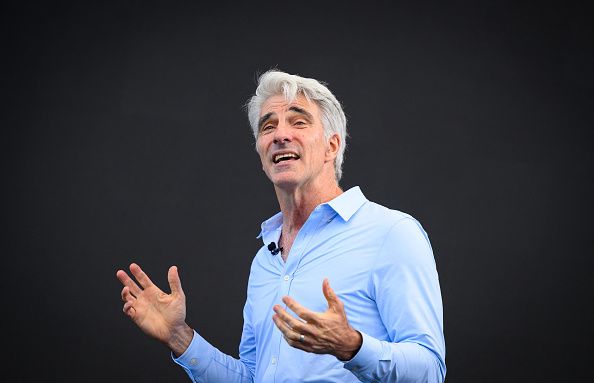
Apple” width=”594″ height=”383″ data-caption=’Craig Federighi, Apple’s senior vice president of software engineering, speaks at the company’s Worldwide Developers Conference in Cupertino, California, on June 8, 2026. Federighi is overseeing Apple’s push to make Siri more capable while keeping privacy central to its A.I. strategy. <span class=”lazyload media-credit”>Photo by Josh Edelson/AFP via Getty Images</span>’>
Craig Federighi, Apple’s software chief, is opening Siri A.I.’s new capabilities to app developers. The company announced an early developer preview on Nov. 3 that lets developers build more actions for the assistant, with App Store submissions planned for the spring. Federighi also oversees Apple’s core A.I. work and its privacy and security teams, giving him responsibility for what Siri can do and how it handles personal information.
Apple’s latest earnings give that work a sizable business to build on. The company reported $114.5 billion in revenue for the three months ended Sept. 26, up 12 percent from a year earlier. Services revenue reached a record $31.6 billion.
Privacy concerns offer Apple an opening. After researchers found that shared links from Meta’s personal agent Muse could expose sensitive information, Meta suspended the sharing feature. Meanwhile, Sweden’s Government Offices restricted browser-based access to ChatGPT and Claude on work computers, although some employees can continue using the models through an approved platform.
Federighi oversees Apple’s A.I. effort with help from Amar Subramanya, its vice president of A.I. New products including the foldable iPhone Duo and iPhone 18 Pro are arriving as Apple expands Apple Intelligence under a multiyear Google partnership. The agreement began under longtime CEO Tim Cook and has continued under John Ternus, who took over in September. Its full value has not been disclosed: the frequently cited $5 billion figure was an estimate by Deepwater Asset Management’s Gene Munster.
“As people realize the value of A.I., a lot of that value comes from giving it more context, giving it more information,” Mark Quinn, who leads A.I. operations at Pearl, tells Observer. Quinn, who previously worked at Apple, Waymo and LinkedIn, adds, “Imagining having an embedded, integrated A.I. on your phone that has access to all sorts of personal comings and goings, that idea of trust, security and privacy is going to be instrumental.”
At some point, Quinn says, Apple decided to “pivot to their strength…and license the commoditized technology, building the consumer experience around it.”
Apple continues to develop its own foundation models. Its third-generation model family, built in collaboration with Google, includes both on-device and cloud systems. The model Apple describes as its most capable cloud model runs on Nvidia processors in Google Cloud through an extension of Apple’s Private Cloud Compute protections. Apple says personal data sent to Private Cloud Compute is not retained and cannot be accessed by the company.
Trust isn’t all for Apple Intelligence
Among U.S. adults who do not use A.I., 76 percent cite privacy concerns, according to Menlo Ventures’ 2026 consumer A.I. report. The survey, from an investor in Anthropic, also found widespread distrust of A.I.’s answers and a preference for human interaction. Safeguarding data is only part of the equation. Products must also be valuable, hence Apple’s enhanced focus on shipping useful A.I. beyond demos.
Subramanya, a former Microsoft and Google executive, has experience bringing A.I. research into products, something Apple described as “important to Apple’s ongoing innovation” in its December 2025 leadership announcement. Apple placed more of its A.I. eggs in Federighi’s basket by having Subramanya report to him as John Giannandrea, its A.I. chief, stepped down.
Since Federighi’s responsibilities expanded, Apple has released Siri A.I., designed to work across apps and draw on personal context. It began rolling out in beta in English in September and expanded to five more languages in October. Availability remains dependent on device, language and region. In Apple’s June 8 announcement, Federighi described it as “a dramatically more capable and conversational assistant designed to help users find information and get things done throughout the day.”
On the Nov. 2 earnings call, Ternus said Siri handles more than 2.5 billion requests a day. His figure covered Siri overall; he did not separate out requests using the new A.I. features.
Apple’s handling of age verification offers another example of its approach to personal data. In Australia, its account-level checks can establish that a user is at least 18. Pornhub parent Aylo said the system helped it restore access for eligible Australian iOS users who had completed Apple’s age confirmation. Those adult-content checks are separate from Australia’s minimum age of 16 for accounts on designated social media platforms.
At the June 2025 Worldwide Developers Conference, Federighi announced, “We’re opening up access for any app to tap directly into the on-device, large language model.” Apple’s Foundation Models framework lets developers run supported A.I. tasks locally, including while a device is offline.
Can Apple Intelligence catch up?
More than a year after announcing delays to planned Siri improvements, Apple has begun delivering the new assistant. The company is also staggering its hardware releases. The standard iPhone 18 is expected in spring 2027, roughly half a year after the Pro models, though Apple has not announced that launch date.
Federighi has publicly acknowledged what went wrong with the earlier Siri upgrade. “We found that the limitations of the V1 architecture weren’t getting us to the quality level that we knew our customers needed and expected,” he told Tom’s Guide in June 2025.
In the meantime, competitors including OpenAI, Google, Microsoft and Meta continued releasing new A.I. systems. Apple’s approach relies on integrating outside expertise with its own software and security architecture. Its spending reflects those choices. Meta expects $135 billion to $145 billion in capital expenditures, including principal payments on finance leases, this calendar year. Apple’s cash payments for property, plant and equipment totaled $9.04 billion in its fiscal year ended Sept. 26.
Those figures cover different periods and accounting measures; neither is a tally of A.I. spending alone. Apple’s research and development spending reached $45.8 billion, about 32 percent higher than a year earlier. That figure covers research and development across the company.
The latest earnings also show the costs of expanding Siri. Apple expects a gross margin of 45 percent to 46 percent in the December quarter, compared with 47.9 percent in the September quarter.
September’s result included about one percentage point from tariff refunds. Even after setting that benefit aside, CFO Kevan Parekh said, Apple expects margins to shrink, mostly because of higher memory prices, with Siri A.I. expenses also contributing.
Parekh said cloud costs associated with the Siri A.I. rollout will be recorded in Services’ cost of sales. Those ongoing expenses make capital spending only part of the cost of providing the service.
Quinn says he attended the MIT A.I. Conference in October, where speakers from OpenAI, Superhuman and other companies harped on security and trust. Their increasing significance is “not lost on consumers,” he says. “This has formerly been a strength of Apple’s, and it’s something that they’ve marketed to. I think it’s something they’re going to lean into and actually get more leverage out of in the age of A.I. because people appreciate the idea of privacy.”
Without naming names, Quinn notes that he and other professionals in the A.I. field are unwilling to use personal agents from key competitors. “They don’t have a brand of trust and security and privacy,” he says. “Apple has an opportunity here to lean into that.”
By pairing outside expertise with its own models and privacy protections, Federighi and the rest of the Apple team now have a chance to get ahead. This leadership and strategy shift suggests that first out of the gate may not always be the winner down the line.