
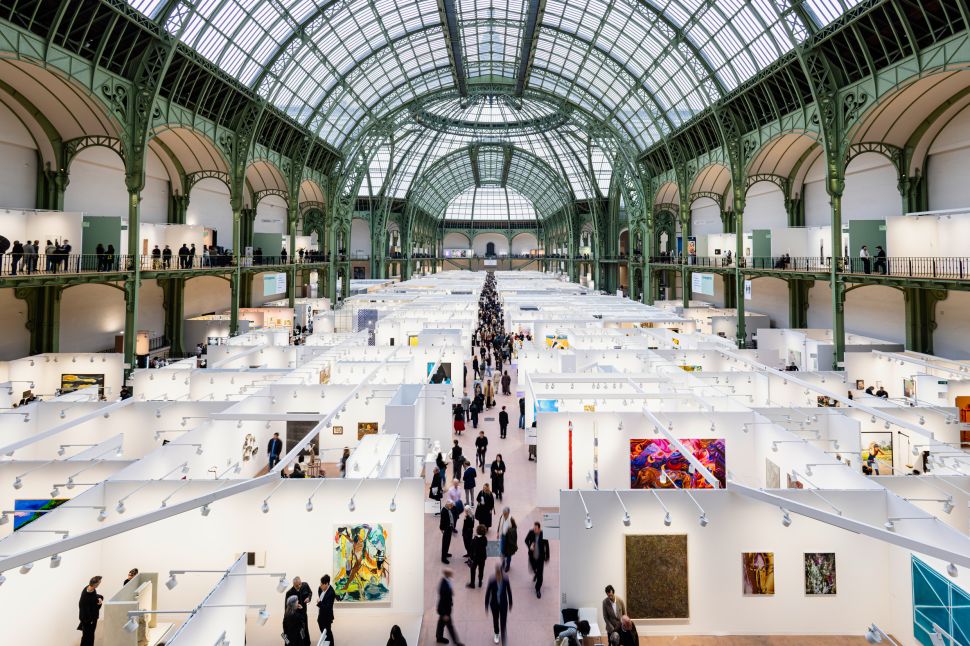
Art Basel Paris 2026 opened its hyper-exclusive avant-première on October 20 before opening to VIPs a day later.”>Art Basel Paris 2026 opened its hyper-exclusive avant-première on October 20 before opening to VIPs a day later.”>
The show must go on, as they say, though the event around which Paris Art Week arguably orbits will run only half as long this year. Art Basel Paris announced today (Oct. 22) that it will conclude its 2026 edition at 7 p.m. on Friday, Oct. 23, in response to protests planned in the French capital for Saturday. Amid the week’s ongoing disruptions, including demonstrations that blocked access to the Louvre and forced it to close on Monday, the fair opened to select guests on Tuesday, Oct. 20, for a hyper-exclusive avant-première, followed by the full VIP opening on Wednesday, Oct. 21. On Sunday, fair reps had reassured collectors and art enthusiasts that it would have “extensive protocols in place” for the Paris show and was working “closely with a private security company and, where necessary, the Paris Police Prefecture to always ensure a safe environment.” As to why the early closure is happening when the preview days passed without incident, an appel à rassemblement (call to assemble) is circulating on social media, now very widely shared, suggesting Saturday may hold more riots. No word has yet been given on whether exhibitors will receive a partial refund.
International collectors, Americans in particular, didn’t let the unrest stop them and came ready to buy. “Art Basel Paris is now undeniably the favorite fair of the year for American collectors, and the protests and looting didn’t keep them away,” art advisor Adam Green told Observer. “Americans love Paris, and it’s an easy fair to convince your spouse to join you for, given the incredible restaurants, shopping and everything else the city has to offer.”
The short avant-première slot, from 3 to 7 p.m., left little time for thorough looking, and many collectors treated it as a first look before returning the following day. Still, the megagalleries were reporting sales by Tuesday evening, and the consensus was that collectors were making decisions faster in Paris than they had at Frieze London.
“This opening afternoon has been very strong, and collectors came ready to make decisions quickly,” said Thaddaeus Ropac. Though concerns about the demonstrations had kept some collectors from traveling, he called it the most international fair of the year. The gallery reported 15 early sales, including four works by Picasso dating from 1906 to 1938 for undisclosed prices, a 1953 mixed-media work by Lucio Fontana for €1.8 million and a 2019 work by Georg Baselitz for €800,000.
“Great edition, serious artists, safe bets,” French art advisor Sascha Zerbib (also behind Austin’s new Ostillo foundation) told Observer at the Wednesday preview, adding that clients now favor long, deep conversations over quick decisions, even though many works were presold. “Safe statements, but great energy. Clients want to be reassured and want to know what they step into. So they are willing to increase their budgets but want pedigree and already established works, preferably with a great history.” The day before, he placed historical works by Sugimoto, Baselitz and Marlene Dumas, along with a group of works by Emma Reyes.
Hauser & Wirth reported activity at the top end, selling Gerhard Richter’s Rokokotisch (Rococo Table) (1965) for around $10 million during the avant-première, alongside Georg Baselitz’s Der Hirte (The Shepherd) (1965) for $10 million and George Condo’s Woman with Designer Shirt (2026) for $2.9 million. Additional sales included a 1961 Concetto spaziale by Lucio Fontana for €1.7 million ($1.9 million), a Philip Guston for $1.5 million and Alexander Calder’s Four Dots and Brass Tail (ca. 1953) for just under $1 million, timed to the gallery’s major Calder exhibition at its Matignon space. Other avant-première placements included works by Henry Taylor for $1 million, Cristina Iglesias for €500,000, Jenny Holzer and William Kentridge for $400,000 each, Lee Bul for $290,000, Roni Horn for $200,000 and George Rouy for £195,000. Five editions by Camille Henrot also sold—three at €130,000 each and two at €160,000 each—alongside works by Noah Davis and Yoshitomo Nara for undisclosed prices.
Richter’s market showed its strength across October’s fairs and auctions. David Zwirner reported several sales of the German artist’s work over the two previews, including a painting for $8.5 million, an overpainted photograph for $110,000 and editions priced between $75,000 and $350,000 each. Other sales included four paintings by Robert Ryman for $4 million, $1.25 million, $850,000 and $650,000; a 1957 Joan Mitchell painting for $3.8 million; a new Marlene Dumas painting for $3 million; and four Josef Albers paintings for $3 million, $900,000, $880,000 and $600,000. Paintings by Luc Tuymans and On Kawara sold for $2.4 million and $2 million, respectively, and a Ruth Asawa sculpture went for $1.2 million. Two Elizabeth Peyton paintings sold for $900,000 and $850,000, alongside a Yu Nishimura painting for $500,000 and a Bridget Riley painting for £450,000.
Gagosian staged a dialogue between contemporary art and the enduring lessons of Marcel Duchamp’s pioneering conceptual investigations, following the gallery’s recent museum-quality Duchamp exhibition at its historic Madison Avenue location. The booth’s highlight was Duchamp’s Fountain (1964, after the lost 1917 original), a porcelain urinal numbered 4/8 from the edition produced with Arturo Schwarz, which also includes two artist’s proofs and two hors commerce copies.
This time, however, it was the new secondary-market venture Pace Di Donna Schrader that brought one of the fair’s most expensive offerings: Amedeo Modigliani’s seductive, exceptionally rare reclining nude Nu étendu (Lolotte) (1917), with an asking price above $100 million. “Paris is deeply connected to the artists who transformed modern art, making it a perfect setting for our presentation. Bringing Modigliani’s Nu étendu (Lolotte), held in the same private collection since 1920, to Art Basel Paris has been a highlight, and the excitement surrounding the work speaks to the power of rediscovering masterpieces with extraordinary histories,” Emmanuel Di Donna, co-founder of Pace Di Donna Schrader Galleries, told Observer.
White Cube’s museum-worthy presentation likewise staged a dialogue between contemporary art and the early avant-gardes around form, symbolism and expressive restraint. Among the highlights was Brancusi’s iconic Oiseau, timed to the opening of “Brancusi: The Artist and His Studio” at MoMA, which features rare sculptures, photographs, films, hand-carved furniture and tools on loan from the Centre Pompidou in Paris. Early sales across the two preview days included a Tracey Emin canvas hanging beside the Brancusi for £990,000 and two gestural Julie Mehretu canvases priced at $7.85 million each. The gallery also placed a gunpowder work on canvas by Cai Guo-Qiang for $700,000, sculptures by Antony Gormley priced between £250,000 and £500,000, a sculpture by Enrico David for £120,000 and another by Marguerite Humeau for £115,000. With a major Ibrahim Mahama exhibition opening at Fondation Cartier that week, White Cube sold two of his textile works, made with reclaimed tire ply and metal tags, for €100,000 each. Other reported sales included a Louise Giovanelli painting for £90,000, a Fernand Léger work on paper for €65,000 and an Emmi Whitehorse painting for $150,000. Interest was also strong in the grotesque, fantastical figures of Japanese artist Shigeo Otake, priced at $16,000. Otake joined the gallery’s roster earlier in October, capping a year that included presentations at White Cube Hong Kong and the Consortium Museum in Dijon. The gallery will bring more of his work to West Bund Art & Design in Shanghai in November, ahead of his first U.K. solo presentation at White Cube Mason’s Yard in spring 2028. Sales reported later in the day included the El Anatsui hanging in the booth, priced at $2 million, a painting on rice paper by Shao Fan and another Léger for €185,000.
Among the masterpieces on the more contemporary side, P·P·O·W presented Martin Wong’s four-meter-long La Iglesia de Dios (1986), the largest painting in his pivotal storefront series, which captures the vibrant life of the Latino community on the Lower East Side, where he lived. Offered in the main section for $1.2-1.5 million, the painting had not been publicly exhibited since 2017, when it appeared in Wong’s traveling retrospective, “Martin Wong: Human Instamatic,” which originated at the Bronx Museum of the Arts in 2015 before traveling to the Wexner Center for the Arts in 2016 and the Berkeley Art Museum in 2017. Wong first exhibited the painting in 1986 at Semaphore Gallery, the influential SoHo space founded by Barry Blinderman and A. James Shapiro.
Another significant historical work with a surprisingly accessible asking price was at Giò Marconi: Christo’s 28 Barrels Structure (1968), which has remained in the gallery’s collection since its 1973 exhibition and is priced at €650,000. The gallery also showed Valerio Adami’s graphic, Pop-inflected paintings. The Italian artist is gaining international recognition, with an exhibition on view at David Nolan in New York.
Pace Gallery reported sales across its postwar and contemporary offerings, led by a $5 million Jean Dubuffet sculpture and a meditative 1979 composition by Lee Ufan that sold for $2 million. Dubuffet’s Site avec 3 personnages (from Psycho-sites Series) (1981) also sold for $300,000, alongside a Richard Pousette-Dart painting for $650,000. Among the contemporary placements were Adam Pendleton’s Black Dada (B) (2026) for $275,000, Alicja Kwade’s Strange Attractor (2026) for €175,000 and Michal Rovner’s Following (2026) for $175,000. Pendleton’s first institutional exhibition in the Netherlands, “Some Kind of Wild Language,” opened at the Stedelijk Museum Amsterdam earlier this month.
The gallery also sold Robert Indiana’s sculpture ART (red) (1972-2000) for an undisclosed price; his work features in “The Bowery: Devil’s Mile” at the New Museum, and his ONE Through ZERO (The Ten Numbers) (1980-2003) remains on view at the Parrish Art Museum through January 2027. Two sculptures by Arlene Shechet, Black Beauty and Pulse (both 2025), sold for $150,000 each, coinciding with her solo show at Pace New York. Additional sales included Nigel Cooke’s I was the Ghost (2026) for $100,000, Pam Evelyn’s Côte d’Azur (2026) for $80,000 and two works on paper by Loie Hollowell, Inverse Red Mandorla and Teal Mandorla (both 2026), for $50,000 each. Hollowell’s paintings also feature in “Exquisite Corpse,” the group exhibition she curated at Pace Berlin, on view through November 8. Four works on paper by Asher Liftin sold for undisclosed prices, coinciding with his solo exhibition, “Recent Work,” at 125 Newbury in New York.
Olga de Amaral hangs alongside abstract paintings, a circular reflective work and sculptures on white plinths at Lisson Galleryâs Art Basel Paris 2026 booth.” width=”970″ height=”728″ data-caption=’Lisson at Art Basel Paris 2026. <span class=”lazyload media-credit”>Courtesy Lisson Gallery</span>’>
Lisson Gallery reported a successful run across its roster. Sales were led by an oil painting by Lee Ufan for $900,000; two stainless-steel and lacquer sculptures by Anish Kapoor for £750,000 and £700,000; and an early oil painting by Carmen Herrera for $650,000. Three works by Olga de Amaral—in wool and horsehair; linen, gesso, acrylic and gold leaf; and Japanese paper, linen, gesso, acrylic and gold leaf—also sold for undisclosed prices. The placements extended the Colombian artist’s market momentum following her 2024-25 Fondation Cartier retrospective, with her auction results climbing from $1.17 million at Phillips in May 2025 to a record $3.125 million for Pueblo H at Christie’s that November.
The gallery also placed three works by Hiroshi Sugimoto: two gelatin-silver prints for $400,000 each and a Type-C print for $250,000. The sales followed a year of strong institutional exposure, with solo exhibitions at the National Museum of Modern Art in Tokyo, the Singapore Art Museum and the Musée Soulages in Rodez, France, while “Unnatural Habitat” at Lisson New York runs through Oct. 24. Other sales included an oil painting on hemp cloth by Ha Chong-Hyun for $250,000, an acrylic painting by Yu Hong for $220,000, a tempera and oil painting on jute by Leiko Ikemura for €140,000 and a red onyx sculpture by Pedro Reyes for $120,000.
Lelong also reported early sales, placing Etel Adnan’s Untitled (2020) for €170,000, Pierre Alechinsky’s ink-and-acrylic New Delhi surplombée (1981) for €150,000 and Juan Uslé’s acrylic painting Horizonte y memoria (2026) for €90,000-100,000. Further placements included Arlene Shechet’s ceramic-and-metal sculpture Together (2026) for €75,000 and Kiki Smith’s pencil-and-watercolor work Blue witness (2024) for €25,000.
Bearing out what Art Basel Paris’s new director, Karim Crippa, told Observer ahead of the opening, the fair felt more deliberately anchored in the French and Parisian scene, with French galleries well represented across the sections and reporting solid early results from collectors eager to support them.
Among the Parisian galleries downstairs, Ceysson & Bénétière placed Bernard Pagès’s metal-and-gravel sculpture Le tas de graviers (1969) for €250,000, Frank Stella’s mixed-media print Moby Dick (1989) for €220,000 and three works on paper by Peter Halley priced between €30,000 and €50,000. Art: Concept sold Nina Childress’s Catherine D. (grosse tête) (2026) and Miryam Haddad’s Ishtar (2026), both oil paintings in the €40,000-70,000 range, while Jousse Entreprise placed Madeleine Roger-Lacan’s oil-on-wood work Bain de minuit / Crépuscule du désir (2025).
Parisian powerhouse Mennour reported higher-value placements, led by Lucio Fontana’s mixed-media Concetto spaziale (1964) for €1.75 million and Lee Ufan’s acrylic painting Response (2026) for $1.05 million. Two sculptures from Ugo Rondinone’s The Angelic (2024), made in bluestone, stainless steel and concrete, also sold for $850,000 each.
Upstairs, the main section continued, shifting toward younger but established artists and the middle market, with Parisian galleries making a strong showing. Despite the ultracontemporary downturn, some artists retained enough momentum to sell out during the preview, among them rising South Korean painter Moka Lee, whose solo presentation at Carlos/Ishikawa, with paintings priced from $18,000 to $85,000 all finding buyers.
Parisian gallery Sultana reported a remarkable opening, selling nearly 80 percent of its presentation within the avant-première’s four hours, with works priced between €1,500 and €25,000. Jean Claracq’s works sold out, and pieces by Benoît Piéron, Bettina Samson, P. Staff and Osama Al Rayyan also found buyers.
“Despite concerns about protests and France’s political climate, the atmosphere was remarkably positive, with strong sales and packed aisles on First Choice VIP day,” the gallery’s director, Kate Park, told Observer. “Local French collectors were strongly engaged, joined by significant international interest, particularly from South Korean and Chinese collectors.”
Leading the booth was a new work by Philipp Timischl that integrates a 90-minute film of the Louvre with traditional painting, while a mound of hospital-sourced fabric by Piéron occupied its center—a smaller iteration of his presentation at Art Basel. The gallery reported sales to existing clients during the avant-première.
Another now-established Parisian gallery, Crèvecœur, placed several paintings by Cristof Yvoré, priced between €38,000 and €100,000 depending on size. Yvoré, who died in 2013 at just 47, left a limited body of work, developed through a slow process of painting and repainting. His thickly worked surfaces give psychological weight to otherwise unassuming subjects, turning the accumulation of paint into something closer to an accumulation of feeling. The gallery also sold a large painting by Yu Nishimura for €250,000 on the first day.
Along the Seine-facing side, Mexico City’s LABOR paired Jerónimo Elespe’s densely textured paintings, whose surfaces flicker and glitch, with sculptures by Yuri Pattison. The pairing extended the attention to surface and perception running through several upstairs booths, moving between the physical density of paint and a reflection on the instability of the images and visual experiences we encounter today.
Nearby was the strong shared presentation by Berlin’s ChertLüdde and Amsterdam’s Ellen de Bruijne Projects. Charged with feminist irreverence, it brought together three generations of artists who challenge prescribed ideas of femininity, domesticity and “women’s work.” Pauline Curnier Jardin, Clemen Parrocchetti and Lily van der Stokker mobilized domestic, decorative and everyday imagery to counter patriarchal conventions through humor, material experimentation and rebellion.
Anchoring the booth was a mesmerizing new installation of soft sculptures by Curnier Jardin, following her recent solo exhibition at the Palais de Tokyo. Alongside it hung oil paintings made in collaboration with Feel Good Cooperative that took an irreverent swipe at the posturing of masculine power. “Modern painting by men no longer exists,” read one of the sweetly cartoonish signs. Another declared: “Reducing Testosterone: fewer dictators, fewer wars, fewer children, more air.” Across their distinct visual languages, the three artists turned forms historically dismissed as feminine or decorative into vehicles for assertion and critique, giving the presentation a singular force, as playful as it was confrontational.
Always worth a stop for something to rediscover—or confirmation of an earlier intuition—is Andrew Edlin, finally promoted to the fair’s main section with a group presentation drawn from the Paris-based Bruno Decharme Family Collection. Decharme, founder of Collection abcd, recently donated more than 900 works to the Centre Pompidou, a gift that anchored the “Art Brut” exhibition at the Grand Palais in summer 2025. The booth featured works by Henry Darger, Martín Ramírez, Edmund Monsiel and Madge Gill, who will be the subject of a solo exhibition at MASP in São Paulo in March 2027. It also included two paintings by Abraham Lincoln Walker (1921-1993), an enigmatic self-taught artist who exhibited only sparingly during his lifetime. Edlin, who reintroduced Walker’s work to a wider audience in 2024, sold a few pieces during the preview, and a Walker also hung in David Kordansky’s booth this year.
“The fair is going great. We’re meeting genuine aficionados as well as serious curators,” Edlin told Observer, reporting the sale of a major Walker painting and numerous other works. “The energy in the booth has been frenetic at times, and I’m confident more deals will be closed in the coming days.”
Highlights from the Emergence section
Along the upper balconies, Emergence offered a counterpoint to the blue-chip ground floor, spotlighting practices that approach the body, nature and everyday objects as unstable systems of signs.
At Bank, Zhang Yibei’s sculptural landscape occupied a strange threshold between the organic and the inorganic, its hybrid forms moving between allegory and ominous hallucination. Individual sculptures functioned as synecdoches—parts standing for a larger whole—within a psychological terrain. Combining sandstone with carnivorous plant forms in bronze and glass, they suggested an entire ecosystem animated by bodily impulses, where vulnerability and aggression take physical shape. With works priced between $4,000 and $40,000, the gallery placed two smaller sculptures during Tuesday’s preview and three more by Wednesday evening.
Nearby, Seoul’s experimental P21 focused on Haneyl Choi, who approaches the body through a colder sculptural vocabulary that implies the absorption of humans into a purely industrial environment. His fragmented forms expose the friction among bodily impulses, conscious intentions, social norms and desire, suggesting a self held together only provisionally. Through materials and mechanical movements that sag, leak or repeat, Choi makes tangible the moments when our presumed control over our bodies and feelings begins to falter. Ahead of his solo show opening next month at Art Sonje, the gallery sold a fountain piece during the avant-première, with prices ranging from €12,000 to €21,000.
Also in Emergence, Brussels-based Kin presented Angharad Williams’ trout paintings, which prompt reflection on the symbols and visual conventions through which we read and codify nature. Repeated across the painted surface, the fish become both recognizable subjects and elements of a pictorial language, extending a narrative from her 2023 novella Eraser into an examination of desire, identification and consumption. The presentation followed solo exhibitions at Fondazione Sandretto Re Rebaudengo in Turin and Fanta-MLN in Milan, and her show “Pale Blue Dot” is on view at Reena Spaulings Fine Art in New York through Oct. 24. The gallery reported early sales, with all works priced at €20,000.
Rome’s Ermes Ermes featured Beatrice Bonino’s elusively poetic assemblages, which evoke the body and its emotional, sometimes intimate encounters with the material environment. Urban relics and discarded objects become fragments through which to consider how we inhabit our surroundings and construct a sense of self. Recalling aspects of the work of Carol Rama and Marisa Merz, as well as a lineage of poetic, diaristic practices in France that finds another expression in Sophie Calle, these compositions carry an erotic tension that extends beyond sexuality to the ways we invest our surroundings with desire and meaning. Priced between €5,000 and €7,000, the works unsettle the familiar codes through which objects acquire significance, hovering between bodily suggestion and abstraction.
Among the Parisian galleries worth catching in the section was exo exo, which has grown steadily in recent years and was making its third Art Basel presentation. This time, it showed three sprawling canvases by Cameroon-born, Geneva-based artist Yann Stéphane Bisso. Suspended between landscape and dreamscape, the paintings draw the eye into a movement that continues beyond their edges, as though the canvases could be unrolled past the structures from which they hang. All works were priced at around €20,000.
Lo Brutto Stahl, another Parisian point of reference for emerging artists, presented Clémentine Adou’s absurdist sculptural humor: umbrellas and clown noses suggest puppets without puppeteers, or remnants of a performance whose actors have disappeared. Priced between €6,000 and €8,000, the works balance comic recognition with an unsettling sense of absence. Moving among Surrealism, satire and parody, their succession of peculiar encounters felt distinctly French, if not specifically Parisian.
A different reconnection with nature’s rhythms emerged at the booth of Jakarta’s ROH, one of the galleries steadily raising the international profile of Southeast Asia’s art scene. Returning to Emergence, the gallery spotlighted Thảo Nguyên Phan, whose visionary work bridges the earthly and the celestial. Her sensitivity to materials and their transformations meets an equally fluid exchange between symbolic traditions, expressed in the delicate, almost whispered imagery of her silk paintings. These surfaces act as filters between the terrestrial world and other realms, allowing Paul Klee’s angels to encounter local deities. The gallery sold the most ambitious expression of this alchemical vocabulary, a work laid out on the floor, along with several smaller paintings on the wall.
Highlights from the Premise section
Some of the fair’s most compelling encounters took place in Premise. Though the section remains somewhat peripheral and has yet to acquire the scale or cohesion of Frieze Masters, its potential as a counterpart is becoming clear. Its strength lies in recovering artists and bodies of work woven into Paris’s artistic fabric, often through figures who arrived from abroad. Rather than simply adding another overlooked name to the market, it illuminates the international exchanges that made the city an art capital.
Brazilian powerhouse Almeida & Dale, for instance, presented works by Tarsila do Amaral, opening a broader perspective on modernism through an artist whose exchanges with Paris helped shape a distinctly Brazilian pictorial language. Her studies with André Lhote, Albert Gleizes and Fernand Léger and her friendship with Blaise Cendrars emerge as part of a reciprocal circulation of ideas and influences, which she translated into a warm tropical palette.
The presentation also marks the centenary of Tarsila’s first solo exhibition in the city, at Galerie Percier in 1926, and follows a series of major institutional exhibitions in Europe that have brought renewed attention to her work. For what was—somewhat surprisingly—its first participation in Art Basel Paris, the gallery assembled a select group of important paintings that have rarely been exhibited and are even more rarely available for acquisition. “The response during the preview has been incredibly encouraging, with strong interest from both collectors and institutions, reflecting the growing international recognition of Tarsila’s significance in the history of 20th-century art,” Carlos Dale, partner director at Almeida & Dale, told Observer.
Also from São Paulo, Galeria Raquel Arnaud revisited Arthur Luiz Piza’s formative years through works made between 1946 and 1956, many of which had never been exhibited in France. Spanning his move to Paris in 1951 and his experiments in Johnny Friedlaender’s printmaking studio, the presentation traced a passage from a dreamlike Surrealism populated by biomorphic forms—evoking the cosmos and its ceaseless movement of energies—toward the more psychologically visceral expressionism that would inform his later work. Works on paper were relatively accessible, priced between €7,000 and €16,000, while canvases ranged from €26,000 to €36,000, with two on hold for the Metropolitan Museum of Art that morning, according to the gallery. By evening, it had sold several works on paper, and both held canvases had been acquired by a Met patron who plans to show them at a nonprofit space in New York later this year. The gallery also reported inquiries from major museums in Switzerland and the U.S.
Nearby, Galerie Zlotowski offered another revealing return to an artist’s beginnings, presenting works by Hungarian avant-garde artist Vera Molnár from 1947 to 1956. These early experiments shifted attention from her celebrated, pioneering role in computer art to the pictorial thinking that preceded it, revealing the foundations of an algorithmic sensibility before the computer entered her practice. Her spare geometric abstractions suggest an entire framework of thought, extending from positivism through modernism toward the systems of ordering and perception that shape our present.
One highlight of the section was Olney Gleason’s presentation, which cast a personal spotlight on the relationship between Ellsworth Kelly and Robert Indiana. Focused on their years at Coenties Slip, the booth traced the two artists’ creative and romantic bond through works that make their mutual influence so tangible that one could easily be mistaken for the other. Among the most affecting were Kelly’s intimate portraits of Indiana, priced between $65,000 and $210,000, several of which sold within the opening hours. Indiana’s paintings and works on paper, meanwhile, revealed affinities with Kelly in their flat, often two-color abstractions. The works on paper, priced at $100,000, had all sold early on VIP day, and a painting sold later for $375,000.
“People are starting to feel this is our specialty,” Gleason joked to Observer, noting the coincidence between the booth’s exploration of an artistic couple and the Metropolitan Museum of Art’s “Krasner and Pollock: Past Continuous.” On Monday’s opening night, the gallery’s Lee Krasner exhibition with Gagosian drew more than 2,000 visitors.
In the end, these conversations, particularly those around overlooked stories tied to Paris, are what make attending a fair like Art Basel Paris worthwhile. Beginning and ending our visit in Premise served as a reminder of what this section, and Art Basel more broadly, can offer: a way to read art history, from the very place where much of it was written, as a history of exchanges, one that complicates inherited accounts of European or Western dominance. The Grand Palais, built for the 1900 Exposition Universelle, is a fitting setting for such reflections, carrying the legacy of international exchanges that were profoundly unequal even as they brought different worlds into contact. With sustained curatorial direction, future editions of the fair could go even further, tracing how those modernisms evolved into contemporary languages and how migration, encounters and the circulation of ideas shaped the art we see today.