
For nearly two decades, Ali Banisadr has built a body of work that feels at once ancient and contemporary, abstract and narrative, personal and collective. His canvases teem with movement: architectural fragments emerge and dissolve, figures materialize and vanish, and swarms of color form scenes that feel both familiar and elusive. To stand before one is not just to look, but to move through it—visually, mentally and over time.
Born in Tehran during the Iran-Iraq War, Banisadr (whose work can be found in the collections of the Met in New York, LA MOCA, the Centre Pompidou, the British Museum and other major institutions) has often spoken about early experiences of conflict and displacement and how those memories reverberate through his work. Yet his paintings never function as direct autobiography. Instead, they transform personal recollection into something more elusive.
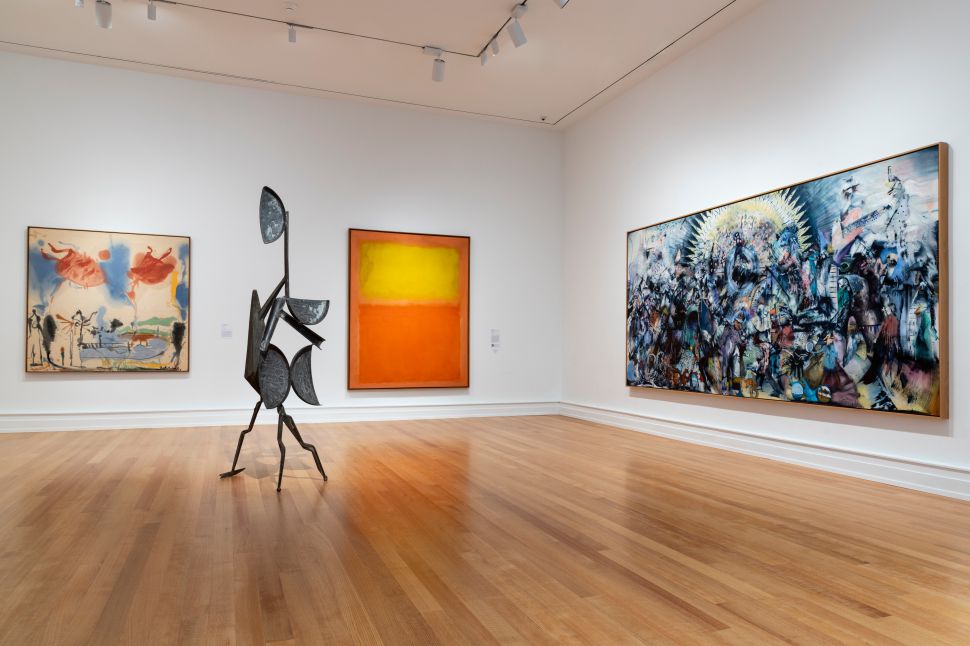
Some exhibitions present paintings; others construct a world around them. “Ali Banisadr: Temple of the Mind” does the latter at the Buffalo AKG Art Museum in the artist’s most expansive museum presentation to date. It brings together works that show how memory and history converge within his distinctly personal visual language, and the result is a show that feels less like a conventional gallery experience and more like stepping into a cohesive visual environment that links Banisadr’s studio practice to the museum’s own holdings. The exhibition places his recent paintings, sculptures and prints in dialogue with notable works of modern and contemporary art, marking the institution’s first artist-led intervention in its permanent-collection galleries.
In many ways, “Temple of the Mind” is more than an exhibition; it’s a direct encounter with an artist whose visual language resists easy resolution and gives that language the institutional scale it has long demanded. Observer sat down with Banisadr to discuss how this new show fits into his larger practice and what it reveals about the architecture of his imagination.
You’ve had major exhibitions around the world, but this show is being described as your most ambitious museum presentation yet. When you walk through “Temple of the Mind” yourself, what feels different about it?
Buffalo AKG has one of the great museum collections in the world, so being able to place my work among artists who shaped my thinking is an extraordinary experience. The museum gave me an unusual degree of freedom to create conversations throughout the Wilmers Building—the Neoclassical original building completed in 1905—allowing my paintings to inhabit spaces alongside works that inspired me for years.
In the Hemicycle gallery, originally the museum’s auditorium and now a small semicircular space, the atmosphere becomes even more intimate, almost like entering another state of mind. That quieter atmosphere allowed us to bring together paintings with remarkable works from the museum’s collection—some rarely or never shown. That exchange between past and present became among the most rewarding aspects of the exhibition.
“Ali Banisadr: Temple of the Mind“
Artist: Ali Banisadr
Venue: Buffalo AKG Art Museum
Address: 1285 Elmwood Ave, Buffalo, NY
Through: November 8, 2026
Does seeing this much of your work gathered in one place change the way you think about your own trajectory?
Absolutely. They don’t feel imposed on the collection—they feel as though they had always been waiting to have these conversations. It also reminded me that many of the questions I’ve asked over the years have remained remarkably consistent, even as the visual language has evolved.
Your work is often discussed through the lens of memory. When you’re painting, do you feel you’re returning to specific experiences, or are you building entirely new spaces out of fragments of remembered ones?
Memory is not a fixed archive—it is a living landscape. It contains countless portals that connect different places and moments, allowing them to merge into entirely new spaces. I’m always fascinated by how dreams and memory operate. They weave together personal experience with mythology, history and imagination until they’re inseparable.
You’ve spoken about experiencing war as a child. As the work has evolved, has your relationship to those memories shifted?
Memory evolves as we evolve. New experiences continually reshape older ones, so the images themselves are never fixed. I’m interested in capturing the state where images, symbols and memories are shifting, dissolving and transforming. That transitional space—before anything fully becomes itself—is where much of my work exists.
What role do your broader influences—art history, ancient civilizations, literature—play in how a painting begins to take shape?
My influences stretch across thousands of years because I’m interested in how images migrate across civilizations. Ancient Near Eastern art is foundational for me, as are Bosch, Bruegel, Uccello, Velázquez, Goya, Tintoretto, William Blake, Max Ernst, De Kooning and Picasso’s Guernica. Rather than borrowing imagery, I’m interested in how visual ideas survive, transform and reappear. Images have lives of their own.
The exhibition includes materials from your studio—notes, images, objects. What do those materials reveal about your process that the finished paintings alone cannot?
My studio practice extends beyond painting. Writing and research are essential to the work. Visitors can see pages from my notebooks, organized around four themes: the Personal, Art Historical, Current Events and the Cosmological. Together they map how I try to understand the world and my place within it. The vitrines also include books that shaped my thinking, early works, clay sculptures and selected works from the Buffalo AKG collection.
My process begins by spending time with the blank canvas. I look at it until I sense what it wants to become. Next, I establish the mood by finding its key note—a dominant color organizing everything else. Sound is equally important; I experience synesthesia. I hear paintings like orchestral compositions. Passages behave like instruments or voices coming into harmony. The images arrive much later. When I begin, I don’t know what the painting will become.
The exhibition is titled “Temple of the Mind.” Where does that phrase come from, and what does it mean to you?
A museum itself can be understood as a temple of the mind—where centuries of thought, imagination and memory coexist. It also comes directly from Albert Pinkham Ryder’s remarkable painting in the Buffalo AKG collection, called Temple of the Mind. Encountering that work made a profound impression on me. Like many of my titles, this one gathers several ideas at once. It speaks about the museum, consciousness, contemplation and the structure of thought.
Contemporary culture is increasingly dominated by speed, screens and instant images. What can painting still do that other forms of visual culture cannot?
Painting asks something few things ask us today: sustained attention. It slows us down. It creates space for contemplation rather than consumption. Unlike the endless stream of digital images, a painting asks us to stay with uncertainty. It invites participation rather than simply [having viewers] receive.
Do you think painting’s slowness—the time it asks of viewers—is part of what keeps you working in this medium?
Absolutely. Painting has a unique presence. It carries time within it—its accumulated decisions, revisions and gestures. I believe it has transformative and healing qualities. There are very few experiences today that ask us to be fully present the same way. That’s why painting remains endlessly compelling to me.