
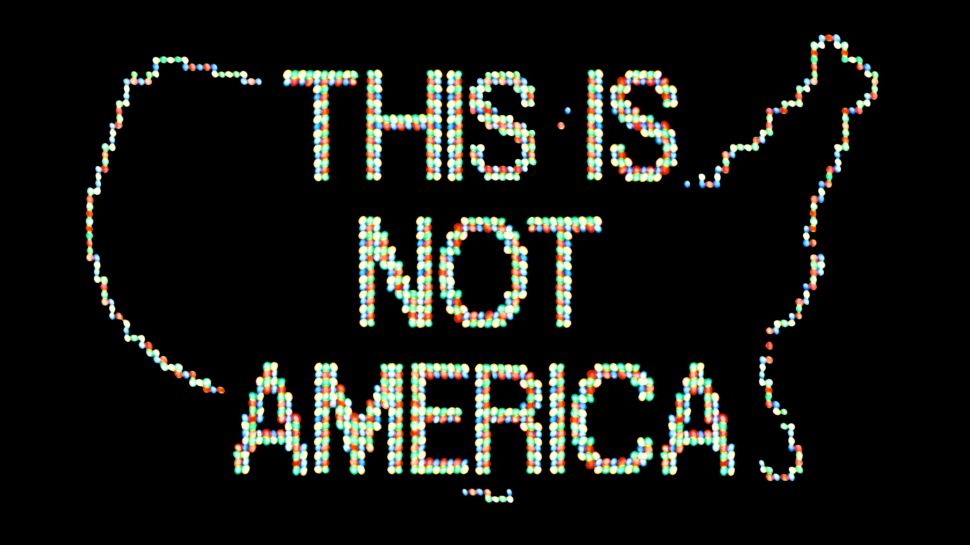
It was a very different America and a very different world when Alfredo Jaar first showed his iconic A Logo for America. It was 1987. Jaar had moved to New York just five years earlier and, as part of the Public Art Fund’s Messages to the Public series, was invited to present this powerful statement on the Spectacolor electronic billboard in Times Square, where it ran from April 19 to May 2. The work hinged on a deceptively simple yet revealing linguistic correction that would become a historic statement: the United States is not synonymous with America.
The sequence was precise. It opened with a map of the United States overlaid with the phrase “This Is Not America.” The U.S. flag then appeared with “This Is Not America’s Flag.” Finally, the word “AMERICA” expanded across the screen, its “R” transformed into the landmass of North, Central and South America.
The animation lasted only about 38 seconds and was deliberately inserted among commercials—the pervasive visual language of mass communication through which the United States built its glamorized global mythology as a land of freedom, possibility and affluence. Since then, the mythology of the “American Dream” has steadily faded, giving way to a broader reckoning with the neocolonial dynamics behind American military interventions—from Asia in the postwar period to South America and, later, the Middle East—often justified through the rhetoric of a “peace mission.” The social and environmental costs of the extractive, capital- and tech-driven model of progress that the country has promoted as the path to global development have also become increasingly visible.
In September, Jaar opened an exhibition at Galerie Lelong New York that presented that iconic work alongside others from the series and their translations into different media. The show arrived more than a year into the second Trump administration, amid its consequences within and beyond the country. When we spoke after the opening, Jaar acknowledged that the work did not begin as the overtly anti-imperialist statement it is often read as today. He described its origin as essentially a “semiotic exercise.”
“I had just arrived in New York from Chile, and for me, as a Chilean and South American, I was American. Soy un americano. I am an American. And this is nothing spectacular, new, strange or weird. Argentinians feel the same way, Brazilians feel the same way. Somos todos americanos,” Jaar told Observer. “That was something that bothered me in the daily use—the erroneous, wrong, mistaken use of that word in everyday language at the time. That’s how the work was born.”
The political charge accumulated with history and the unfolding of American politics. “It started to have a life of its own, and it acquired different meanings according to different people, different moments and different locations,” according to Jaar. He remains fascinated by how differently the work is read in the United States, Europe and Latin America. He addressed this again in The Power of Words (1984/2021), presented at Art Basel Unlimited in June.
Jaar created A Logo for America in the late Reagan era, a period of surface confidence already shadowed by a major crisis over U.S. intervention abroad. Ronald Reagan’s administration had made containing communism in Latin America a foreign-policy priority, with particular focus on Nicaragua, El Salvador and Cuba. The U.S. backed the Contra forces fighting Nicaragua’s Sandinista government, while Congress repeatedly clashed with the administration over how far that support should go. By the time Jaar’s work appeared in April 1987, the Iran-Contra scandal was dominating Washington, revealing that administration officials had used proceeds from secret arms sales to Iran to fund the Nicaraguan Contras despite congressional restrictions. Reagan addressed the nation on the controversy in March 1987, just weeks before A Logo for America lit up Times Square.
Donald Trump facing a young girl, with altered âWelcome to Americaâ text.” width=”970″ height=”647″ data-caption=’Alfredo Jaar, <em>Welcome to the USA (TIME)</em>, 2018. <span class=”lazyload media-credit”>© Alfredo Jaar Courtesy Galerie Lelong, New York, and the artist, Lisbon</span>’>
When Galerie Lelong invited him to do the show, Jaar could not help but address how history was repeating itself. Since the start of the Trump administration, he had watched similar dynamics unfold through the invasion of Venezuela, new threats toward Mexico and Cuba and a new war in Iran.
Born in Chile and coming of age under the military dictatorship of Augusto Pinochet, Jaar never had the luxury of ignoring politics, and critical commentary on narratives of power and new ideologies of progress became central to his work. He grew up keenly aware of the role the Nixon administration, Henry Kissinger and the CIA played in the region.
Historical amnesia, he argued, is part of what led to the current situation. Now, however, the mythology has been stripped away, making plain what the country’s role has been—and continues to be—in recent global history. “Now, thanks to Trump, everything is transparent. Everything is quite evident. There is no more hiding,” he said without hesitation. “His government and spokespeople are following his language. Everything is clear, and they are treating Latin America again as a backyard, with no respect whatsoever for sovereignty.”
For Jaar, bringing A Logo for America back into public view opens what he called “a little crack in the system”—a reminder that the present is not normal and that another order is imaginable. Art may not change the world, Jaar believes, but it can offer a different perspective on it, beyond dominant narratives. “That’s what this work does. It makes a correction that I think is necessary. But from that to changing the world is really a huge step,” he admits.
Meanwhile, more voices in the Latino community in the United States have been rising in that direction, particularly as ICE raids intensify, from Bad Bunny speaking out on major national stages to “This Is Not America,” the 2022 song by Puerto Rican rapper Residente and French-Cuban duo Ibeyi, which directly echoes Jaar’s message.
“It was marvelous, and such an honor, that my work served as a kind of starting point for these songs,” Jaar commented when we pointed out those references. Invoking Antonio Gramsci, he holds that art and culture can contribute to change, though slowly rather than spectacularly. “You can see how art and culture can penetrate the world at large and sometimes.”
Jaar also observed that younger generations are more socially and politically aware, more willing to speak out and, in his view, reshaping public discourse. “The new generation is spectacularly non-silent. Before, it was incredibly silent, and now they are awake. They are aware,” Jaar said. Still, he stops short of calling himself hopeful. “We have these hopeful signs within this machine that is surging and trying to stop this progressive wave. We see censorship emerging. We see oligarchs acquiring social media platforms and traditional mainstream media because they see that the narrative is changing.”
Asked how artists can respond when language, information and even access to truth are heavily manipulated by algorithms, Jaar described the political climate in stark terms. “It’s absolutely spectacular to observe the narrative changing in front of our eyes. I never expected to see this in my lifetime. But instead of arguing against this narrative and presenting a better argument, what do they do? They say, ‘We’re going to silence these voices,’ buying these platforms and changing the algorithm,” he said, adding that what is happening is pure fascism.
He admitted he does not know how this will unfold or what the remedy might be. Yet that uncertainty, and the constant questioning it prompts, is central to his understanding of what it means to be an artist. “As an artist, I’ve never been afraid to say, ‘I don’t know.’ I’m searching,” he reflected. “I’m searching for ways to respond.” He cited Nigerian writer Chinua Achebe’s idea that art is an attempt to change the order of reality given to us. It remains one of Jaar’s favorite definitions of art because it poses the question that drives his practice: how can an artist alter, even slightly, the reality they inherit?
Each of his projects is an attempt to answer that question, made from a position of uncertainty: “Every project I do, every work I make, I am thinking: How do I change the order of reality that’s given to me? So I am in this fog, trying to understand and act accordingly. But it is difficult.”
Jaar stresses that he is a “project artist,” not a studio artist. “All my work has always been a reaction to the real world,” he considered. “I’m an architect who makes art, and as an architect, I respond to context. So all my work is a response to a given political context. I’ve done that for decades.”
His widely discussed The End of the World, presented at this year’s Venice Biennale, shows how Jaar opens questions around the complex conditions of our time. Here, he turns his attention directly to the ecological crisis. “I had responded to many political crises and tragedies around the world, but I had never focused on the planet itself,” he said. “I was naive to believe that this was not as political as the rest of it. It was very political.”
In an immense, cathedral-like room flooded with red light, visitors breathe in a sense of danger that hangs in the air, an almost purely psychological atmosphere, as they move toward a totemic black cube at the center. It is a potent metaphor made physical, addressing the entangled workings of geopolitical violence, economic interests, ecology and the material infrastructure of contemporary technology.
The installation grew out of years of research with political geologist Adam Bobbette, whom Jaar asked to identify the minerals essential to contemporary technological life and to explain where they come from, what they enable and how they intersect with political conflict. The research revealed how deeply the same materials that sustain digital life and the green transition are embedded in warfare and international tensions. “I commissioned him to write these 10 essays. What I discovered blew my mind. I couldn’t believe the importance of these minerals: how they serve new technologies, how they serve the green movement and how they also serve war,” Jaar explained. “It unveiled this complex, largely hidden infrastructure connecting technological progress, ecological transition and geopolitical violence.”
The challenge then became formal: how could the enormous body of information they had produced be distilled into an artwork without losing its force? Jaar’s model was the haiku, “a very short poem—17 syllables—that can contain an explosion of meaning.” This led to a cube composed of 10 layers, each corresponding to a mineral. Jaar decided that the small object needed to sit within a much larger, nearly empty environment so that space and silence could lend it gravitas. Red became central to the installation because it holds contradictory meanings as “the color of blood, the color of life, the color of love, but it’s also the color of danger.”
Visitors entering the installation feel almost dizzy, exactly as Jaar intended: “It’s also about the instability of the world today. I wanted to suggest that we are in a very dangerous, very unstable situation.” The installation captures the psychological burden of information overload: an accumulation so intense that people become submerged in crisis and begin to normalize it, a reading Jaar endorses.
For Jaar, the aim of each work and exhibition has always been the same: to spark curiosity, encouraging viewers to read, research and become more aware of the systems—and, in this case, the minerals—that structure contemporary life. “I want to invite people to acknowledge that we are in a pivotal moment. It’s a radical moment. As Gramsci said, we are going through a moment where monsters are emerging all around us,” Jaar concludes.