
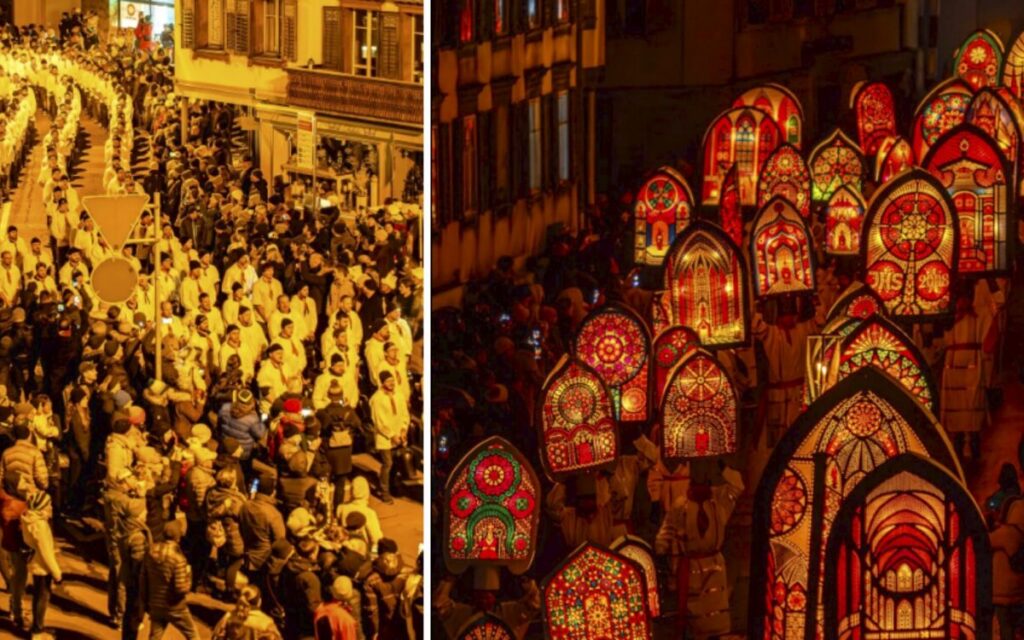
1,500 men bring giant illuminated hats, deafening bells and St Nicholas to the streets.
A Swiss village is preparing for one of Europe’s most extraordinary Christmas celebrations, when more than 1,500 men take part in a spectacular night-time procession featuring enormous illuminated hats, deafening cowbells and a rather unusual appearance by St Nicholas.
Küssnacht am Rigi, in the canton of Schwyz, will host its annual Klausjagen celebration on Friday, December 4, attracting up to 30,000 spectators. Unlike conventional Christmas parades, this centuries-old tradition combines elaborate craftsmanship, thunderous noise and an impressive display of lights, with the village’s street lighting switched off as the procession gets under way.
Most Read on Euro Weekly News
Giant illuminated hats lead the procession
More than 200 participants carry enormous structures known as Iffelen, shaped like the ceremonial hats worn by bishops. Some measure over 2.5 metres tall and feature intricate patterns cut into cardboard, with coloured translucent paper illuminated by candles inside. Their appearance creates the impression of enormous moving stained-glass windows as they pass through the darkened streets.
Before they arrive, performers known as Geisselklepfer crack long whips, producing explosive sounds that announce the procession. St Nicholas, known locally as Samichlaus, follows the illuminated figures, accompanied by torchbearers and his assistants, called Schmutzli.
Around 1,000 men known as Trychler then swing enormous cowbells in rhythm, producing a deafening sound. Approximately 200 horn players complete the procession with a distinctive musical call. More details about the traditional Klausjagen procession and its participants are available from the organisers.
A tradition that authorities once tried to ban
Klausjagen’s history is almost as unusual as the spectacle itself. The first documented complaint about the noisy celebrations dates back to 1732, when local authorities objected to young men disturbing residents with horns and bells. More attempts to prohibit the festivities followed in 1837 and 1888, while a local priest even preached against the practice in 1914.
However, supporters refused to abandon it. A society was established in 1928 to preserve the custom in an organised form, with the St Nicholas Society formally constituted in 1933. The history of the Swiss Christmas procession explains how the tradition was eventually organised.
Switzerland’s celebration joins other unusual European festive customs, including Austria’s famous Krampus tradition, which sees horned figures take to the streets in early December. Germany has its own unusual winter custom, as explained in this story about the controversial cow-horn tradition on the island of Borkum.
When does the Swiss procession take place?
This year’s main Klausjagen procession starts at 8.15pm on Friday, December 4, in Küssnacht am Rigi. A children’s procession takes place earlier that afternoon at 2.15pm.
Further information, including the official procession route and 2026 timetable, is available from the organisers. Switzerland Tourism’s guide to Klausjagen also provides background on the spectacle.