
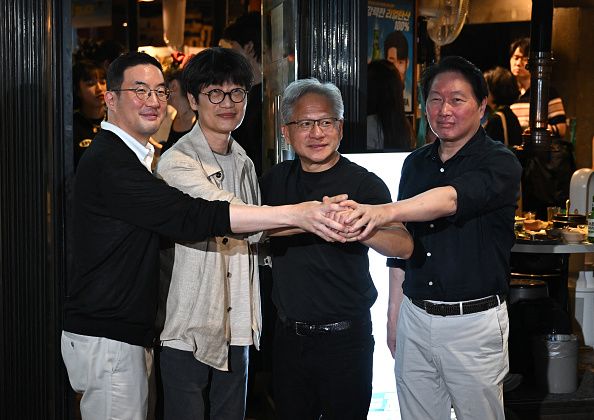
Koo Kwang-mo, Naverâs Lee Hae-jin, Nvidiaâs Jensen Huang and SK Groupâs Chey Tae-won pose in a row after dinner at a Korean barbecue restaurant in Seoul.” width=”594″ height=”420″ data-caption=’LG Group Chairman Koo Kwang-mo, far left, and Nvidia CEO Jensen Huang, second from right, pose after dinner in Seoul on June 5, 2026. LG has since tested its wheeled CLOiD robot on a washing machine line at its plant in Clarksville, Tenn. <span class=”lazyload media-credit”>Photo by Jung Yeon-je/AFP via Getty Images</span>’>
LG Group Chairman Koo Kwang-mo is putting his robotics partnership with Nvidia to work at a washing machine plant in Clarksville, Tenn. In August, he and Jensen Huang posed at Nvidia headquarters with a miniature humanoid they had both autographed. The LG robot, which has since completed an initial test on the factory floor, gets around on wheels. LG says the wheeled robot carried washer tops and lined up and loaded drain pumps during the trial.
As chairman of LG’s holding company, Koo can draw on LG Electronics, LG Innotek and LG Energy Solution for everything from a robot’s joints to its batteries. He also has a proving ground in Clarksville that has produced 10 million laundry appliances. On Nov. 19, LG Electronics announced that its smart-factory business will get a dedicated sales and marketing division on Dec. 1 to win orders from other manufacturers. LG could also sell a manufacturer just the joints. On Nov. 27, the Korea Herald reported that LG Electronics and three Korean robot makers had agreed to use a common standard for describing actuators, the parts that move a robot’s joints.
LG’s 10,000-square-meter Data Factory, located on Seoul’s Yangjae research and development campus, is designed to house hundreds of robots. One job the company has taught its wheeled CLOiD is how to hang a nine-pound washing machine panel on a rack. At Nvidia’s A.I. Day in Seoul on Nov. 9, LG robotics engineer Park Jeong-seop described how his team used video of skilled workers to teach the robot their movements. On Nov. 16, LG said it would seek pilot safety certification for CLOiD in South Korea as part of an agreement to evaluate how safely robots can work alongside people.
The factory includes a replicated home environment and a simulated manufacturing space modeled on LG’s washing machine plant in Clarksville. The wheeled CLOiD robots practice moving, stacking, and assembling parts there. LG uses Nvidia’s Cosmos software to generate more training examples. Between real and simulated work, LG is aiming for about 500,000 hours of training data by year’s end to develop its own robot foundation model.
LG is going even further by pursuing a two-legged humanoid robot, also in partnership with Nvidia. The robot uses Nvidia’s Jetson Thor computer to control its movements and is built on Isaac GR00T, Nvidia’s humanoid model. LG plans to unveil it in the first quarter of 2027. LG’s first buyers are universities and research institutes. At a Nov. 9 investor forum, LG laid out plans to start selling the two-legged robot in the second half of 2027, according to South Korea’s Maeil Business Newspaper.
Another LG A.I. factory is scheduled for the first half of 2027. It will serve as a reference site, using Nvidia’s Vera Rubin computing platform and DSX A.I. factory architecture, along with LG cooling and power systems. LG plans an 80-megawatt facility in Cheonan, South Korea, by the first half of 2028. Whereas the Data Factory in Seoul tests physical movements, the Cheonan site will house the computing power to train robot models.
LG plans to sell complete robot systems and individual parts, including the AXIUM joints it already uses in CLOiD. The standard it agreed to use with HD Hyundai Robotics, Doosan Robotics and Yujin Robot gives an engineer a way to compare how competing joints perform and how they connect. LG has a pilot line in Changwon, South Korea, and plans to sell its actuators overseas starting in 2027. Its priorities are manufacturing and logistics, with academia and the public sector among the early markets. Home humanoids would follow around 2030, LG’s head of robotics strategy, JaeMo Lee, told investors in October. For now, he said, the Seoul team is training LG’s own robots. Paid trials for outsiders are a longer-term prospect.
Huang returns to Nvidia
Huang resigned on Nov. 11. Nvidia announced on Nov. 23 that its board had reinstated him as president, CEO and a director the day before. Colette Kress, Nvidia’s chief financial officer, served as interim CEO. On the Nov. 17 earnings call, she described the leadership transition as “business as usual.” She made no specific commitment to LG on that call. LG Electronics shares rose 16 percent in Seoul on Nov. 24 as investors bought Nvidia suppliers across Asia.
Nvidia’s overall revenue jumped 103 percent year over year to $115.8 billion in its fiscal third quarter. Its edge computing revenue climbed 42 percent to $8.2 billion during the same period. Robotics shares that category with gaming and other businesses. Nvidia didn’t disclose how much came from robotics.
For robotics engineer Darrell Dai, the change at the top was personal. Dai announced on X on Nov. 14 that he had decided to leave Nvidia. Of Huang, he wrote, “I admire his willingness to invest in a future that was not yet obvious.”
On Nov. 23, after Nvidia announced Huang’s return, Dai wrote on X that he had acted hastily and wanted time to think. He was “open to exploring the possibility of returning,” he wrote.
Huang has a particular interest in both robotics and the open-source software that can speed up its development. In September, Nvidia agreed to buy Hugging Face, where developers share A.I. models, in a deal worth up to about $12.9 billion, including equity to retain employees. With Poolside, the arrangement was a $6 billion nonexclusive license and a separate $1 billion investment, according to an investor letter reviewed by Newcomer.
Koo wants robots that can build a washing machine and robots that can use one. For Nvidia, that variety could stand in the way of the mammoth-sized market share it enjoys in A.I. data centers.
“My assumption is that it’ll be less centralized than data centers, just because the use cases in robots are so much more fragmented,” Lior Prosor, managing partner and co-founder of deep tech venture fund Deep33, tells Observer. “I think Nvidia will be a very relevant player in the ecosystem. They’re spending a lot of time and resources, and they have great expertise. But I just think the number of use cases is a lot more divergent, so it’s going to be much harder for them to have that level of dominance.”