
Most people assume Miami became an “art city” only after Art Basel arrived and turned it into an annual stop on the global art calendar. Yet while the international fair has been instrumental in establishing Miami Art Week and attracting more collectors, the city’s cultural strategy has always extended beyond it. Miami’s institutional commitment to public art predates the contemporary art boom, and the launch of Art Basel Miami Beach, by decades. In 1973, Miami-Dade County established one of the earliest public art programs in the United States, with an ordinance allocating 1.5 percent of the capital costs of new county construction to the acquisition or commissioning of artworks. That made public art part of the civic infrastructure, embedded in the region’s rapid development.
Miami-Dade Art in Public Places has since commissioned more than 1,000 works and gained international recognition as a leader in the field. Its artworks are installed countywide at a wide range of sites, including Miami International Airport, Metrorail and Metromover stations, PortMiami, Zoo Miami, the Adrienne Arsht Center for the Performing Arts, parks, fire stations, libraries, police stations, public housing developments, courthouses and community health centers. The program’s early artworks include a monumental mural by Purvis Young, installed at the Northside Metrorail Station since 1986, and Claes Oldenburg and Coosje van Bruggen’s Dropped Bowl with Scattered Slices and Peels, a playful Pop sculpture with a distinctly local nod to Florida’s citrus culture, installed in front of the Stephen P. Clark Government Center.
In 1984, Miami Beach created its own Art in Public Places program, which was formalized by ordinance in 1995 and had a similar funding mechanism that initially allocated 1.5 percent of construction costs to public art. “One thing the City of Miami Beach is particularly proud of is that we have been investing in arts and culture for a long time, in different ways. We have cultural grants for cultural institutions and organizations, as well as our investment in Art in Public Places,” Francys Vallecillo, interim director of Miami Beach’s Tourism and Culture Department, tells Observer. “These are programs that run throughout the year. They are not centered on just one week, and they have been a priority for the city for some time.”
The program is overseen by the Art in Public Places Committee, a seven-member board appointed by the City Commission that advises the mayor and commission on the selection, commissioning and purchase of artworks. Its acquisition priorities are threefold: to enrich the public art collection, to attract international attention and to celebrate Miami Beach’s diversity and heritage.
In September 2019, the City Commission voted to raise the allocation to 2 percent of the hard costs of eligible city projects and to expand eligibility to joint public-private projects. That same year, the city launched the Legacy Purchase Program in partnership with Art Basel Miami Beach. Each year, it acquires a work presented at the fair for the city’s permanent public art collection, to be displayed in a publicly accessible area of the Miami Beach Convention Center.
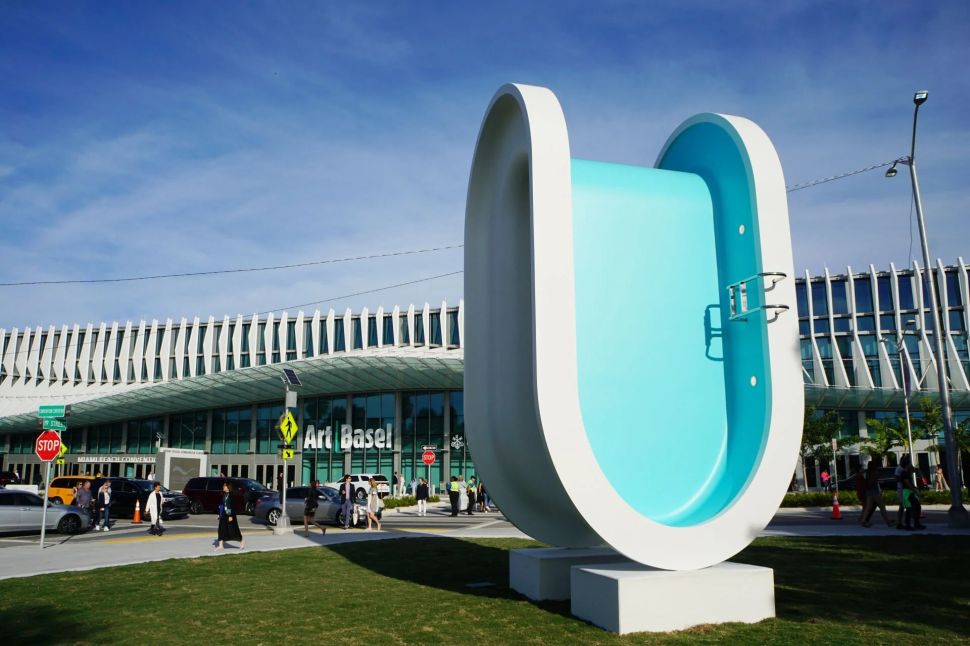
The convention center’s 2019 renovation included six commissions by internationally recognized contemporary artists, including Ellen Harvey’s etched mirror-glass installation Atlantis (2019), Joseph Kosuth’s neon text work Located World (2019) and Franz Ackermann’s About Sand (2018). On the north exterior is Sarah Morris’s Morris Lapidus (2018), a large-scale porcelain tile installation. In the surrounding area are Elmgreen & Dragset’s iconic Bent Pool (2019) at Pride Park and Joep van Lieshout’s Humanoids (2018) at Collins Canal Park.
Every year, galleries and artists presenting at Art Basel submit works for the Legacy Purchase Program, which are narrowed down to three finalists. The public is then invited to vote. This year’s finalists are Marlon Portales, with Nocturno para Ana (2026), presented by local gallery Spinello Projects; Bony Ramirez, with The Custodian (2026), presented by Canadian gallery Bradley Ertaskiran; and Indian artist Sumakshi Singh, whose thread-and-lace sculpture Pichla Darwaza II is presented by 193 Gallery. (Singh was one of the artists representing India in Venice this year.)
The public vote closed on Nov. 23, and the winner will be announced on Dec. 2. Leaving the final decision to the public gives residents a direct role in shaping the city’s collection and in deciding which art remains after the fair closes. It’s an opportunity to give emerging artists greater visibility beyond the fair itself, according to Vallecillo. “We try to create opportunities for emerging artists at different levels,” she says, describing this as one of the program’s key priorities. “The artists participating are typically represented in certain sections of the fair, such as Nova, and are often at an earlier stage in their careers or represented by newer galleries. It creates for them an opportunity to go beyond what they would otherwise achieve simply by participating in the art fair.”
Previous Legacy Purchase acquisitions include works by Amoako Boafo, Ebony G. Patterson, Sanford Biggers, Farah Al Qasimi, Juana Valdés, Anneke Eussen, Nina Surel and Ximena Garrido-Lecca. The broader Miami Beach Art in Public Places collection currently comprises 28 works installed across the city’s parks and public spaces. Under the ordinance, the program’s growth is tied to municipal construction and to the share of eligible capital-project costs allocated to public art.
The gravitational pull of Art Basel’s global megabrand—and the increasingly brand-driven festival that has grown around it—can be a double-edged sword. For all the international visibility and economic activity it brings, Miami Art Week is often criticized as more focused on commercial spectacle, corporate collaborations and luxury-brand activations than on the artists, galleries and cultural organizations that sustain the city’s creative ecosystem year-round. The imbalance has become a growing subject of debate, sharpened this year by the launch of the Art Basel Boycott campaign by Artists 4 Artists Miami. The grassroots collective is calling on local artists, curators, gallerists, collectors and residents to reconsider their participation in the fair, questioning how much of the wealth generated by the international art-market machine actually reaches Miami’s own creative community. Its demands extend beyond visibility to labor, housing affordability, environmental costs and the public resources devoted to hosting the event, and it advocates for alternative, locally rooted cultural initiatives.
The city, for its part, has developed a series of initiatives that go beyond permanent commissions in an attempt to provide targeted support and visibility for local artists. One of these is No Vacancy, a juried art competition that turns participating Miami Beach hotels into temporary art destinations. Supported by the City of Miami Beach, the Greater Miami Convention and Visitors Bureau (GMCVB) and the Miami Beach Visitor and Convention Authority (MBVCA), “it creates an opportunity for anyone to experience the work, whether they are staying at the hotel or simply visiting the different locations,” Vallecillo says.
For this year’s No Vacancy, the city restricted eligibility to local artists to give local practitioners a platform and greater visibility, particularly during a week when the international art market can overshadow the local scene. “Of course, it can also be easier to work with local artists because they are based here and more accessible, but the main point is to give them that opportunity and a platform of visibility during this week, and beyond,” she explains, adding that this year’s local-only edition received more applications than any previous one.
The 12 participating artists put site-specific works at 12 Miami Beach hotels, where they will remain through Dec. 19. Each selected artist or collective received a $10,000 stipend to realize their project. Artists are selected through an open call issued by the city, and each is also eligible for two additional prizes: the $10,000 Public Prize, awarded by the GMCVB, and the $25,000 Juried Prize, awarded by a jury of local art professionals.
Vallecillo points out that the city also supports commissions year-round. “Elevate Española” was a recent series of temporary installations suspended above the historic Española Way corridor, the pedestrian link between Española Way and Ocean Drive. The city also issues calls throughout the year for time-limited public art commissions and cultural programming, often with local cultural partners.
“Of course, as a city, we cater to tourists and residents through everyday services, from maintaining our beaches and hotels to keeping everything safe and clean, but arts and culture are definitely among our priorities,” Vallecillo says. “We want to make art more accessible to people who may not be able to attend one of the fairs. These are all opportunities that allow residents and visitors to become more involved in the city’s art scene beyond the annual art fairs.”