
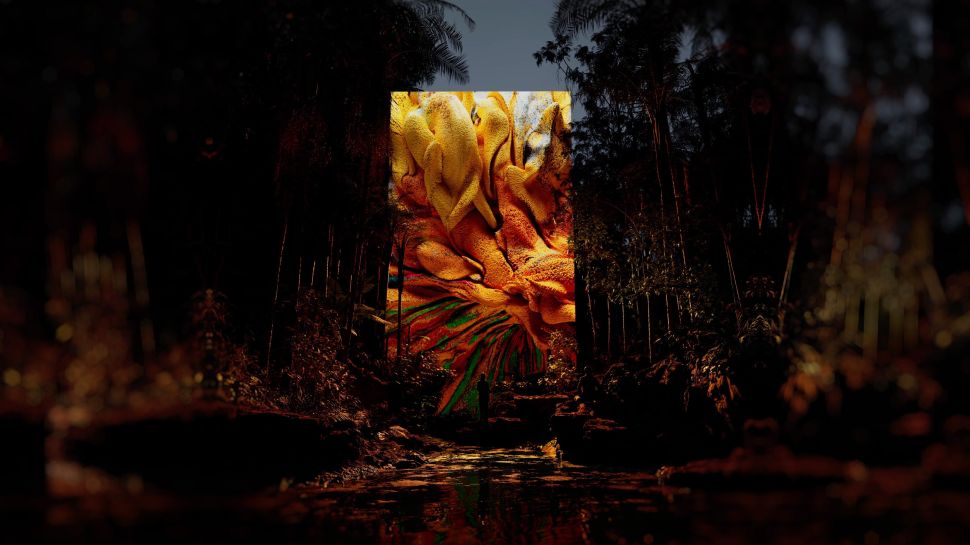
At its launch at Art Basel Miami Beach last year, the fair’s digital art section, Zero 10, generated considerable buzz, much of it fueled by Beeple’s viral installation, a dystopian spectacle of technocrats, politicians and other figures of power wrestling in an arena. But beyond the spectacle, Zero 10 created a space for debate about what constitutes digital art today and how we understand the increasingly complex relationship between art and technology. Most importantly, it raised questions about who is looking at and buying this kind of work, and what economic models should underpin a field shaped by the dynamics of online communities and co-creation.
Subsequent iterations in Hong Kong and Basel offered more distinct, context-specific visions, with the former engaging more directly with the region’s own digital art ecosystem, and the latter considering the broader history of digital art by bringing together overlooked pioneers and institutionally established contemporary practitioners.
In its latest chapter, with Nicole Sales Giles as global head, Zero 10 returns to Miami under the curatorial co-direction of Eli Scheinman and Karen Archey, an American curator and critic who heads the curatorial department at Kunstsammlung Nordrhein-Westfalen in Düsseldorf. Her practice has long engaged with the intersections of art, technology and institutional structures. From 2017 to 2025, she served as curator of contemporary art at the Stedelijk Museum Amsterdam, where she worked extensively across contemporary art and time-based media, organizing major exhibitions with artists including Hito Steyerl, Rineke Dijkstra, Metahaven, Pamela Rosenkranz and Marina Abramović. She also co-organized the landmark 2014 exhibition “Art Post-Internet” at Beijing’s Ullens Center for Contemporary Art and is the author of After Institutions (2022), an examination of museums as changing public spaces.
With that background, Archey brings to Zero 10 a perspective that bridges the institutional and the experimental, at a moment when digital art is increasingly entering collections and broader art-world conversations. Ahead of the fair, Observer sat down with her to discuss the evolution of Zero 10, the challenges and opportunities of bringing digital practices into the traditional art-market framework and what it means to curate art in an era increasingly shaped by technology.
In curating this edition with Scheinman, who has been involved with Zero 10 since its launch, Archey’s priority was to broaden the representation of artists working with technology and to reflect a fuller range of creative practitioners. She acknowledges that her own perspective is shaped by being an elder Millennial. “I grew up knowing what life was like before the internet, and then witnessed its entire evolution,” she explains. “I also came of age in an art world in which the internet, art, and technology had not yet been fully addressed. Much of my curatorial work and writing has therefore focused on how technology relates to art history. I try to bring artists into the presentation in a way that reflects that sense of historicity.”
Digital art, she says, should not be narrowly defined by its medium, and her criteria for Zero 10 centered on works that engage with technology from a cultural or social standpoint. “A work does not necessarily have to be made on the blockchain or on a screen; it should engage with technology and with the ways technology influences culture,” she says, citing the Ethiopian artist collective Yatreda, whose work centers on a car imported from the Soviet Union to Ethiopia that became a recognizable fixture of Addis Ababa before gradually disappearing. Although the car is an analog technology, its history opens onto questions of cultural memory, global distribution and colonialism—all subjects that Archey and Scheinman wanted to bring into the presentation.
The section’s title, “Generation,” encompasses several ideas, according to Archey, including the development of generative art from the 1950s and 1960s and generative practices from the present at a moment. “The works in this year’s presentation are quite broad, so I began by asking what might bind them together. One of the connecting ideas was authorship: if an artist makes a work through digital means, algorithms or A.I., it is still very much part of a creative process. That is something that is not always acknowledged or understood.”
Archey points to Jon Rafman’s Report a Concern: The Cleaners, presented by Sprüth Magers. Rafman collected images captured by Google’s Street View vehicles around the world, then used generative A.I. to extend these visual worlds into unsettling fictional narratives that expose the dynamics of surveillance and the manipulation of perception embedded in the systems that accompany our everyday lives. After her recent exhibition with Rafman at K21 in Düsseldorf, Archey faced criticism from viewers who questioned the artist’s use of A.I. and dismissed the work as “A.I. slop.” She sees A.I. and digital tools instead as instruments for editing and creative decision-making that can enable more critical engagement with these technologies, as artists test their limits and possibilities.
“I think of artists using artificial intelligence, digital platforms, and frameworks as using an editing tool or a creative tool,” she argues. “They are processing data and imagery, then creating a compendium of what they find interesting. In that way, we can reflect on what A.I. and other digital tools are doing to society.”
Archey and Scheinman also wanted to push and expand what Zero 10 could include, and to actively involve galleries already participating in Art Basel Miami Beach. Many of the works on view have a fluid multimedia presence, somewhere between immersive installation and the translation of computational processes into physical, three-dimensional supports. Refik Anadol is presenting his latest collaboration with the Yawanawá people of the Amazon, with a new body of prints and canvases sharing space with his digital creations. Studio DRIFT, in collaboration with TAEX, is presenting Murmuring Minds, an engaging body of work that recently debuted at LUMA Arles and bridges nature and technology. And Faig Ahmed is showing work that builds on his participation in the Azerbaijan Pavilion at the 61st Venice Biennale.
This year’s program also includes historical material, such as the Institute for Studies on Latin American Art’s presentation on “Arte y Cibernética,” revisiting early experiments with art and technology in Latin America. Initiated by Buenos Aires’s Centro de Arte y Comunicación (CAYC) in 1969, the project brought artists together with engineers, programmers and computer technology, becoming an important early experiment in computer-generated art in Argentina. “Eli and I wanted to think through the role of Art Basel Miami Beach in relation to the Latin community,” Archey says, “and to consider representation in that context.”
The goal is to bring together audiences with very different collecting habits: some digital art collectors are comfortable acquiring blockchain-based works, while others at the wider fair may be more accustomed to traditional, non-digital objects. “I have also learned a great deal from Eli, the artists and the galleries about newer collectors coming from the technology world,” Archey acknowledges. “The distribution of wealth in society is changing dramatically. New types of people are becoming high-net-worth individuals who might not have occupied that position 30 years ago, or in previous generations. Traditionally, art collecting has often been passed down through families and generations. I see that changing now, and I find it really exciting.”
Coming from institutions that pioneered the collecting of new media and digital art, such as the Stedelijk Museum Amsterdam and now Kunstsammlung Nordrhein-Westfalen, Archey is keenly aware of the obstacles to collecting, conserving and exhibiting works that depend on rapidly changing technologies. The practical challenges differ by medium. Acquiring a video as a digital file can be relatively straightforward, while collecting a Chrome extension—such as the one by Rafaël Rozendaal acquired during her time at the Stedelijk—requires extensive documentation. Archives of digital performances raise a different curatorial question: how should such material be exhibited, and what should audiences actually see?
Archey sees collectors, particularly those coming from the tech world, drawn to blockchain-based works partly because they offer a sense of security and permanence. More broadly, however, she believes the field needs accessible support from freelance conservators and specialist companies that can help collectors care for works they may not know how to handle. Traditional art-storage providers are not necessarily equipped for time-based or technology-dependent media.
“Beatrix Ruf, who hired me at the Stedelijk, really wanted to focus on time-based media and to make it an official subcollection, with a dedicated curator and conservator,” she says. “We achieved that while I was there, and we hired the museum’s first time-based media conservator.” There is, she notes, a close-knit community of people in this field willing to share knowledge and expertise.
Then there were the protocols and the systematic acquisition process developed with the museum’s conservation team to secure the works’ future. “When we acquired a work, we conducted an acquisition interview with the artist,” Archey explains. She’d then write a text summarizing the interview, and the team produced informal iteration reports with the conservator documenting exhibition histories, the artist’s preferences and other relevant information. The conservator would then assess the work and establish appropriate storage conditions.
For a museum, it’s a matter of long-term responsibility. “I was always thinking about a horizon of 100 years: will someone still be able to see this work in a century?” she says, adding that private collectors do not necessarily need to undertake the same level of research. Their responsibility is to provide a stable environment and ensure that the work does not disappear, and specialist time-based media conservation companies can help make that possible.
Asked whether digital art might eventually become so integrated into artistic practices that a dedicated section is no longer necessary, Archey considers that the boundaries between media have become increasingly outdated. “The Stedelijk was a very post-medium institution. Almost every artist was working across several media within a single work. It is no longer the case that someone is simply a painter or a sculptor,” she says, even as she concedes that the systems for collecting and preserving art remain medium-based.
Initiatives such as Zero 10 are so important in part because they give visibility to and support works that may be unfamiliar or harder to collect, demonstrating to a broader public how such works can enter collections. While collectors, even in our increasingly technologized world, continue to gravitate toward painting, Archey nonetheless believes it’s “very necessary to highlight that it is possible to collect this work and support these practitioners. Some of the most forward-thinking and important work being produced today engages with the society we have become.”