
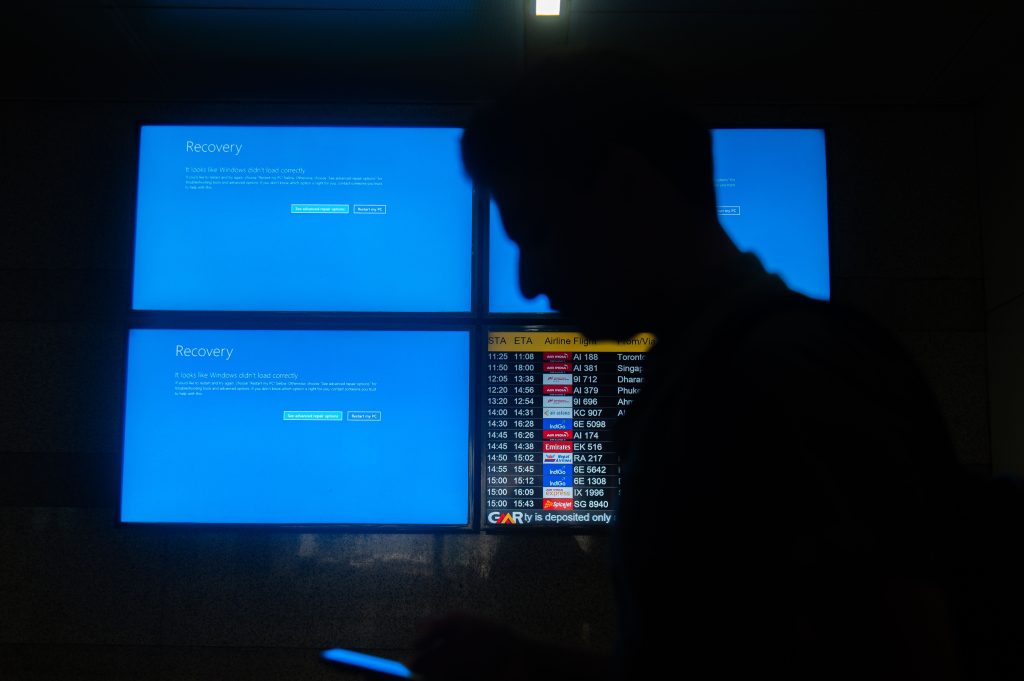
Microsoft error message during an outage” width=”5435″ height=”3616″ data-caption=’Recent disruptions at Microsoft, the FAA and other organizations underscore the need for stronger testing standards, risk management and leadership accountability. <span class=”lazyload media-credit”>Photo by Kabir Jhangiani/NurPhoto via Getty Images</span>’>
I took about a dozen calls last week asking what caused the outages at Microsoft, the Federal Aviation Administration (FAA), JPMorgan Chase and other organizations. Even my dry cleaner asked. I know only what has been published, and I have no inside knowledge of any of these incidents.
The organizations involved describe ordinary failures. Microsoft’s preliminary post-incident report names a software defect that combined with a surge in traffic and reduced server capacity. The Transportation Department said a router installed while a contractor replaced copper lines with fiber flooded the air traffic control network. The administration’s explanation is broader. In a White House statement, the director of national intelligence Jay Clayton said institutions are patching vulnerabilities and upgrading outdated systems, and some of those systems are not coming back as expected. He attributed the Nov. 17 outage of the NSA’s classified network to a software patch.
A.I. is finding far more software flaws
A.I. models are finding software flaws in far greater numbers than they were a year ago. Microsoft’s November security release addressed 1,235 vulnerabilities, nearly 20 times the 63 it addressed in November 2025. VulnCheck, a security research firm, says more than 100,000 vulnerabilities have been published this year, more than double last year’s total. Josh Bressers of VulnCheck told The Register that A.I. accounts for most of the increase.
Finding these flaws is good, because a vulnerability that a defender identifies can be fixed before an attacker exploits it. Each one still has to be assessed, and many must be fixed, tested and deployed by people who already have full schedules.
I cannot definitively say what caused any one of these outages, and the published accounts differ. My view is that the pressure I see inside the companies I work with played a part in some of them.
Three demands on the same people
The technology executives I work with now face three demands at once.
The first is security work. The monthly batch of fixes has grown significantly, and emergency fixes arrive whenever a serious flaw is disclosed. Each one forces a choice. Apply the fix quickly and the known vulnerability is closed, but a fix that has not been fully tested can break the system. Take the time to test it properly, and the system stays exposed for longer, while attackers may begin exploiting some flaws within days of their disclosure. Nobody can weigh those two risks with precision, so people make mistakes in both directions.
The second is the work already underway. Before the vulnerability counts rose, technology teams were running full portfolios of system replacements, regulatory deadlines and products the business had been promised by a specific date.
The third is the A.I. portfolio. Leadership expects a new set of A.I. projects and expects results quickly. Most technology teams have not magically increased in size to take on the added work.
Three priorities and no one in charge
Each demand is somebody else’s top priority. The security and risk staff care about one thing: getting vulnerabilities closed, because that is what they are accountable for. If you sponsor a client-facing website upgrade, it is the project you have worked on all year, and it may be what gets you promoted to managing director this year. Senior leadership talks constantly about the A.I. strategy, and nobody wants to be accused of slowing it down. If you are the person working on all three priorities at once, or testing changes for a living, nobody tells you which comes first. In effect, all three are the priority, and without clear guidance, something either does not get done or gets done without appropriate care.
Each owner can meet a target by taking hours away from one of the others, and in most companies, no one is responsible for all three demands together. The priorities are set in separate places. The security team sets the patching policy. Each business sets deadlines for its own projects. The A.I. deadline is often set in another meeting, with no discussion of the work it will delay. Each decision is reasonable in isolation. Nobody checks whether the same people can deliver on all of them, and only the leadership team has the authority to make that assessment.
What leadership should decide
How to allocate these teams’ time is a decision about how much risk the company is willing to accept and how much additional investment it is prepared to make. I would start with which systems cannot go down and which cannot be exposed. A payments platform and an internal reporting tool should not share the same patching deadline. This approach is called risk tiering. If you have not assigned a risk rating to every application at your firm, start tomorrow.
A named senior leader should explicitly approve the order in which known flaws are fixed and be accountable for that decision. There should also be a clear escalation point. When an engineer or a tester is asked to serve two or more strategic priorities at once, they need to know whom to approach to resolve the conflict. When the decision could have a material impact, a senior leader or group may need to make it.
Every system that goes live should have documented testing standards that someone outside the team can audit. When a patch breaks something in a live system, the failure should be reported, and leadership should require a written account of what happened, why it happened and which trade-offs, if any, were made beforehand. The aim is transparency. A company that examines its own failures in writing finds out where its teams ran short of time, which is information leadership rarely gets any other way.
All of this costs money. A common view is that A.I. will save money, and in some areas it will. A.I. is also making the technology environment significantly more complex. The flaws it finds have to be fixed, and every new A.I. system is one more thing to secure, test and monitor. More complexity means more controls, more testing and more cost. Leaders have to decide whether to make that investment and how far to take it.
Companies need to act long before a hastily deployed patch puts them on the front page of The Wall Street Journal. Those with clear testing standards, risk ratings, escalation points and flexible funding can respond to whatever comes next. They will still have incidents, but leadership will have made the risk decisions deliberately instead of leaving a junior developer to make them alone.