
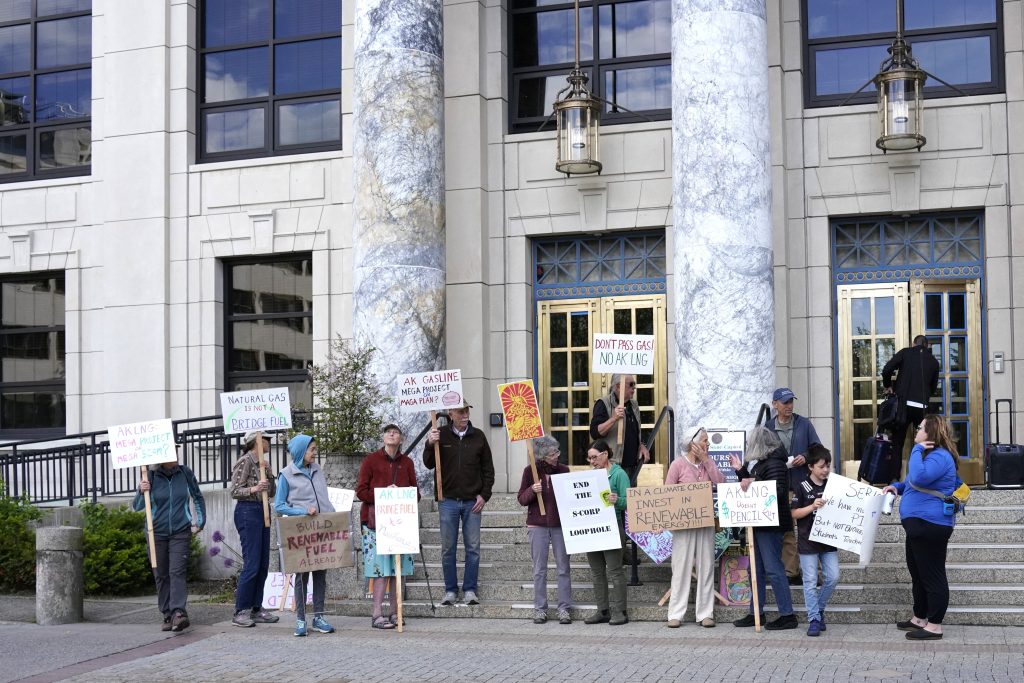
A small group of Alaskans rally at the Capitol building against the Alaska LNG pipeline on July 16, 2026. (Photo by Alix Soliman/KTOO)
About a dozen people gathered on the Alaska State Capitol building steps in Juneau on Thursday morning to oppose a proposed liquefied natural gas pipeline while lawmakers inside debated a multibillion-dollar tax break for the project.
The Alaska LNG project is proposed by Glenfarne Group, a private development firm headquartered in New York City. The pipeline would funnel liquefied natural gas more than 800 miles from the North Slope to Nikiski, on the Kenai Peninsula.
As Alaska Public Media reports, Southcentral Alaska faces a looming natural gas shortage that could cause residents to lower their thermostats this coming winter. A recent survey of around 1,600 Alaskans found that 68% support the Alaska LNG project.
But not the small group on the Capitol steps.
Signs read “AKLNG doesn’t pencil out” and “DON’T PASS GAS.”
Doug Woodby is co-chair of 350Juneau, a local climate action chapter of a national advocacy group. He said he opposes the pipeline for two reasons.
“Number one is climate — we’re in the midst of a growing climate catastrophe,” Woodby told the group. “The second reason is economic. This pipeline has the possibility of seriously impacting the state’s economy.”
According to a confidential document reported by the Alaska Beacon, the state could be required to pay Glenfarne if the project flops. Woodby said that could be financially disastrous for the state. The Alaska Beacon also reports that, according to a confidential memo, the state could be asked to pay billions more to own a quarter of the development if the project costs more than expected.
Woodby said Alaska already has a funding problem built on the boom and bust cycle of the fossil fuel industry, and that other developments show how costs can balloon. For instance, the Trans-Alaska Pipeline System cost roughly $8 billion in the 1970s, exceeding initial estimates by more than eight times.
Woodby said liquefied natural gas is not a bridge fuel to a renewable energy future. It’s made primarily of methane.
“Methane is 80 times more powerful as a greenhouse gas than CO2,” he said. “And the problem with methane is it leaks.”
A landmark study published in 2024 found that the climate footprint of liquefied natural gas is on par with coal.