
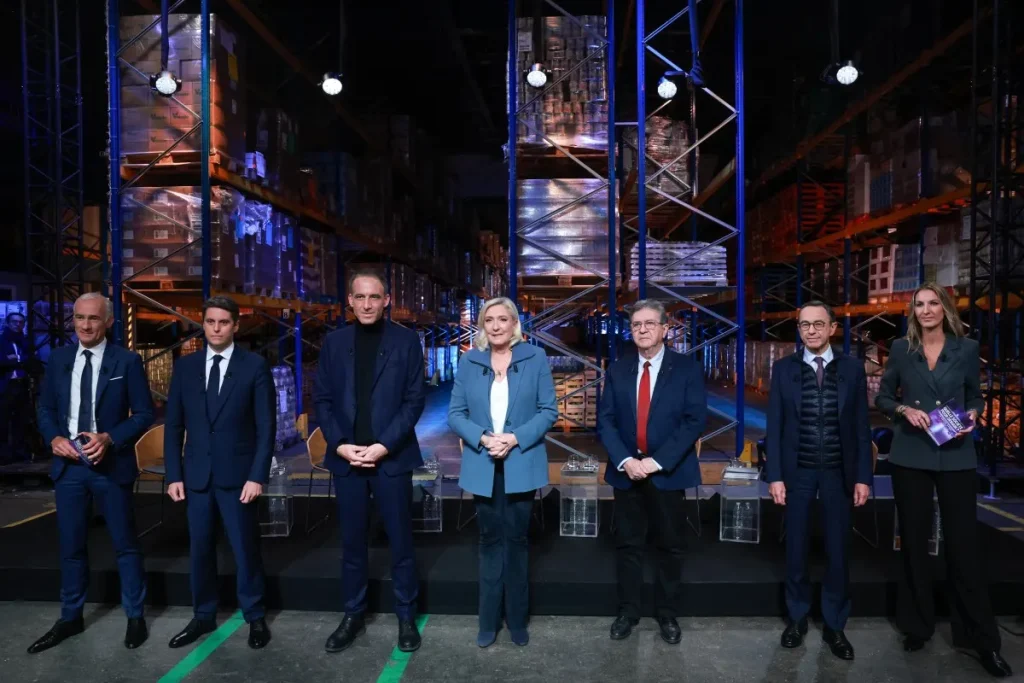
There are growing calls in France for a primary to try and unite the moderate or mainstream options into a single candidate to take on the far-right frontrunner Marine Le Pen, but what would this involve, and is this likely?
This week in France 1,000 local mayors and councillors signed an open letter calling for a ‘primary of the mainstream’ ahead of next spring’s presidential election.
They wrote: “We need a broad gathering of democrats, and a primary now stands out as the only chance to achieve it. The coming together begins with the primary. And time is running out.”
The local mayors join a growing chorus of calls for a primary of the centre, which includes high profile politicians such as Justice Minister Gérald Darmanin, former prime minister Michel Barnier and even president Emmanuel Macron.
Listen to the team at The Local discussing the idea of a primary on the Talking France podcast – download here
Likewise, an increasing number of polls of voters suggest that they support the idea.
So what are these calls all about, and is the primary likely to happen?
Why a primary?
There are currently 38 declared candidates for the presidential election scheduled for April and May 2027. Although some of them likely won’t achieve enough parrainage signatures to make it onto the ballot paper, this still represents an unusually high number of presidential candidates (in the 2022 elections there were 12 candidates who made it onto the ballot paper).
Although the candidates cover a wide spread of political views, many of them cluster around the political ground of the centre-right, centre and centre-left.
Currently leading the polls for the first round are the far-right candidate Marine Le Pen on roughly 31 percent of the vote and the far-left’s Jean-Luc Mélenchon with around 19 percent.
Following are centre-right Edouard Philippe on approximately 14 percent, centre-left Raphaël Glucksmann on 13 percent, centrist Gabriel Attal on nine percent and right-wing Bruno Retailleau on eight percent (polling for these final four varies more widely because pollsters often test out scenarios where not all of them are running).
France’s two-round voting system means that the two highest-scoring candidates from the first round go through to the second round, and voters go to the polls again and pick their favourite of the two.
READ ALSO: EXPLAINED: How France’s two-round voting system works
On current polling, this would see a far-right v far-left second round, with all polls predicting a comfortable win for Le Pen in that scenario.
The calls for a primary are therefore coming from people within the political centre, who want to ensure that a more mainstream, centrist politician is a choice in the second round, rather than what they dub ‘les extrèmes‘, the extremes, aka Le Pen and Mélenchon.
What would this involve?
In France, in order to stand for president, a person needs to be aged 18 or over, a French citizen (although not necessarily a citizen from birth) and not to have been banned by a court from standing for election.
They also have to gain 500 signatures of support from elected officials (MPs, Senators or local mayors) by March 2027, under the parrainage system.
Other than that, there is no mechanism to force people to withdraw from the race – the only way to thin the field is for candidates to voluntarily withdraw.
The idea of a primary is for the leading candidates of the centre ground to voluntarily agree to take part, and for the losing candidates to withdraw from the race – there’s nothing legally binding about this, however, it could only ever be a voluntary agreement.
The other option is for candidates to come to agreements between themselves to withdraw and throw their support behind others; its widely reported that the two former Macronist prime ministers in the race – Edouard Philippe and Gabriel Attal – have an informal agreement that the candidate trailing in the polls will withdraw some time around Christmas, and support the other.
Is it likely?
Edouard Philippe, who currently has a narrow lead among the ‘mainstream’ candidates, has repeatedly ruled out taking part in a primary, saying that voters should have a full choice of candidates and should be the ones to decide.
He is, however, coming under increasing pressure as more and more of his fellow candidates back the idea – media coverage of the issue has ramped up in recent days.
He has previously said that candidates with “no chance”, should stand down by February, in order to narrow the field.
Even if there was a primary, would it have the desired effect?
The Local’s politics expert John Lichfield said: “This idea has been around for a while and those who have been calling for a primary for some time feel justified because at present the three or four candidates of the central political mainstream are all somewhat becalmed in the polls.
“Therefore, logically you could assume that if we have one candidate of that central mainstream, we can add all their figures together and between them they could get 40 percent – that would be easily enough to qualify for the second round, maybe even enough to top the voting in the first round.
“But I don’t think it will happen that way.
“People on the centre left are not willing to vote in the first round for a centre right candidate. In the second round – that’s different, people are used to having to swallow what they really believe and vote for the lesser of two evils in the second round. But in the first round they want to vote with their heart.
“So it’s difficult to believe that having a primary would necessarily be the solution to the present problem.
“In some ways what Edouard Philippe, who refuses to take part in a primary, argues makes sense – he says that this is likely to lead to more confusion, it will make people believe that it’s just the establishment ganging up and therefore proving the case of Le Pen and Mélenchon on the extremes, who say that there is in reality only one party of the centre which takes the same view, whatever it may say during the election campaign, and ends up governing in the same way, in the interests of the elites rather than the people.
“So there are problems with the primary – it wouldn’t be a magical solution.
“The rather weird process of a ‘primary of the opinion polls’, which has become the norm in France in recent years, is I am afraid the only way of solving this muddle.”