
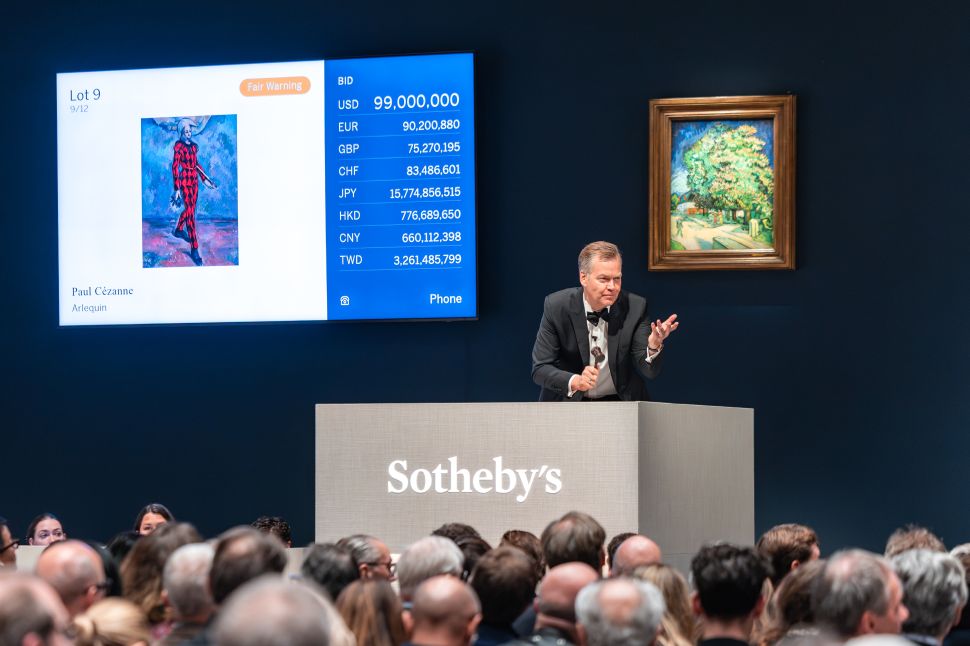
After several marquee sales pushed the season past the billion-dollar mark, one might expect an art market described as “recalibrating” to be ready for a breather. Not quite. Buyers, auction houses and the global art crowd were still very much in the game, with all eyes on Sotheby’s final major evening sales in New York on Nov. 18. Leading the night was what has been called “the El Dorado of collections”: 12 long-unseen masterpieces from Argentine collectors Carlos Pedro Blaquier and Nelly Arrieta de Blaquier. With a pre-sale estimate of $414.5-512.1 million, the Blaquier-Arrieta Collection Evening Auction closed white-glove at $412 million, narrowly missing its low estimate but setting the stage for an extraordinary evening.
By the time the final hammer fell on it and the $365.8 million Modern Evening Auction that followed, Sotheby’s had brought in $777.8 million across the two sales against a total estimate of $674.7-840.5 million—the house’s highest-ever single-night total, beating its $706 million debut at the Breuer building in November 2025.
Yet the night opened quietly. A Maurice de Vlaminck met its estimate at $2.5 million, while a Derain sold below estimate for $5 million. The room warmed up as the top lots approached. Lot four, Claude Monet’s Le Jardin des Tuileries, unseen in public for more than 50 years and in the Blaquier-Arrieta collection since 1979, sold for $20.2 million, at its high estimate. That paved the way for what was arguably the evening’s most highly anticipated top lot, Van Gogh’s Châtaigniers en fleurs, painted in the village of Auvers-sur-Oise, where the artist spent the final two months of his life after leaving the asylum at Saint-Rémy. The work has been ranked by experts alongside MoMA’s The Starry Night, the Musée d’Orsay’s The Church at Auvers-sur-Oise and Wheatfield with Crows at the Van Gogh Museum in Amsterdam.
The once-in-a-lifetime piece was notably not guaranteed to come to the rostrum. After Van Gogh’s death in July 1890, the painting passed to his brother Theo, then to Theo’s widow, Johanna van Gogh-Bonger, and their son, Vincent Willem. It later entered the collection of Samuel Fischer, the Jewish-German publisher and founder of S. Fischer Verlag, and it was this part of its “extraordinary” provenance that became the subject of an eleventh-hour restitution claim, when Fischer’s heirs argued that the family had been forced to sell the painting in Amsterdam in 1936 under financial pressure resulting from Nazi persecution. Sotheby’s disputed the claim, citing records from Galerie Paul Cassirer showing that the work sold in June 1936 for 68,000 Swiss francs (approximately $22,000), which the auction house maintained was a fair market price at the time. The transaction also preceded the Nazi occupation of the Netherlands in 1940. Ultimately, however, Sotheby’s negotiated an agreement with Fischer’s heirs, making them secondary beneficiaries of the sale of the work, which had a $180 million estimate. Bidding opened at $135 million and sparked an energetic battle between two phones and the room before the hammer fell at $165 million—a record $190.5 million with buyer’s premium and the second-highest price for any work ever sold at Sotheby’s.
After the Van Gogh closed, the collection’s other star lot, Cézanne’s Arlequin, went smoothly. Bidding opened at $60 million, and after a brief pause the work hammered on the phone at $99 million, or $111 million with fees, the second-highest auction price for the artist. The canvas carries a distinguished exhibition history, having appeared in some of the most important Cézanne shows of the past century, including the Salon d’Automne in Paris in 1907, the Museum of Modern Art in New York in 1929, the Art Institute of Chicago in 1952 and Tate in London in 1954. Bidding from Asia was particularly strong, fittingly: a smaller version of Arlequin sold at Sotheby’s in 1988 for $8 million and is now in the collection of the Pola Museum of Art in Kanagawa.
The next lot, Henri de Toulouse-Lautrec’s Femme assise de profil vers la gauche, only just met its low estimate after fees, selling for $3.9 million despite being slated for the artist’s forthcoming exhibition at the de Young Museum and the Guggenheim. Camille Pissarro’s Parisian scene La Place du Théâtre-Français et l’avenue de l’Opéra, soleil d’après-midi en hiver, painted from a window of the Grand Hôtel du Louvre and formerly in the collection of Norton Simon, sold below estimate for $24 million, a testament to how selective the market can be today. Still, the Blaquier group closed with a bang: the following lot, a snowy Pissarro landscape depicting the home of his close friend and fellow painter Ludovic Piette—Maison de Piette à Montfoucault, effet de neige, avec un homme portant un fagot, in the collection since 1956—sold for $2 million, far above a modest $700,000-900,000 estimate.
An hour into the night, the Modern Evening Auction led by Helena Newman was powered by several more of the season’s valuable consignments from important private collections: works from Sydell Miller’s holdings, the Armand Hammer Collection, the Hans Neumann Collection and a distinguished Japanese collection, plus a new selection from the Magnum Opus collection, which has brought in more than $70 million so far, with more lots to come in future sales.
“We continue to see the interest and demand for the provenance, connoisseurship and rarity that these important private collections carry,” UBS art advisory specialist Rachel Peart told Observer following the sales. “This season, we are fortunate to see many impressive collections that have been brought to auction after being held privately for decades.”
The night’s second half opened with Pablo Picasso’s Nu (1972), which hammered at $3.2 million, within its $2.5-3.5 million estimate, for a final price of $4.024 million with fees. Executed in the artist’s final decade, the large-format work on paper last appeared at auction at Christie’s New York in May 2006, where it sold for $284,800. The new result represents a more than fourteenfold increase, a striking appreciation for a work that has remained in the same hands for two decades.
A few lots later, another Picasso, Tête de fou, conceived in 1905 and described by Sotheby’s as one of the artist’s most accomplished early bronzes, drew strong bidding from Asia and sold for $1.792 million with fees, just shy of its $1.8 million high estimate. The sculpture came from the Magnum Opus collection, whose first round in October brought the auction house $70 million across four sessions. While Sotheby’s has not officially named the consignor behind the cross-category trove of more than 900 objects, it has been linked to the Frederick Iseman Art Trust and private equity investor Frederick Iseman, nephew of Helen Frankenthaler and a former Morgan Library board member. The consignor acquired the sculpture at Christie’s in November 2018 for $2 million, and its earlier provenance reaches back to the dealer Ambroise Vollard, who bought it in Paris. Its exhibition history includes the artist’s major retrospectives at MoMA and the Musée Picasso.
Also from the Magnum Opus collection, Georges Seurat’s Femme en blanc et noir (La Promenade)—a delicate Conté crayon drawing last seen publicly in MoMA’s landmark 2007-08 exhibition “Georges Seurat: The Drawings”—sold within estimate to a bidder in the room for $3.536 million with fees. The consignor acquired it at Christie’s New York in November 2010 for $3.33 million, so the gain was relatively modest.
Later in the sale, Edgar Degas’s Danseuse rajustant son chausson, from the same collection, fared better, selling for $7.44 million against a $5-7 million estimate, driven by several bidders from Asia. The exquisite 1887 pastel was shown in the Musée de l’Orangerie’s major Degas retrospective in 1937 and, more recently, in MoMA’s “Edgar Degas: A Strange New Beauty” in 2016.
One of the evening’s most compelling moments came when Aaron Douglas’s Harriet Tubman (1931) hit the block, with proceeds earmarked to support Bennett College’s future growth and its women’s health and student-success initiatives. Bidding began at $2 million and continued for more than five minutes, with eight bidders competing on the phone and in the room, before the painting reached $14.48 million with fees. The result set a new auction record for Douglas, more than 28 times his previous record of $500,000. A landmark work of the Harlem Renaissance, the painting was commissioned by Bennett College and had been on long-term loan to the North Carolina Museum of Art.
From the Sydell Miller collection, René Magritte’s L’Ami de l’ordre (1964) was another success, though more or less expected given the strength of the artist’s market amid the ongoing Surrealist revival. One of Magritte’s most compelling transformations of his familiar bowler-hatted figure, the painting sparked a prolonged contest, hammering at $39 million, or $45.53 million with fees, against an estimate of $25-35 million. By contrast, Piet Mondrian’s early landscape Avond (Evening) failed to find the same momentum, selling for $2.304 million, below its $2.5-3.5 million estimate.
American art delivered another of the night’s headline results. Edward Hopper’s The Martha McKeen of Wellfleet (1944), from the collection of Baroness Carmen Thyssen-Bornemisza, drew a sustained bidding battle before hammering at $41 million, for a final $47.83 million with fees. Estimated at $20-30 million, it was the highest-valued work offered in the American art category this year and achieved the artist’s second-highest price at auction. Its rarity likely heightened its appeal—it was the only Hopper seascape on the market.
A few lots later, Maurice de Vlaminck’s La Route (1906), a vibrant example of his Fauve period, sold for $7.44 million with fees, against a $6-8 million estimate. It has been requested for the forthcoming exhibition “Van Gogh and the Fauves,” scheduled to open at the Van Gogh Museum in Amsterdam in October 2027 before traveling to the Musée d’Orsay in Paris, as has André Derain’s Londres: La Tamise au pont de Westminster (1906), another important Fauve-period landscape, which brought in $6.4 million with fees, within its $5-7 million estimate.
Not every top lot delivered. Paul Cézanne’s Pichet et fruits sur une table (1893-94) hammered at $15 million, selling for $16.73 million with fees, short of its $20-30 million estimate. Alexander Calder’s monumental Un Blanc, quatre noirs (1967), first exhibited at Galerie Maeght in Paris in 1968 and held in the renowned collection of Irma and Norman Braman for nearly three decades, sold for $3.475 million. Frida Kahlo’s small Naturaleza muerta con hucha y caballo negro sold for $2.048 million, an auction record for a work on paper by the artist. It last appeared at Sotheby’s New York in May 1990, when it sold for $1.4 million. Many scholars read this unusual still life as an early wedding portrait, with the piggy bank standing in for Rivera and the delicately painted horse for Kahlo. The work also reveals her growing fascination with Mexican craftsmanship, evident in the intricate Tonalá ceramic plate and horse and the delicate natural dyes of the zarape textile backdrop.
Claude Monet’s Chrysanthèmes (1897), from the estate of Charles Dolan, comfortably surpassed its $6-8 million estimate, reaching $10.8 million. Mary Cassatt’s Summertime (1894-95), from the Armand Hammer Collection, achieved $13.33 million. Last on the market in 1971, it drew bidding from six dealers and set a new auction record for the artist. Late in the evening came another notable Degas result, as Trois danseuses (Jupes jaunes) (1899) sold for $17.01 million, a new auction record for an oil on canvas by the artist. Held in the Hammer Collection for more than 55 years, it was described by Sotheby’s as the finest Degas painting to come to market in decades.
Another top lot failed to live up to the hype. Amedeo Modigliani’s Madame Eyraud, from the Hans Neumann Collection, opened at $8 million and closed at its guaranteed hammer price, with little action in between. Painted in 1919, the canvas belongs to the celebrated series of final portraits the artist made in the months before his untimely death in January 1920.
One of the evening’s true discoveries came near its end: Maxfield Parrish’s The Glen, whose almost digital rendering of light and color makes it hard to believe it was painted in 1936. Last sold at Sotheby’s New York in November 2021 for $3.29 million, roughly in line with its estimate at the time, it fetched $5.6 million after a close bidding war between phone and online bidders, a nearly 71 percent increase in five years. The name and the result may have surprised some, but the numbers showed that plenty of collectors are paying attention to Parrish’s pioneering sensibility; the lot carried both a guarantee and an irrevocable bid. Born Frederick Maxfield Parrish in Philadelphia, he became one of the most commercially successful American illustrators of the early 20th century, openly occupying an unusual position between fine art, illustration and popular culture. That may explain why much of the art world overlooked him—though not Andy Warhol, one of the painting’s previous owners.
Near the close, Remedios Varo’s El vagabundo, one of the most enigmatic and complete of her rare gouaches to come to auction in recent years, was passed despite growing interest in the rediscovered Surrealist.
However orchestrated the sale, and whatever the state of the market, Sotheby’s evening delivered solid results as scheduled: only one lot was passed, at least eight works sold for above $20 million and 17 for more than $10 million. “Overall, the week showed a fairly strong market, with a few surprises,” Philip Hoffmann, founder and CEO of The Fine Art Group, told Observer after the sale. (A bigger success—and surprise—for him was the tiny painting by Claude Monet that sold earlier in the day at Christie’s Impressionist and Modern Art Day Sale for nearly $7 million against an estimate of $300,000-500,000, pushed by 20 bidders chasing it. Per square inch, it may be one of the most expensive pictures ever sold.)
The Blaquier-Arrieta auction, according to Hoffmann, was impressive as an event, but he believes the market might have overhyped it: “The guarantees were pitched too strongly, and the room was flat… We were all expecting the Van Gogh to go over $200 million, and it made $191 million. The Cézanne crept to $99 million plus premium, at the low end of expectations, and many of the other works sold at 50 to 60 percent of their low estimates.” As a financial bet, he added, it wasn’t a great one.