
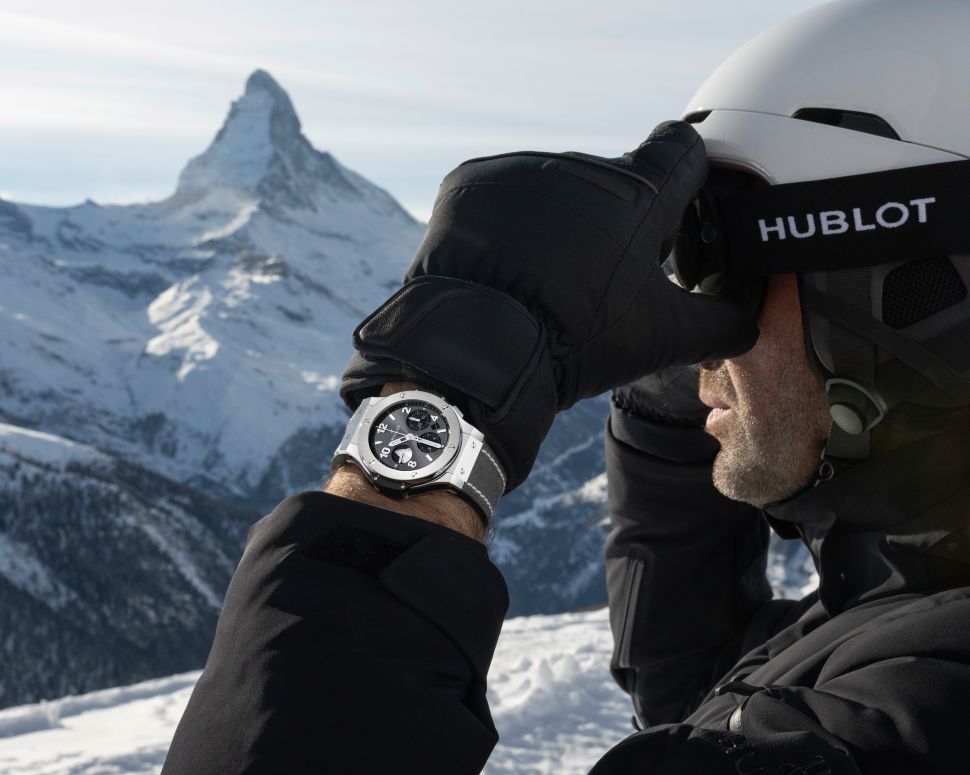
Hublot ski goggles, showcasing a stainless-steel Hublot Big Bang Zermatt chronograph on a gray strap with the snow-covered Matterhorn peak in the background” width=”970″ height=”776″ data-caption=’The limited-edition Hublot Big Bang Steel Zermatt celebrates the brand’s connection to the Swiss Alpine resort town and the Matterhorn. <span class=”lazyload media-credit”>Photo: Laurent Xavier Moulin, courtesy Hublot</span>’>
In the Swiss resort town of Zermatt, Hublot has a boutique built in the traditional Alpine style, a cable car bearing its name and a longstanding partnership with the local tourism office. The watchmaker even serves as official timekeeper for Chez Vrony, a mountain restaurant overlooking the Matterhorn. On the slopes, Longines has spent more than a century measuring ski races down to fractions of a second, developing technology that tracks not just finishing times but how fast athletes move down the mountain.
From Gstaad and St. Moritz in Switzerland to Courchevel in the French Alps, high-end watchmaking has become a familiar presence in ski culture, appearing through boutiques, sporting partnerships, limited-edition watches and exclusive events. While Switzerland’s watchmaking industry developed primarily around Geneva and the Jura Mountains, its relationship with Alpine resorts has grown alongside their emergence as destinations for wealthy international travelers.
For watchmakers, the appeal goes beyond skiing itself. These resorts bring together an international clientele interested in luxury hospitality, fine dining and high-end shopping, offering brands opportunities to connect with collectors outside the traditional boutique environment. For some companies, the relationship began with competitive timekeeping. For others, the mountains have become an extension of the luxury experience.
Hublot’s place in Zermatt
Over the past decade, Hublot has developed a highly visible presence throughout Zermatt, a compact Alpine resort town of just over 6,000 residents that can be crossed on foot in less than half an hour. Its wooden boutique takes cues from local architecture, while the Hublot-Express cable car carries skiers toward the slopes. The brand has produced Zermatt-themed watches featuring the Matterhorn, incorporating one of Switzerland’s most recognizable landmarks into its collections.
“Our ambition has always been to become part of the destinations where we establish a presence, rather than simply having a boutique there,” Hublot CEO Julien Tornare told Observer. The company has developed a similar relationship with Aspen Snowmass in Colorado, extending its approach beyond Europe. “Places like Zermatt bring together an international community that shares a passion for adventure and exceptional experiences.”
The strategy reflects the broader evolution of Alpine resort culture. Destinations once associated primarily with skiing have become centers of high-end hospitality, with luxury hotels, destination restaurants and designer boutiques attracting visitors as much for the social scene as the slopes. For watchmakers, establishing a presence in these locations means reaching customers in an environment where luxury spending is already part of the experience.
Hublot plans to continue expanding its involvement in winter destinations, with Tornare confirming that a few new winter releases are scheduled for December.
Longines and a century on the slopes
While Hublot’s relationship with the mountains is closely tied to luxury hospitality, Longines has a considerably longer history with alpine skiing. The Swiss watchmaker first provided timing equipment for a ski race near its Saint-Imier headquarters in 1913, beginning a relationship with the sport that continues more than a century later.
“Today, our involvement goes beyond measuring time,” Longines president and CEO Patrick Aoun told Observer. “We are proud to contribute to the sport and to be part of the passion, emotions and unforgettable moments that make alpine skiing so special.”
Longines has served as an official timekeeping partner of the International Ski and Snowboard Federation, or FIS, since 2006, providing timing and data technology for the Alpine Ski World Cup and World Championships. The partnership was extended again in October 2026, continuing the brand’s involvement in competitions where results can be decided by hundredths of a second.
At the 2017 World Championships in St. Moritz, Longines introduced its Live Alpine Data system, using sensors to track skiers’ speed, acceleration and other performance data in real time. The technology was subsequently expanded for the 2023 championships in Courchevel-Méribel, bringing more detailed performance information to spectators and broadcasters.
Its connection extends to the athletes themselves. Swiss skier Marco Odermatt serves as a Longines ambassador, bringing one of the sport’s biggest names into the brand’s wider marketing and sporting activities. “Marco is a wonderful ambassador for Longines, not only because of his incredible achievements, but also because of who he is,” Aoun said. “He is talented, focused and ambitious, yet remains humble and approachable.”
Beyond the competitions, Longines organizes guest experiences around major World Cup races, giving visitors opportunities to watch the action and see its timekeeping operations behind the scenes. This coming winter will be especially significant, with the 2027 FIS Alpine World Ski Championships returning to Crans-Montana, Switzerland, from February 1-14. The resort last hosted the championships 40 years ago in 1987, when Longines also served as official timekeeper.
“Looking ahead, the 2027 FIS Alpine World Ski Championships in Crans-Montana will be a very special moment for us,” Aoun said. “As a Swiss brand, we are naturally very proud to support such an important event at home.”
Richard Mille wristwatch on an orange strap, resting beside an olive-green ski boot in the snow” width=”970″ height=”1213″ data-caption=’Arthur Offel de Villaucourt joined the Richard Mille athlete roster in December 2025. <span class=”lazyload media-credit”>Courtesy Richard Mille</span>’>
Beyond the racecourse
Outside of Hublot and Longines, other watchmakers have developed their own relationships with winter sports and mountain hospitality. Audemars Piguet, based in Switzerland’s Vallée de Joux, has made its local landscape part of the visitor experience at its Hôtel des Horlogers in Le Brassus. The hotel offers access to some 220 kilometers of cross-country skiing trails, allowing guests to explore the region where the watchmaker was founded.
The maker has also strengthened its sporting connections through Lucas Pinheiro Braathen, whom it recently welcomed as a Friend of the Brand, the watchmaker’s term for an ambassador. Representing Brazil, the alpine skier won giant slalom gold at the Milano Cortina 2026 Winter Olympics, becoming the first Brazilian athlete to win a Winter Olympic medal.
Richard Mille has taken a more performance-oriented approach through its relationships with winter-sports athletes including French alpine skier Alexis Pinturault, Czech skier and snowboarder Ester Ledecká, retired Norwegian biathlete Johannes Thingnes Bø and fellow Norwegian cross-country skier Johannes Høsflot Klæbo. The brand developed a version of its ultralight RM 67-02 Automatic for Pinturault, incorporating the colors of the French flag and lightweight materials selected for their durability. Pinturault, who grew up in Courchevel, has spoken about wearing the watch during training and highlighted the importance of its lightweight construction.
More recently, Bell & Ross introduced its BR-05 Chrono Snow Rocket in October, a 250-piece limited edition inspired by French speed skier Simon Billy, who set a world record of 255.50 kilometers per hour in 2023. The 42mm chronograph features a matte white dial with red accents inspired by Billy’s racing suit, along with skeletonized hands shaped to resemble competition skis.
Between the athletes, boutique openings and resort partnerships, the relationship between Alpine culture and luxury watchmaking has taken on many forms. For Longines, that relationship is rooted in more than a century of competitive skiing, while Hublot has found a place in the resorts and restaurants surrounding the slopes. Other brands have followed their own paths, working with athletes, developing watches for winter sports and bringing guests into the mountains. Whether visitors come to ski, shop or simply spend a few days in the resorts, watchmaking has become a regular part of the Alpine experience.