
Among the most exciting new additions to Tokyo’s art ecosystem is UESHIMA MUSEUM. In a former British School building on the grounds of Shibuya Kyoiku Gakuen—the school its founder once attended—this six-floor private museum houses works by some of the most talked-about artists in contemporary art. Many pieces were acquired directly from those artists’ exhibitions or at fairs and biennials around the world. Behind UESHIMA MUSEUM is Japanese entrepreneur Kankuro Ueshima, who in less than five years has built one of the most extensive and contemporaneous art collections, numbering 850 works.
Ueshima belongs to a generation of self-made entrepreneurs who launched their first businesses while still students. His portfolio has since expanded across engineering, pharmaceuticals, real estate, construction and other sectors. He became seriously involved in the art world around 2022, consulting Kyoko Hattori, then Phillips’s representative in Japan, who encouraged him to study the offerings of leading international galleries.
In conversation with Observer, Ueshima recalled that a major turning point came in 2016, when he saw Gerhard Richter’s Abstraktes Bild 941-1 in New York. “Kensuke Onishi of Peace Winds Japan, whom I had met through disaster-relief work, had told me about Richter’s engagement with society, and seeing the painting in person deepened that interest,” he said. His first purchase was Bernard Frize’s Bitje, acquired from Perrotin in Tokyo.
Ueshima entered the art world on his own, without a family background in collecting. “I did not begin with much knowledge of art or an established network. My first step was to find out what I was drawn to. Hattori, now vice president at Pace Gallery, also helped by suggesting that I look through the Instagram accounts of major galleries and find the works I liked,” he said. Takeo Obayashi, one of Japan’s leading collectors, was also among his mentors.
“I still learn by seeing works in person at art fairs and festivals, and by researching the artists who interest me,” Ueshima explained. “As the collection has grown, my guiding idea has remained contemporaneity: how artists experience and express the time we share.” Beyond a work’s immediate impact, he values the power of its details and materials, and whether he will want to return to it. “An artist’s distinctive voice and the surprises that come from learning a work’s background also draw me in.”
At first, Ueshima focused on what he wanted to display where he lived and worked. But once he realized how many works, once purchased, sit in storage and are rarely seen, he felt the need to share his collection with a wider audience. “Sharing work with others became part of what collecting meant to me, and that led me to open the museum,” he said.
Working with curator Yuko Hasegawa on the exhibitions showed him how the placement of works and the relationships between them could create a narrative. “I discovered the pleasure of exhibiting as well as collecting. At home, by contrast, I choose works that bring a sense of calm when they catch my eye.”
Asked about the threads running through his collection, Ueshima acknowledged being drawn to works that deal with light and perception, while others prompt him to think about history and society. He sees the collection as open-ended: “These interests connect and expand through encounters with artworks and with people.”
When we visited the museum in September, during Tokyo Gendai, these threads were evident in the current exhibition, “The Image Burns, Distorts, and Sublimates into Light,” which brings a substantial portion of the collection into view. Firmly anchored in the notion of contemporaneity, previous exhibitions set works in dialogue through opposing yet complementary forces—the heat of the city and the gravity of matter, or color and narrative. For this third iteration, Hasegawa, who has shaped the museum’s exhibition program since its opening, conceives the visitor’s ascent from the basement to the top floor as a narrative of transformation. Beginning with the emotionally charged scenes of large-scale paintings, one moves through the Pop-inflected, glitch-driven energy of the city and the shifting representations of the human figure. It ends with abstract light itself, detached from any recognizable image. As visitors climb, the image gradually loses its outline, dissolving into the most elemental conditions of perception and the essence of the phenomenology of seeing.
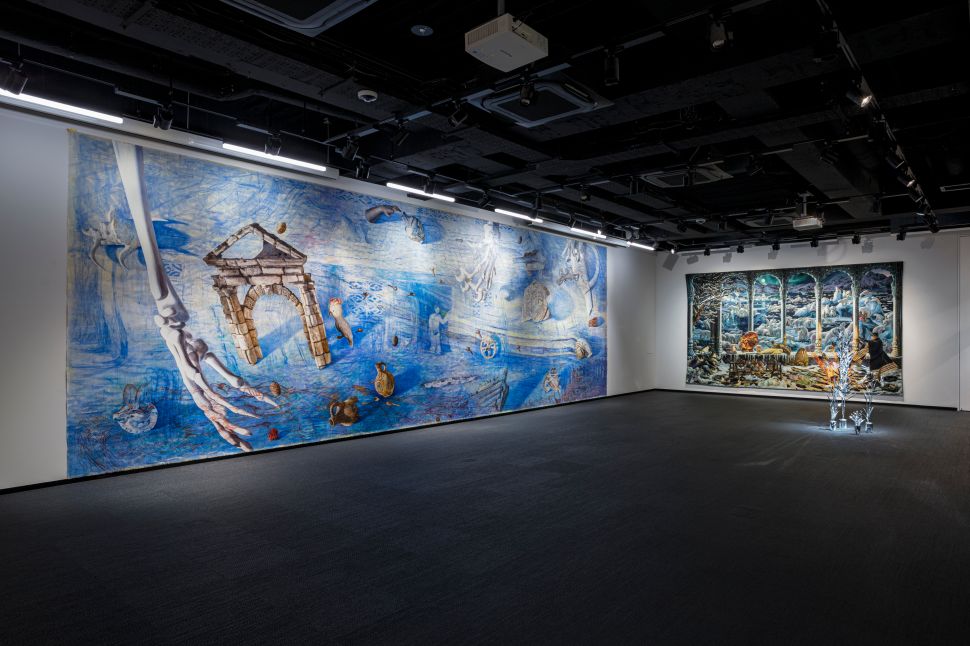
The exhibition starts in the basement with “Dissolution and Landscape,” where individual mortality intersects with the fate of a planet threatened by environmental collapse. Raqib Shaw’s monumental jacquard-woven tapestry The Pragmatic Pessimist (2024), acquired from White Cube in 2026, introduces an almost apocalyptic vision of approaching winter, rendered in the artist’s characteristically intricate, jewel-like imagery. Based on a 2022 composition, the work depicts a fantastical winter palace in which the artist burns art books to keep warm while polar bears struggle to survive on shrinking ice floes outside—a poignant image of the simultaneous fragility of civilization, the natural world and art itself. This darker vision is in dialogue with the more futuristic, architecturally imagined worlds of Minoru Nomata’s Continuum-21 (2024), suggesting a different relationship among humanity, technology and possible futures. Kei Imazu’s monumental canvas The Sea is Barely Wrinkled (2025), with fragments of ruins and historical imagery dispersing across the water, offers another reflection on the fragility of human civilization and the traces it leaves behind.
On the first floor, “City and Trace” offers a more immediately accessible, Pop-inflected introduction, with works by Daniel Arsham and JR engaging with visual codes of consumer culture, urban imagery and the circulation of images in public space. Arsham’s eroded sculptures turn recognizable objects, from classical busts to contemporary consumer goods, into archaeological relics of an imagined future. JR’s interventions at the Louvre play with the relationship among public space, architectural memory and the instability of images. Beneath their playful surfaces, these artists engage critically with the contradictions of the contemporary world, sometimes with a more explicit social commitment, as in Nanae Mitobe’s irreverent satire of Donald Trump’s political rhetoric. Works from Mika Rottenberg’s Lampshare series further complicate the relationship among everyday objects, material transformation and the absurdities of contemporary consumption.
The next floor, “Repetition and Image,” offers a timely interrogation of what an image can be in an age of endless reproduction, digital mediation and machine-generated visual narratives. More abstract works and serial structures, such as Gerhard Richter’s STRIP (2025), explore the progressive dissolution of recognizable imagery into mechanical repetition, while Ai Weiwei’s Table with two legs (2005) challenges the familiar forms and functions of everyday objects. The section also includes teamLab‘s Matter is Void – Fire (2022), an endlessly running digital work associated with the collective’s early NFT experiments. Drawing on the Buddhist concept of emptiness, it questions the very notion of exclusivity and uniqueness in digital art. Anyone can download and display an authentic version, but only the NFT holder can modify the words that appear within it, and those changes are reflected across all distributed versions.
Occupying an entire room is Ryoji Ikeda’s nine-screen installation data.scan [n°1b-9b] (2011/2022), which explores perception through mathematical systems and the continuous flow of digital information. Acquired from Taro Nasu in 2022, the installation translates vast quantities of data into rapidly changing visual configurations across nine synchronized monitors. Each screen presents a different visualization, yet together they suggest a multidimensional system whose complexity exceeds our capacity to comprehend it. Rather than communicating information in any conventional sense, Ikeda’s work exposes the limits of human perception before the seemingly infinite scale of data that increasingly structures contemporary reality. The artist’s investigations into data, perception and the digital image also featured prominently in Art Basel’s Zero 10 sector in June 2026, where Almine Rech presented data.gram [n°11] (2026), from his data.gram series.
The next floor is devoted to “Portrait and Concealment,” which gathers different representations of the human figure. They range from Andy Warhol’s iconic portraits and Julian Opie’s stylized figures to the psychologically fragmented subjects of George Condo and the atmospheric urban scenes of rising Japanese painter Keita Morimoto. Among the works in this section is Ewa Juszkiewicz’s Portrait with Cordyline (2025), which is back on view after being displayed in the artist’s exhibition at the Museo Nacional Thyssen-Bornemisza in Madrid. Subverting the conventions of historical portraiture, the painting depicts a woman in a red dress whose face is concealed by foliage, disrupting the codes of beauty and feminine representation that have long shaped the genre. Other works move beyond literal representation, suggesting human presence more allegorically—as memory, spirit or ghost, intertwined with other forms of existence. Anicka Yi’s Releasing the Human From The Human (2019), with its softly illuminated biomorphic form, proposes precisely this dissolution of the boundaries between human identity and other biological or artificial systems.
A floor further up, “Fragment and City” exposes and sublimates the fractured condition of urban life, channeling the chaos of the outer world and the inner self into the cathartic, intuitive gestural language of Nigel Cooke’s psychologically charged landscapes. His Nemesis (2026), previously shown at Art Basel, turns painting into an unstable projection of emotional and psychological states. The work relates to the artist’s recent investigations into landscape and memory, which also informed his Venice exhibition “Bad Habits” at Fondazione Querini Stampalia. A similar perceptual disorientation takes a different form in Pipilotti Rist’s immersive video installation Flüstern mit Kometen (Whispering with Comets) (2026), which blurs the boundaries between visual perception and bodily sensation. Rather than presenting the city as a coherent whole, works by Japanese artists such as Aya Ito and Osamu Mori, as well as the anonymous Japanese collective EVERYDAY HOLIDAY SQUAD, reassemble the fragments of memory, experience and emotion that urban environments leave within the individual. The collective’s patchwork my city / Shibuya (2022) makes this explicit, presenting a city continually reconstructed from its own fragments, like a map redrawn from within through a visual language of distortion, noise and digital glitches.
The ascent ends on the top floor with “Light and Shadow—Toward a Place Where the Image Is Let Go,” where everything finds resolution in the most elemental condition of any image and of our encounter with reality: light. Dan Flavin’s fluorescent installation untitled(for Ad Reinhardt)1b (1990) converses with works by Olafur Eliasson, including Shadow Lamp and Holo Lamp (both 2005), which investigate the relationship among light, movement and perception. In Holo Lamp, the precise alignment of a light source, mirror and glass disk produces a holographic apparition, turning a physical arrangement into an almost immaterial visual experience. Alicja Kwade’s SunderState V (2025), acquired from Pace that year, further complicates our understanding of space, matter and reality. A clock seen through a polished glass column appears optically distorted, conveying the tension between the supposedly objective measurement of time and its inevitably subjective perception. Suspended from the ceiling, Latifa Echakhch’s Entre la nuit et l’aurore (Between night and dawn) (2025), also acquired from Pace in 2025, offers a more poetic meditation on the passage of time. Its strands of colored glass beads shift from pale green to purple and blue, floating in space and evoking the gradual transition from night to dawn. As light filters through the translucent beads, the work becomes an almost immaterial image, completed in the viewer’s imagination through the experience of its physical presence.
Ueshima has not only collected leading international names but also made a sustained effort to support Japanese talent. He has acquired works by several artists who have emerged in recent years, often early in their careers. By placing their work alongside that of internationally established figures, he creates opportunities for Japanese artists to be seen in a broader global context. Asked how he approaches the relationship between Japanese and international contemporary art, and his role in bridging the two, Ueshima said he prefers not to divide works by the artist’s nationality. He acknowledged, however, that many artists in Japan are not yet widely known abroad. “I want to create more opportunities for people, especially outside Japan, to encounter their work,” he said. “At the museum in Shibuya, visitors from Japan can experience international contemporary art, and visitors from abroad can discover Japanese artists.”
One example is Kei Imazu, a rising Japanese artist whose profile has grown across Asia’s museums and biennials. In 2025, she had major institutional solo exhibitions at Museum MACAN in Jakarta and Tokyo Opera City Art Gallery, following earlier participation in the Aichi Triennale and the Bangkok Art Biennale, and she took part in the Singapore Biennale that year. UESHIMA MUSEUM presented a solo exhibition of 12 of her works at its annex in 2025, and in the current collection exhibition, her monumental canvas hangs alongside works by international artists. “Through our exhibitions, multilingual texts and loans to other museums and exhibitions, I want to help artists’ work reach wider audiences,” Ueshima said.
Imazu’s work also led Ueshima to discover another approach to collecting: following a single artist over time. The collection now holds 18 of her works, spanning 2008 to 2025, and three of them, from 2012, 2020 and 2025, hang in the current exhibition. “When I stand in front of the 10-meter-wide The Sea is Barely Wrinkled (2025), which shares its title with her solo exhibition at Museum MACAN in Jakarta that same year, it feels less like having acquired a single work and more like walking through time alongside the artist,” he said, calling it one of his favorites.
Another work to which Ueshima feels particularly close is Yoshitomo Nara’s Hey! Ho! Let’s Go! (2011), a pair of paintings on an old signboard the artist made himself, with scraps of wood attached. “When it was shown at an art fair in Hong Kong in March 2026, I heard that visitors were photographing each other in front of it, raising a fist like the girl in the painting, and I learned how a work can change the way people behave,” Ueshima recalled. The work has been on view on the museum’s second floor since September. “This work is what led me to think about collecting in terms of how people will spend time in front of a work.”
He points to Kohei Nawa’s PixCell-Deer #40 (2015) as the work that taught him something about himself. “Nawa’s work had a profound impact on me at the Takahashi Collection exhibition at the Contemporary Art Museum, Kumamoto, in 2017, and I have deeply admired his work ever since,” he said. The work entered the collection in 2022 and has greeted visitors at the first-floor entrance since the museum opened. Five works by Nawa are now on view in the building. “When I later met the artist and heard how his interest in physics runs through his work, I understood why I had been drawn to it on instinct: it connects to a fascination with physics, light and vision that I have had since my early teens,” Ueshima explained. The encounter helped him articulate what lies at the heart of his collection.
For Ueshima, speaking directly with artists is one of the great pleasures of collecting. “Learning about their backgrounds, their working environments and the thinking behind a work is deeply stimulating,” he said. His relationship with Theaster Gates, for instance, reshaped his understanding of his role as a collector. “I first encountered his work at the Tokoname venue of Aichi Triennale 2022, where I heard him explain the concept in person. That experience led me to begin collecting his work,” he recalled. “Later, while the museum was still being prepared, he visited and walked the building with us, thinking about where the works should go. Watching an artist find a place for his work inside the museum made me realize that a collector’s role is not to own works but to create the place where they go on living,” he added. Works by Gates are still on view in the museum today.
His starting point, Ueshima acknowledged, was simply the wish to live with works that drew him in and to see them every day. “Looking back, my idea at the time was to own works so I could see them in my own living spaces, at home and in the office. The idea of sharing them with others came later,” he said. Over time, he felt a growing desire to make the collection accessible to a wider audience.
Today, he offers a model for a new generation of Japanese collectors willing to take a more active role in the growth of Japan’s art system and the broader international art world. They act as cultural patrons, sharing their collections, supporting contemporary artists and helping shape their markets.
Looking ahead, expanding public access to the collection and creating more opportunities for audiences to engage with it are among the priorities shaping the next phase of his collecting journey and his commitment to both Japanese and international art. “Alongside collecting, I want to create more opportunities for younger generations to encounter contemporary art directly, through exhibitions and partnerships with schools,” Ueshima said. “I would like to continue working with artists and curators to introduce the works to audiences, and to keep rethinking how the collection is presented as I encounter new forms of expression.”