
Artissima, Turin’s publicly owned contemporary art fair—and the only fair in Italy devoted exclusively to contemporary art, as any Italian will gladly remind you—held its 33rd edition from October 30 to November 1. Staged at the Oval Lingotto arena, next to the Pinacoteca Agnelli, the fair brought together 183 galleries from 35 countries, divided into four sections selected by its galleries committee, plus three curated sub-sections. Each section was color-coded, but all were mixed together on the floor.
Fair director Luigi Fassi took his cue from American philosopher Martha Nussbaum, conceiving of art as a flexible, acrobatic body, “capable of moving beyond our own perspective and approaching the experience of others,” as he put it. “At a time when our societies seem increasingly divided in the midst of trembling times, I find this idea especially meaningful.” Over the past five years, Fassi told Observer, his ambition has been “to strengthen Artissima as a place where collectors can discover the unexpected, encountering galleries and artists they don’t know yet, as well-travelled and informed as they can be.”
Italian collector Patrizia Sandretto Re Rebaudengo, who has attended Artissima since its inception, agreed that discovery is the fair’s forte. She visits several times but prefers Sundays, after the collectors have gone, and makes a point of seeing every gallery, starting with the New Entries section. “Obviously when you go to Art Basel, every Art Basel, you know there’s Gagosian, Hauser & Wirth, David Zwirner—you don’t have any of these in Torino,” she told Observer. “You have many new proposals, many galleries to discover. So I go with this idea of ‘I want to discover,’to know more about what the new generation are doing.”
“When I started collecting, I started collecting my generation,” she continued. “Then I started to collect my son’s generation. And now younger—my sons are around 40! We pay attention to artists who are 25, 27…” For her, “the fair is not just a question of ‘to buy’—it’s also a question of starting a relationship to have with a new generation. In months, you can have an exhibition—this happened with Aziza [Kadyri, whose work “Choreography of the Latent” is currently on view at Fondazione Sandretto Re Rebaudengo]. I met her at a fair.”
There were plenty of still-under-the-radar galleries to discover. Studio SALES di Norberto Ruggeri, which mostly shows at Italian fairs like ArtVerona and Arte Fiera, presented a solo booth by Bologna-based artist Flavio Favelli. His series of 55 drawings is made on found office and hotel letterhead (Holiday Inn Lhasa, Grand Hyatt Tokyo), layered with logos for candy, eau de toilette and brands like Sprite, along with Bank of England bills, and set in found frames. “There’s a lot of influence of Italian and American Pop Art,” noted gallery rep Rebecca Bevilacqua, “to talk about images of capitalism.” Each drawing was priced at €3,000, or €70,000 for the full set. Favelli also has an installation in one of Turin’s main squares for Luci d’Artista, incorporating manufacturing material from Piemonte and Emilia-Romagna.
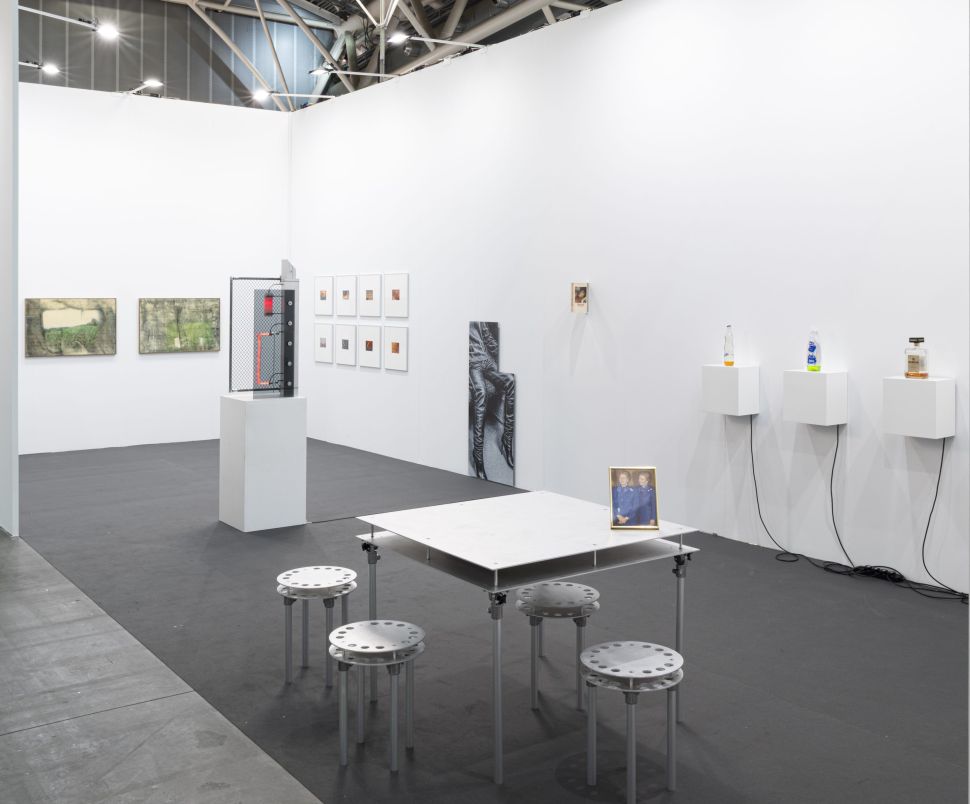
MATTA, which previously showed in the New Entries section, made its debut in the main section this year. Caterina Migliore said the gallery was keen on Artissima because “the whole system of the art world is participating,” citing the presence of the public, curators and institutions alike. The booth presented a group show spanning MATTA’s full roster. The undoubted star was Danish-born, London-based artist Clara Hastrup, whose work is on view at the gallery’s Milan space and will be shown at Tate Britain in December. In Tidal Range, liquids in five receptacles, including a French press and a bottle of Disaronno amaretto, are controlled via Wi-Fi and synced to an Italian live-streaming data center that measures water levels in Venice; as the data changes, the liquid levels gradually but visibly shift. “It’s a game of illusion; this is what I love about this work. It’s dramatic, it’s like messinscena,” Migliore told Observer. The work was priced at €34,000 for all five vessels, or €6,800 each. The booth’s most accessible price, €1,100, was for a piece by multimedia artist Francesco Tozini, whose digital work was “very simple, very delicate, on the smallest screen on earth”—think the size of a thumbnail—programmed with images of flowers that turn on and off like a lamp. One of the Assemblages by thebackstudio, a young duo from Turin and Mumbai, had sold for €8,800: “they put together different materials with what they find, so it’s another way of production. It’s not ‘I want to do this, and then I buy the material.’”
At Hannah Barry Gallery, the booth was devoted to C. Mae Bloom, an emerging artist who finished her MA just two years ago and had her first show at the gallery’s London space in 2025. The gallery took part in Artissima years ago, but “had a break from doing art fairs,” according to director Diana Córdoba. (Besides Artissima, the gallery will be at Paris Photo and NADA Miami before the end of 2026.) The number of institutional figures drawn to Artissima motivated the gallery to put Bloom’s work in front of them. Her site-specific installation Time as Exchange, which extends across two walls, delves into the value of labor and objecthood. Bloom mechanizes small items tied to sewing—”mending, fixing, making”—to honor three generations of textile-working matriarchs in her family, who were “paid very little money for high-skilled work.” The full installation, comprising 153 small objects, was priced at €17,500. Nearby, small handmade sculptures using vintage tickets and factory measuring units ranged from €1,000-€1,500.
Bigger names were present too. At Galleria Lia Rumma, recognizable artists included Marina Abramović, Vanessa Beecroft and Alfredo Jaar. “We have a lot of collectors from Torino, so it’s a good occasion to meet and link up and be all together. It’s not the best time for art fairs in general all over the world, but we still invest in Italian fairs,” said Lidia Rebuffat, a representative of the gallery, which also takes part in Miart and several editions of Art Basel (France, Switzerland and Qatar). Prices on the booth ranged from €5,000 for a work by Michele Guido to €200,000 for a Wael Shawky wood-and-glass vitrine filled with ceramic plates. At P420, another established Italian gallery, Pieter Vermeersch’s oil on canvas Untitled (2025) was the booth’s most expensive work, while a piece by a recent art school graduate was the most accessible. Works by Merlin James, Steven Rosenthal and Francis Offman had already sold by the fair’s second day.
Beyond the Oval, Sandretto Re Rebaudengo noted that Artissima also serves as a showcase for everything else the city has to offer. “There is a quantity of good institutions—public and private—that we can offer to collectors, directors, curators. [There’s] the possibility of going to the fair, but one can also to visit our museums, our foundations”—her own included, where Andrea Bowers and Nan Goldin were on view. Three of Turin’s largest institutions, GAM, Castello di Rivoli and Fondazione Merz, joined forces for a three-part tribute to Italian artist Marisa Merz, the only woman associated with the Arte Povera movement in the 1960s. Fassi echoed Sandretto Re Rebaudengo: “Artissima’s international identity is inseparable from Turin.” The fair, he said, has become “a meeting point between this local cultural ecosystem and the international art world… a statement about contemporary culture, a driver of the cultural life of its city.”