
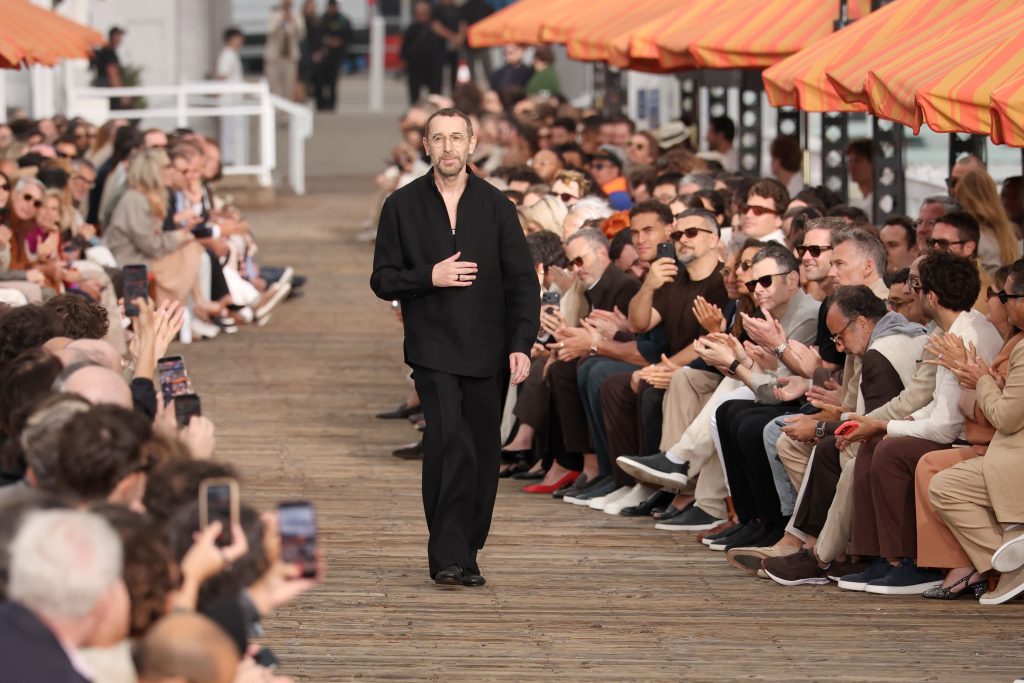
Alessandro Sartori walks the runway during the Ermenegildo Zegna Runway Summer 2027 Los Angeles Show at Malibu Pier on June 05, 2026 in Malibu, California” width=”3968″ height=”2646″ data-caption=’To reverse its prolonged downturn, luxury must move beyond ever-higher prices and ubiquitous marketing toward genuine scarcity, durable products and new sources of value. <span class=”lazyload media-credit”>Photo by Frazer Harrison/Getty Images</span>’>
Earlier this year at Milan Fashion Week, Alessandro Sartori, artistic director of luxury menswear brand Zegna, presented a collection inspired by “a family closet,” emphasizing the emotional value of clothes passed down from grandfathers to grandsons. This idea served as a reminder to Zegna’s customers that they can have their clothes repaired indefinitely. It was also a signal that when style outlasts fashion, products can retain their relevance for decades. That longevity offers an alternative to the overconsumption and overproduction that deplete natural resources, strain supply chains and contribute to environmental damage.
Yet initiatives like Zegna, while important, do not fundamentally change the business model of big luxury, which remains built around growing the firsthand market. Since the 1990s, revenue from personal luxury goods has quadrupled, according to Bain & Company. At the Luxury Innovation Summit in Geneva earlier this month, panelists discussed launching more entry-level watches to help restore sales volumes. But pursuing endless growth creates a double threat for luxury brands. It weakens the promise of rarity while making environmental sustainability harder to achieve.
Volume growth violates the promise of rarity
Most big personal goods luxury companies, including LVMH, the industry leader whose portfolio includes Givenchy and Guerlain, have been grappling with a prolonged downturn since 2023. Consumers are increasingly questioning luxury’s appeal, with some estimates pointing to a loss of 50 million customers between 2022 and 2024. The industry’s problem runs deeper than cyclical weakness. Big luxury is confronting three interconnected deficits: rarity, authenticity and perceived value.
The business model that took shape with LVMH’s rise in the late 1980s helped turn luxury into a global industry. But it also encouraged the massification of marketing, with brands always on, everywhere, all the time. Retail footprints expanded, products became readily available online and boutiques and customer experiences grew standardized across markets. Meanwhile, the steep price hikes of recent years have not always been matched by improvements in quality or functionality that customers can readily discern. The result is growing skepticism about both luxury’s intrinsic value and its value for money.
Consumers have also gradually become more aware of how artificial scarcity can be. Until recently, brands could burn their unsold inventory rather than find ways to recirculate it, a practice that sat uneasily with luxury’s claims of enduring value. Over three decades, the industry’s drive for scale has risked making luxury commoditized, almost banal.
The watch industry offers a counterpoint. Independent makers such as MB&F and De Bethune have bucked the recessionary trend by building their appeal around distinctive design, exceptional creativity and limited production. Audemars Piguet, too, has maintained a powerful identity outside the major luxury conglomerates. These businesses demonstrate that customers at the highest end of the market may respond more to a clear promise of distinction than to another product launch.
Volume growth makes environmental sustainability more difficult
The second problem is the environmental cost of a growth model that depends on selling more new products. Research for Purposeful Luxury, my book examining sustainability across 100 of the world’s largest luxury companies in six sectors, points to a gap between the industry’s sustainability commitments and the transformation required to meet them.
Among a subset of 18 major luxury brands, eight (44 percent) reported relative targets for reducing Scope 3 greenhouse gas emissions. These emissions occur across a company’s value chain, including its suppliers and, where relevant, the use and disposal of its products. They account for the majority of many brands’ total emissions. Relative targets, which measure emissions against a unit of output or another business metric, can allow emissions to rise as production expands. Of the ten brands in the sample with absolute Scope 3 reduction targets, only four were on track to meet them within their stated time frames.
The research also found that sustainability reporting remained heavily weighted toward environmental, social and governance (ESG) disclosures. Ninety-five percent of the content examined focused on ESG topics, while just five percent addressed transformation through circularity and innovation.
How much are luxury brands actually investing in that transformation? Since companies are not generally required to disclose sustainability spending in a standardized way, the full picture is difficult to establish.
Moncler, however, stood out for its transparency, topping the Dow Jones Best in Class Index for sustainability for its seventh consecutive year in 2026. The company has made sustainability a visible part of its corporate reporting, outlining its efforts to integrate environmental and social considerations into its operations. That commitment is worth considering alongside its spending on marketing and sales, which accounted for 37.3 percent of revenue in 2024. The comparison raises a broader question about how luxury brands balance the resources devoted to promoting their products with those invested in changing how they make and sell them. Across the sector, there is an overall posture of compliance and reputational risk management around sustainability rather than one focused on innovation and transformation to suit our changing times.
That approach could threaten luxury’s long-term legitimacy. Climate change is intensifying pressure on natural systems and resources, while access to essentials such as food and water remains a growing concern in many parts of the world. Luxury depends on the continued social acceptance of producing and consuming goods that are, by definition, superfluous. Brands that fail to account for their environmental and social impacts risk undermining the very legitimacy on which their businesses depend.
A new definition of growth for brands and success for society
To recapture the hearts and minds of customers, luxury brands will need to pair environmental sustainability with renewed commitment to rarity, while rethinking some of the business practices that defined the industry before its late-1980s expansion. The aim should be a model that combines craftsmanship and exclusivity with new forms of creativity, revenue and customer value.
Before the industry scaled up, luxury was often produced on demand rather than made speculatively for stock. Customers had to wait for their purchase, and that delay could reinforce the sense that an item has been made just for them. Haute couture remains a powerful expression of this relationship between time, craftsmanship and perceived value. Brands must, however, be scrupulous about avoiding waitlists based on opaque criteria, which is unfortunately the norm today. Technologies like A.I. could help anticipate supply and demand to reduce wait times.
The same principle applies to marketing and retail. Before the era of always-on campaigns and ubiquitous influencers, brands relied more heavily on selective events, shows and sponsorships to build their reputations. A more selective approach today could free up resources for research and development, including new materials, repairable products and circular design. ID Genève Watches, a young brand supported by Leonardo DiCaprio, offers one example of a business built around circular principles and an innovative management of product lifecycles. Its approach illustrates how brands can also compete on values as sustainability becomes part of a brand’s creative identity.
Brands could also reconsider the relationship between volume, pricing and profitability. What they’d lose in firsthand sales, they may be able to offset by raising prices for wealthier customers, with only a limited effect on profit margins. The more durable opportunity is to generate revenue throughout a product’s life through repair, refurbishment, upgrades and resale instead of relying almost entirely on the first transaction. Making that shift toward circularity would require rethinking how products are designed from the outset.
For affluent customers outside the ultrawealthy segment, luxury brands could claim a greater share of the expanding secondhand market and experiment with rental or sharing models. These approaches could help monetize valuable products from collectors that otherwise sit unused, from watches to handbags to cars. Here, luxury brands would use their considerable influence to reset the meaning of success from outright ownership to access.
A renewed emphasis on meaning would help brands reset this narrative, particularly among younger customers. Many look for opportunities to learn, develop new skills and connect with ideas and communities. Chinese brands offer examples of how luxury and lifestyle businesses can build relationships beyond transactions. To Summer has supported public engagement with Chinese art through curated events and exhibitions, while NIO’s 2,000 peer-to-peer communities for professional and personal development point to the importance of integrating meaning and purpose beyond consumption in the next luxury value proposition. Such initiatives do not, on their own, establish a more sustainable business model. But they point toward a broader proposition in which brands can create value through culture, knowledge and community as well as through the products they sell.
The way out of luxury’s downturn is not more volume, but restoring the distinction that made luxury desirable in the first place by focusing on rarity, innovation and meaning. Volume growth has depreciated the value of luxury goods and negatively impacted the environment. As prices for new products continue to climb, innovation will need to come from new materials and circular models that keep luxury from becoming an industry defined solely by inequality.
Stéphane JG Girod is a Professor of Strategy at IMD, where he leads the Luxury 2050 Initiative. He is the author of Purposeful Luxury: The Strategic Playbook for Sustainability in Luxury Industries and co-author of Honest Luxury: What the Rise of Chinese Luxury Brands Changes for the World… and What it Does Not.