
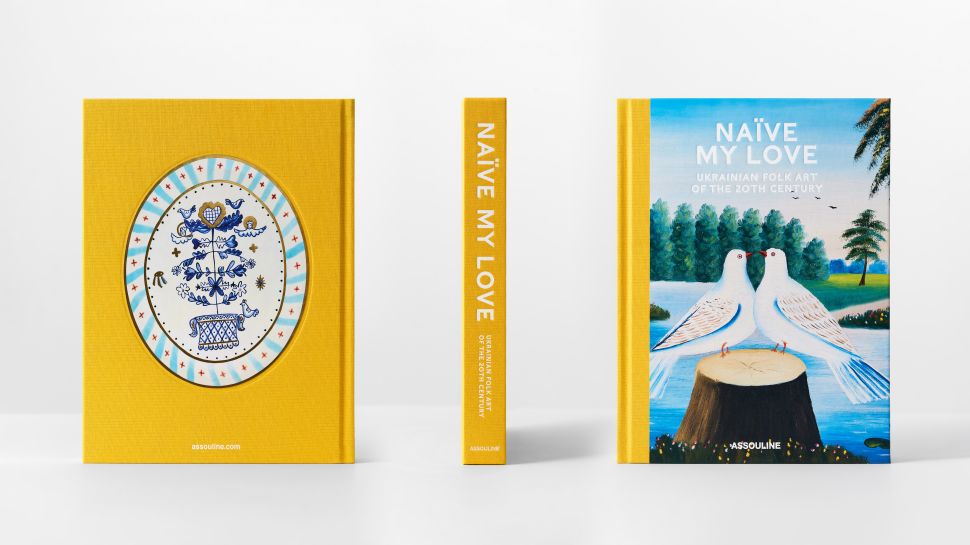
Assouline shown from the back, spine and front, featuring a yellow cloth binding, a decorative floral illustration and a cover painting of two white doves in a landscape.” width=”970″ height=”546″ data-caption=’GUNIA Project and Assouline recently launched the imprint’s first-ever book dedicated to Ukrainian culture. <span class=”lazyload media-credit”>Courtesy GUNIA x Assouline</span>’>
What happens to a country’s artistic identity when its history has been repeatedly written by those who sought to control it? For Ukraine, the question predates Russia’s full-scale invasion by well over a century. Long before Russian tanks crossed its borders, Ukraine’s cultural identity had endured centuries of pressure. Imperial restrictions on its language and institutions came first, followed by a Soviet system that sought to control not only cultural and artistic production but also how that production was understood, circulated and preserved.
In the 1920s, Soviet Ukraine experienced a significant cultural renaissance, as artists, writers, filmmakers and theater directors developed an extraordinarily sophisticated modernist culture. Kyiv, Kharkiv and Odesa became important centers of artistic experimentation, taking part in the same international debates that shaped modernism elsewhere in Europe. This flourishing chapter was documented in “In the Eye of the Storm: Modernism in Ukraine, 1900–1930s,” an exhibition held at the Museo Nacional Thyssen-Bornemisza in 2024. In 1932, however, Soviet authorities dismantled independent artistic organizations and moved toward a centralized cultural system. They eventually established Socialist Realism as the official doctrine, requiring art to serve the ideological objectives of the Communist Party.
Several artists who emerged in this period, such as Kazimir Malevich, Alexandra Exter and Sonia Delaunay, had significant biographical or creative ties to Ukraine. Yet their contributions were often subsumed into broader Russian or Western European art-historical narratives.
While the renaissance of Ukrainian modernism was brutally curtailed under Stalin, the country’s folk traditions occupied a more ambiguous position. They were celebrated as expressions of regional identity yet frequently confined to a politically convenient image of rural innocence. It is this rich and often misunderstood heritage that a new Assouline volume, Naïve My Love: Ukrainian Folk Art of the 20th Century produced in collaboration with GUNIA Project, now brings into international focus. The book offers a more deeply rooted, culturally specific lens through which to understand Ukrainian art, its myths, folklore and vernacular traditions, beyond the narratives imposed by external powers.
“The idea came from this vision of telling the world about Ukrainian naïve art. We dreamed of publishing it with Assouline because we wanted to reach not only Ukrainians but a much wider audience,” Maria Gavryliuk, who co-founded GUNIA Project with Natalia Kamenska, tells Observer. Launched in Kyiv in 2019, GUNIA Project is a Ukrainian design and lifestyle brand dedicated to preserving and reinterpreting the country’s rich cultural heritage through contemporary craftsmanship.
Beyond its commercial activities, GUNIA Project has increasingly positioned itself as an advocate for Ukraine’s artistic heritage, particularly as Russia’s ongoing invasion threatens the survival of historical works and cultural sites. In the process, the brand has become a cultural ambassador for Ukraine. It collaborates with museums and artisans to preserve traditional techniques while confronting what this kind of cultural guardianship means in wartime. The collaboration with Assouline extends that mission beyond contemporary design into art-historical research and publishing. It brings renewed attention to generations of Ukrainian self-taught artists whose contributions have remained largely overlooked internationally.
The book’s introduction evokes the Ukrainian village of the late 19th and early 20th Centuries as a vibrant center of artistic production and craftsmanship. Women preserved family traditions in weaving, painting, decorating their homes, embroidering clothing and making special ritual cloths known as rushnyks, lovingly passing these skills from generation to generation. Men often practiced woodcarving and painted chests and canvases.
Malevich, who grew up in the Ukrainian countryside, recalled these practices in his autobiography, acknowledging their profound influence on his decision to become an artist. “The villagers, as I’ve said before, made art (a word I didn’t know then). Rather, people were doing things that I really liked. It was these things that held the secret to all my sympathy for the peasants,” he wrote. “I watched with great excitement as the villagers painted their houses, and I helped them smear clay on their floors and paint patterns on their stoves. The peasant women did wonderful depictions of roosters, horses and flowers. The paints were all prepared right there from different clays and blue pigment.”
“Artists such as Alexandra Exter and even Kazimir Malevich worked with naïve artists and village artists. They exhibited together and worked together,” Lidia Lykhach, an art historian and the book’s editor, tells Observer. “Around the world, people know names such as Malevich, Sonia Delaunay and Alexandra Exter, but not many know that they were influenced by Ukrainian naïve art. This book opens those pages, too.”
Delaunay was also shaped by childhood impressions of village celebrations and everyday rituals. They nurtured a chromatic sensibility and an appreciation for craftsmanship that continued to inform her experiments with geometry and rhythmic color relationships in Simultanist abstraction. “I love the pure, bright colors of my childhood, of Ukraine. I remember the village weddings of my country where red and green dresses decorated with countless bows flew around in dance,” Delaunay once recalled.
The task of telling this long-overlooked story of unexpected influences and neglected perspectives fell to Anna Lodygina, a journalist accustomed to writing about the avant-garde. “The goal was to write about Ukrainian naïve art in an accessible language for an international audience that may never have read about these artists,” she explains, noting that Ukrainian culture remained largely invisible to international audiences for decades. “Ukraine spent centuries under Russian imperial and Soviet rule, which sought not only political control but also to suppress or obscure Ukrainian culture and its distinctiveness.”
This is the first book Assouline has dedicated to Ukraine, and the publisher deliberately chose to approach the country’s rich artistic culture through so-called outsider artists. It was precisely their position outside formal institutions that allowed these forms of expression to retain a degree of autonomy from the aesthetic prescriptions imposed on officially sanctioned art. “For a very long time during the Soviet occupation of Ukraine, the academic art community did not notice naïve art because the only officially sanctioned artistic method was Socialist Realism. So naïve art remained invisible and untouched,” Lodygina says.
The crucial nuance, she adds, is that Soviet authorities did not simply prohibit folk art. They selectively promoted it within the broader Soviet cultural agenda, shaping the narrative around these artists to fit the prevailing ideology. Lodygina cites Maria Prymachenko and Kateryna Bilokur as examples. “They were portrayed simply as folk artists living in villages, enjoying a nice life, working on farms, and still finding time to paint flowers, interesting animals or village scenes. That was the image presented of them.”
Much of this art was rooted in everyday life, from decorating cups, plates, carpets and homes to embellishing practical objects used outside the home. It also interpreted the surrounding world through archetypal forms that lent daily existence a deeper symbolic dimension. Ancient symbols of life, fertility, wisdom and protection appeared on household objects, interwoven with the earthy routines of daily life and the belief systems through which people sought to understand the world and imbue it with meaning and beauty. Many of these artists had no formal training and did not necessarily consider their creations fine art. “They simply made what they found beautiful,” according to Lodygina.
The book is the result of years of painstaking research, made all the more challenging by decades of loss and repression. During our conversation, the authors stress how difficult it was to locate objects, identify their makers and reconstruct the circumstances in which they were created. Many of these works survived precisely because they were kept in private homes, sometimes treated as ordinary household objects or even repurposed as building materials, rather than recognized as worthy of museum preservation. “What is especially important about this book is that this art is fragile. It is very important to preserve it and show it to the world,” Kamenska emphasizes.
Working with Ukraine’s leading art museums, GUNIA Project spent several years researching and preserving this heritage. The team conducted expeditions across the country and collaborated with archives, museums and artists’ families to document works that had been scattered, forgotten or were at risk of disappearing—including research undertaken during wartime. This extensive ethnographic investigation also informs the brand’s contemporary collections, which reinterpret historical motifs and traditional craftsmanship through collaborations with local artisans. “It started as a hobby, out of our love for Ukrainian traditional culture. We were exploring Ukraine, and naïve artists and painters were especially interesting to us,” Kamenska says. “We began working with their art as inspiration and translating it into contemporary design objects.”
She cites the artist Polina Raiko as a particularly poignant example. Raiko’s painted house in Oleshky, featured in the book, was severely damaged in June 2023, when flooding after the destruction of the Kakhovka Dam inundated the property and destroyed most of her paintings. Raiko endured one personal tragedy after another. After her daughter’s death in a car crash, her husband’s passing and her son’s imprisonment and death, she painted her first dove on the gate to her yard, at age 69. “From the dove she moved onto the walls of her empty home, its ceiling and doors, redefining her life by creating inimitable pictures in simple, high-gloss house paint. Here were her sisters looking like angels sitting on a half-moon; here was her husband in a boat with the fishing pole he’d dreamed of; here were her children with their guardian angels,” the book reads. Her entire home became a deeply personal temple to grief and the longing for transcendence. It embodies art’s universal cathartic power to help us confront the limits of our earthbound, time-bound existence.
With Russia’s full-scale invasion now in its fifth year, and the broader Russo-Ukrainian conflict extending over more than 12 years, much of this heritage has been lost or placed at serious risk. Kamenska and Gavryliuk also recall the destruction, at the start of the invasion, of a museum housing works by Prymachenko, whose art is now internationally recognized. (Staff members and local residents risked their lives to save dozens of her paintings.) Works from threatened museum collections have since been moved to western Ukraine for safekeeping, part of a broader effort to protect the country’s artistic heritage.
The book thus becomes an important repository of these stories, allowing the works to survive in images and preserving the memory of the artists who made them. These records inevitably also bear witness to the humanitarian crisis that has unfolded in Ukraine over the past several years, documenting not only what has been lost but also the cultural richness that remains at risk.
Even amid this tragedy, the authors hope readers will find beauty and creativity to recognize, celebrate and preserve. “Our biggest dream is to show the beauty of Ukraine,” Gavryliuk says. “Most people now hear news about Ukraine only in connection with the war or other difficult conditions. We want to show that Ukraine has many extraordinarily talented people and its own truly unique culture and identity.”
The publication also aims to generate wider interest among international curators, collectors and readers. Beyond widely recognized figures such as Prymachenko, many of the artists in the volume remain little known internationally, though they deserve a place in broader accounts of naïve art. “We want to bring attention to them because we believe they have a place in the international naïve art scene. That is our idea: to talk about them and attract more attention,” Gavryliuk argues. “We have a great deal to share with the world—not only in contemporary forms, but also through our cultural heritage and the ways we bring these ideas into the modern world. Above all, we want to share the positive and beautiful things we see in Ukraine.”