
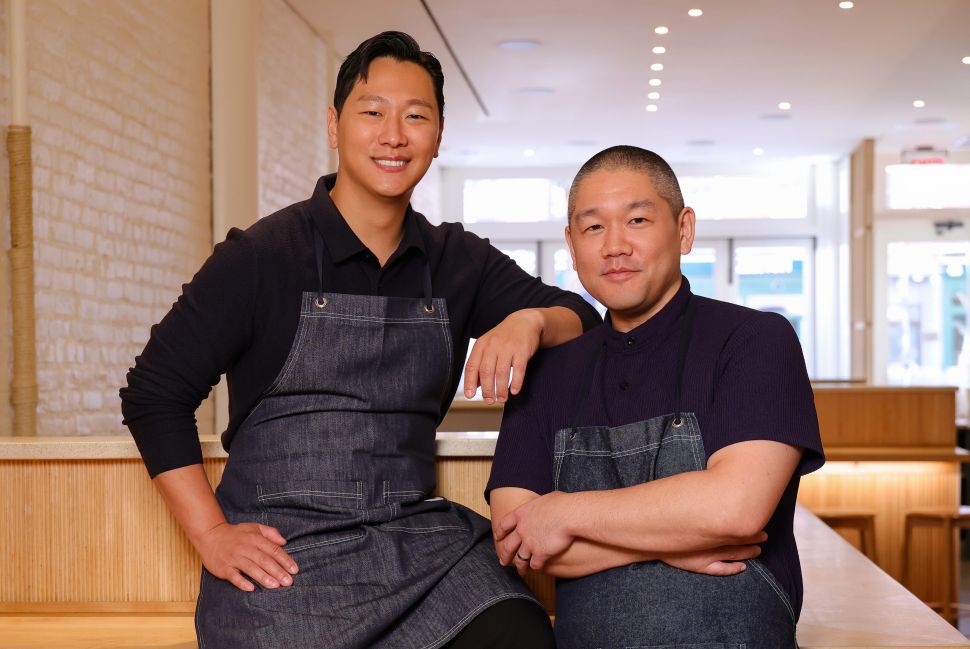
Jihan Lee and Takahiro Sakaeda, in dark shirts and denim aprons, stand side by side in a restaurant with white brick walls and light wood detailing.” width=”970″ height=”650″ data-caption=’Launchpad Hospitality chef partners Jihan Lee and Takahiro Sakaeda are taking TBD Gimbap permanent while Nami Nori prepares to expand to West Palm Beach, Florida. <span class=”lazyload media-credit”>Beige Salad Studio</span>’>
Jihan Lee and Takahiro Sakaeda are chef partners at Launchpad Hospitality, the group behind Nami Nori and this year’s TBD Gimbap pop-up. Nami Nori now operates five dine-in restaurants in four states. The partners say those restaurants serve more than 7,500 diners a week and that the business grew 40 percent last year. From mid-March through August, TBD Gimbap operated out of the former Postcard Bakery space next door to Nami Nori in the West Village, rolling about 350 gimbap a day and usually selling out by 4 p.m.
On Aug. 15, the Mets’ Korean Heritage Night drew 34,737 fans to Citi Field, and Lee says TBD Gimbap sold close to 1,000 rolls there. On Oct. 8, it popped up at Taste of Asia in Madison Square Park. The partners now plan to give the concept a permanent Manhattan home backed by a new commissary kitchen.
Sakaeda and Lee opened Nami Nori in the West Village in 2019 with managing partner Lisa Limb. Pharrell Williams joined Launchpad as a partner and advisor in 2024, and Nami Nori opened at Atlantic Park in Virginia Beach, Virginia, last October. Next is a 4,300-square-foot Nami Nori in West Palm Beach’s Nora District, Florida, expected in the first half of next year. In May, the partners hired Launchpad’s first COO, Ryan Suh, who was Blue Bottle Coffee’s growth director for North America before leading its expansion into Korea. Lee and Sakaeda are 2026 Observer Nightlife & Dining Power List honorees.
Why gimbap? What did you want New Yorkers to understand about it?
Jihan Lee: Good gimbap was hard to find in New York, and for Koreans it’s deeply nostalgic. My mom made bulgogi gimbap at 5 a.m. before my taekwondo tournaments and fishing trips. She always wanted at least one Korean meal a day, so to me, gimbap was never a snack. It’s a complete meal someone makes by hand so you can go do something.
I spent years in a sushi kitchen, where the craft is treated like art, and gimbap deserves the same seriousness. The rice, the seasoning and the way every filling is cut and layered so each bite is balanced—that’s technique. I wanted New Yorkers to see that gimbap isn’t “Korean sushi” or a convenience-store afterthought. Made right, it’s one of the best handheld meals in the world.
TBD Gimbap kept selling out and closing early. What did running out teach you?
Lee: Every filling was made fresh each morning, and storage was tight, so when a big group ordered in bulk, there was no way to make more. Selling out taught us demand was greater than we expected—and we had high hopes. People lined up for something most of them had never eaten. New restaurants create lines; only the good ones keep them. Selling out feels good once, then it’s a problem. It pushed us to bring in our commissary kitchen, and that’s the foundation for going permanent.
What was it like taking TBD Gimbap to Citi Field?
Lee: Surreal. I never imagined serving my mom’s bulgogi gimbap at a Mets game. We rolled close to 1,000 out of a stadium concession, and Citi Field told us it was the longest pop-up line they’d ever seen. What stuck with me was who bought it: New Yorkers, including some Korean families who told us it tasted like home and younger kids who’d never heard of it before. Gimbap always belonged in a stadium.
Where did Nami Nori’s open-style temaki come from, and when did you first notice other restaurants copying it?
Takahiro Sakaeda: At Masa, we served an open-style temaki near the end of the omakase, a style that already existed in Japan. We were also inspired by Brazil’s temakerias, where whole restaurants are built around the hand roll. The open U-shape became our canvas: Like nigiri, you can see every ingredient.
Our innovation was building an entire restaurant around that format, down to the holders we designed. As far as we know, we were the first to bring it all together. Within a couple of years of opening in 2019, we started seeing the format everywhere, sometimes down to the holders. We take that as a sign we got something right.
How did Pharrell Williams become a partner, and what does he actually weigh in on?
Lee and Sakaeda: Pharrell first tried our temaki when we catered the launch of his auction house, Joopiter. He started coming into the restaurant, became a fan and eventually a partner.
He weighs in on creative direction and growth. He brings a lens from music, fashion and culture that pushes us beyond how operators and chefs usually think. He also has a strong instinct for where the energy is going. That’s especially valuable as we choose where Nami Nori goes next.
Why Virginia Beach?
Lee and Sakaeda: Pharrell brought us Atlantic Park, a project in his hometown he’d been building long before we met. When he told us a surf park was at its heart, the stars aligned: Nami Nori means “surfing” in Japanese.
We want it to be a gathering place where locals meet friends, bring their families or stop in after a session. Being part of Pharrell’s vision for his hometown makes that especially meaningful.
After years of fast growth, you paused to hire a CEO and write Launchpad’s first strategic plan. What made you stop?
Lee and Sakaeda: In six years, Nami Nori went from a counter in the West Village to five restaurants in four states, plus catering events around the globe. Almost every one of those moves started as a yes to an opportunity, not as part of a plan.
As we enter this next phase of growth, we will continue to trust our instincts, but we knew the next five restaurants couldn’t be built the way the first five were, on pure energy, guts and late nights. So we paused and brought in a CEO, then Ryan as COO. Since then, with a fresh perspective, we wrote Launchpad’s first five-year strategic plan.
See all of Observer’s 2026 Nightlife & Dining Power List honorees.