
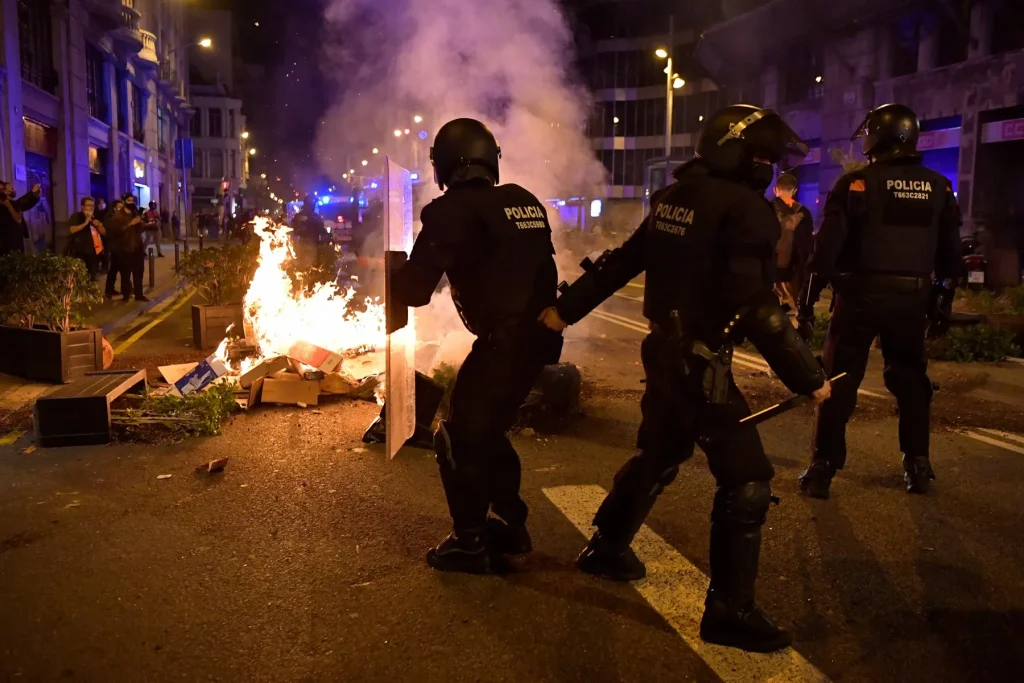
Spanish police are conducting a probe into what sparked the sudden wave of looting and rioting in Barcelona over the weekend, with experts pointing to social media and even foreign actors as being behind the unrest.
The Catalan capital is still recovering from the disturbances that took place on Saturday night in the city centre.
Police made 128 arrests overnight in Barcelona for acts of “vandalism”, damage to public property” and “looting”, the regional Catalan police said on Sunday.
READ ALSO: Spanish police make 128 overnight arrests in Barcelona for ‘looting’
Fourteen police officers were reportedly injured, several of them seriously.
Aldarulls al centre de Barcelona en el marc d’una protesta convocada per suposats estudiants a través de les xarxes socials Els Mossos han efectuat càrregues per dispersar els concentrats i alguns esvalotadors han fet destrosses a vehicles, comerços i mobiliari urbà https://t.co/W3jLbZRjoi
— RTVE Notícies (@rtvenoticies) October 24, 2026
This comes as a wave of housing and pensions protests sweep Spain during the general election campaign ahead of polling day on November 29th, the majority of which have been peaceful.
The Chief Commissioner of the Mossos d’Esquadra, Silvia Catà, said Sunday: “These are not groups of young people or individuals wishing to demonstrate to demand a right. They are people who gather in small groups of just a few individuals to carry out acts of vandalism.”
“They are copying what is happening in France,” he added.
Grupos de WhatsApp, TikTok… ¿injerencia extranjera? Los ejecutores del caos en los altercados de Barcelona fueron jóvenes e incluso menores no ideologizados, pero la infraestructura fue tecnológica y los investigadores no descartan un ataque híbrido Cristina Rubio y Quico Alsedo
— EL MUNDO (@elmundoes) October 26, 2026
The scenes come at a time when countries across Europe have been grappling with unrest, with France, Italy and Albania all seeing protests give way to incidents of looting and violence.
Reports in the Spanish media, however, suggest that police sources believe the looting was inspired by events in France and subsequently organised on social media.
READ ALSO: Lawmakers say EU must probe social media role in protests
Catalan Mossos d’Esquadra police are monitoring social media in an attempt to identify those responsible for a protest that led to 23 shops being vandalised and street furniture and vehicles being set alight in the area around Plaça Catalunya.
The protest was organised via the anonymous platform Blocus, which called for the demonstrations in France for the “dignity of secondary schools” to be replicated in major Spanish cities.
Of those arrested, 72 were reportedly minors.
The Blocus call to action also had an impact in Madrid, according to police sources, though it did not lead to the serious incidents that occurred in Barcelona.
The Chief Commissioner of the Mossos d’Esquadra, Silvia Catà, told Catalan radio on Sunday that in collaboration with other European police forces, work was already underway to “monitor” the spread of the call to action, which mainly gained traction via TikTok, a platform widely used by minors.
The platform included a QR code to join Telegram or WhatsApp groups where instructions were given on how to take part in the protest: dressed in black, with their faces covered and, if possible, carrying fireworks.
Digital experts have identifed two levels of online organisation.
“On public social media platforms, there was talk of rallies, whilst on private ones, such as WhatsApp or Telegram, which are the ones they used to organise themselves, there was talk of looting,” social media analyst Marcelino Madrigal explained to TVE, having already warned earlier in the week that a call to action was brewing in Barcelona that essentially sought to loot shops.
Police sources told Spanish daily El Mundo that no hypothesis can be ruled out regarding the organisation, despite appearing to be spontaneous, not even the involvement of a foreign actor, be it Russia or another country seeking to destabilise Spain.
In the midst of an election campaign, political point scoring quickly came into the analysis.
Feijóo dice que Sánchez está “jugando con fuego” y le señala por los disturbios en Barcelona: “Se están resistiendo a abandonar el poder con violencia” https://t.co/41qzu2Hbmq
— Europa Press (@europapress) October 25, 2026
The leader of the centre-right People’s Party, Alberto Núñez Feijóo, linked the riots to the Prime Minister Pedro Sánchez.
He claimed that Sánchez has “undermined” law and order in Spain and is “playing with fire”.
At a rally in Salamanca, he stated: “They are resisting relinquishing power through violence”.
Gabriel Rufián, far-left ERC candidate, for his part, said on Sunday that it is “quite likely” that the far right “is behind” the disturbances.
With reporting from AFP.