
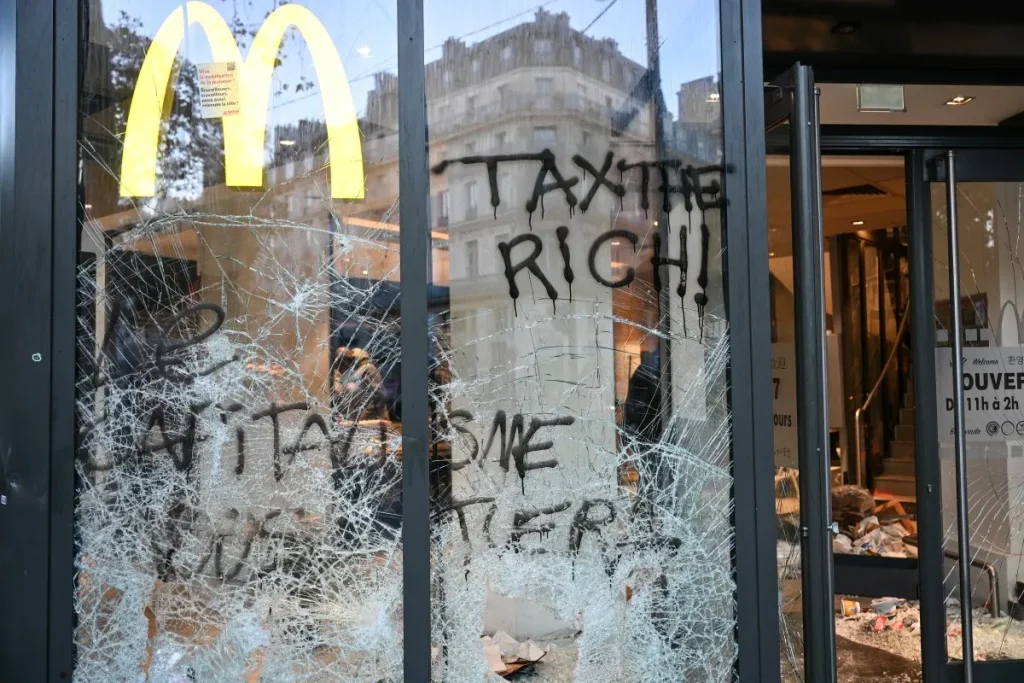
An uneasy calm has returned to the shattered streets of French cities since the weekend – writes John Lichfield – but the explosion of violence seen on Saturday is not over.
The Gilets Jaunes – whoever they may be these days – have called another day of marches this Saturday. The main French trade union federations have ordered a day of strikes and protests on November 5th (inviting Bonfire Day to cross the Channel).
Both insist that their events will be peaceful. Both know that they will provide occasions for the amorphous groups behind the orgy of violence and looting on Saturday October 17th to smash up the streets and attack the police again.
READ ALSO: Protests in France: What to expect on Saturday, October 24th
France – and especially the French Left – has a strange relationship with political violence. Supposedly moderate leaders of the Left and trades union have condemned the violence this week while suggesting that it is somehow an inevitable response to nine “brutal” years of Macronism (so brutal that the state still spends 30 percent of GDP on pensions and other social benefits, little different from 2017).
Jean-Luc Mélenchon’s La France Insoumise (LFI) can scarcely bring itself to condemn street violence at all. It is always the fault of the government or the police.
Is LFI responsible for fomenting last weekend’s violence as the government claims? Not directly maybe. Atmospherically, certainly.
There was a chilling moment in the National Assembly on Tuesday. The LFI group president Mathilde Panot was challenged by the Prime Minister Sébastien Lecornu to condemn the burning down of the Limoges town hall on Saturday in what appears to have been a planned attack by a group from the ultra-left. Madame Panot looked panicked for a couple of seconds before she changed the subject to police violence.
Consider that. The parliamentary leader of a supposedly democratic party was unable to say that she thought, on the whole, that burning down town halls is a bad thing.
It is no accident that Saturday’s uprising happened six months before the Presidential election. This is just a dress-rehearsal for what may happen if Marine Le Pen wins. The hard left is already warning of a “third round” on the streets if the Far Right enters the Elysée Palace.
It is important to try to be precise, even though the situation is confused. The LFI did not plan last Saturday’s uprising. It has no control over the hard-core ultra- left, the so-called “black blocs”, even if a couple of its deputies have well-documented connections with splinter-groups of the violent, extreme Left.
What is true is that Mélenchon and the LFI have for weeks been winding up the political rhetoric surrounding a justified lycée protest movement. What is also true is that Mélenchon sent a tweet during the worst of Saturday’s violence which rivalled some of Donald Trump’s Truth Social outpourings in its malignant stupidity. It showed peaceful marches elsewhere in Paris and said: “Look, all calm and joy where there are no police”.
In other words, according to Mélenchon, it was the police who initiated the weekend violence against masked youths armed with molotov cocktails, agricultural bird-scaring rockets and hammers.
Many questions remain. Why did Saturday’s violence spin so far out of control? Will the same happen this weekend and again on November 5th?
Two things conspired to make the weekend’s violence the worst I can remember in 30 years of covering France.
The numbers of the ultra-left casseurs (smashers) on streets were far greater than usual, not just in Paris, but in Lyon, Marseilles, Bordeaux and almost every large French city. The internal security services failed to anticipate this surge of support for a nebulous movement with no clear leaders.
READ ALSO: ANALYSIS: Who are France’s ‘casseurs’ and why can’t police stop their violence?
The government put far too few police on the streets of French cities – 60,000 in all, compared to 90,000 at the height of the Gilets Jaunes movement in December 2018.
The riot police were overwhelmed. The word spread on social media. A second, largely apolitical, wave of opportunistic young looters from the poor inner suburbs poured into Paris, Marseille and elsewhere. They smashed and looted 2,000 shops across France (and more on Sunday).
Why were the numbers of the so-called “black blocs” so great? This is an important question with no simple answer. The ultra-left claims to be a justified response to the “violence of the bourgeois, capitalist state”. It has traditionally drawn its members from the bourgeoisie that it detests, rather than the “suffering” working class (who have turned rather to the Far Right).
The size of Saturday’s violent protests – almost an insurrection at times– cannot be entirely blamed on Mélenchon and the LFI. It suggests that support for such anti-democratic, “smash-the-state” ideas is growing as jobs for the middle class young dry up. One masked activist on Saturday carried a placard which said: “five years of study, a diploma and now nine rejections a day”.
The remains of the Gilets Jaunes movement in 2020 was partly violent and far left. They probably joined in.
There seems also to be some crossover with pro-Palestine movements radicalised by the Gaza confict. This was not the Islamist “intifada” that some right-wing French politicians have claimed but there was a scattering of Palestinian flags among the violent and non-violent protesters alike.
The government believes that LFI comments justifying the violence of the lycée protests since September have contributed largely to the infusion of new blood to the ultra-left. The refusal of Mélenchon and Panot to condemn even the worst of the violence last weekend suggests that the government may be right.
What happens now? Further violence this Saturday and on November is inevitable. The government will deploy more police and some troops. The riots, and especially the looting, will probably be less severe.
Any further explosions of violence will pile humiliation on the discredited centre-ground of French politics in the dying days of Macronism. The first poll opinion since Saturday’s events suggests that they have further increased the insolent lead of Marine Le Pen in the spring presidential election. Mainstream candidates like the former centrist Prime Minister, Edouard Philippe, are suffering by association with Macron. Mélenchon rose slightly.
The longer the violence continues the more France may become polarised between its political extremes. The ultra-left protesters – priggish or sincere, genuinely suffering or driven by empty-headed nihilism – are bringing France closer to rule by the Far Right that they detest. Their response next May will be more violence.