
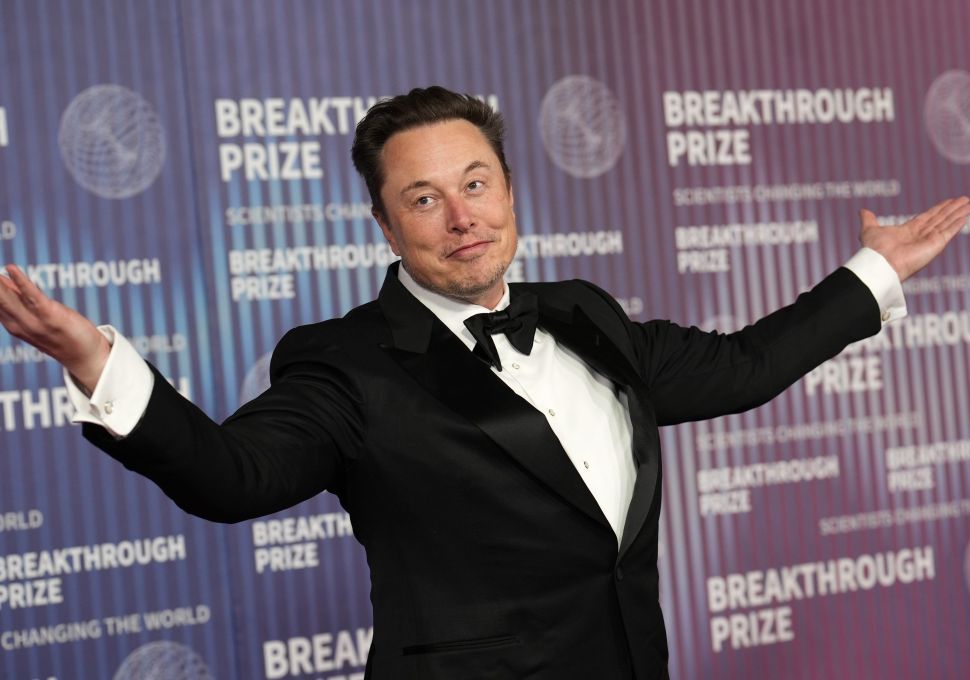
Elon Musk on April 13, 2024.” width=”970″ height=”681″ data-caption=’Elon Musk is pursuing robots, chips and a possible SpaceX combination as Tesla’s vehicle deliveries stall. <span class=”lazyload media-credit”>JC Olivera/WireImage</span>’>
Elon Musk has had a whirlwind week of earnings reports for his collection of companies. SpaceX reported earnings on Oct. 20, with Musk hinting at a tie-up between Tesla and SpaceX. The next day, Tesla reported earnings, lowered its capital-spending outlook, and executives noted that both boards had formed special committees to explore a potential merger. Neither company has announced a merger agreement.
Tesla’s vehicle deliveries have stalled and its profit is shrinking as it spends on projects beyond cars. Musk’s answer is a possible SpaceX merger that, in analyst Sam Abuelsamid’s view, is mainly about Musk himself.
The possible merger is “more about Elon consolidating his control,” Sam Abuelsamid, vice president of market research at Telemetry, tells Observer. Abuelsamid points out that a year ago, there was plenty of coverage about Musk’s enormous pay package, which centered on the idea that he wanted to increase his stake in Tesla. “He already has that controlling stake in SpaceX,” Abuelsamid says. Depending on how a potential deal is structured, the analyst argues, Musk could end up with more control over Tesla than he has today.
Tesla delivered 486,532 vehicles in the third quarter, about 2 percent fewer than a year earlier, and net income attributable to common shareholders fell about 43 percent to $787 million as spending on robots and A.I. climbed. A day earlier, SpaceX reported a $4.4 billion profit, and Musk said merging his two companies would be a good idea. Tesla now expects more than $20 billion in capital spending this year, down from a prior outlook of more than $25 billion. Those forecasts do not establish an exact $5 billion cut.
The Tesla Roadster stunt
The Tesla Roadster relaunch on Oct. 15 sparked some initial talk of a potential SpaceX-Tesla deal. In Texas, Tesla unveiled a new SpaceX-powered Roadster, with a flashy Hollywood stunt showing the car launching itself into the air and flipping using SpaceX technology. At the time, analysts believed that the show indicated a future Tesla-SpaceX deal, and Tesla stock popped after the reveal.
The Roadster has been in the works for nearly 10 years, and the flying version that Musk showed off in Texas is unlikely to ever see production, as Abuelsamid points out, for a multitude of safety and practicality reasons.
Abuelsamid thinks Tesla might build only one or two for Musk or his closest friends. He describes what the company showed as “so ridiculous,” questioning its safety and practicality. He calls the flying version “even dumber.”
Abuelsamid says that the Roadster stunt was largely another ego-driven move by Musk, aimed at silencing his critics and pleasing his most dedicated fanboys. Musk showed off and took $50,000 reservations for the second-generation Roadster back in 2017, and those reservation holders are still waiting for the vehicle.
As The Drive points out, the fine print in the document customers sign to reserve a new Roadster today, which is theoretically planned for production in 2028, notes that Tesla cannot guarantee when, or if, the car will ever be delivered.
Musk is pushing to turn Tesla into a robotics company and is considering a combination with SpaceX. On SpaceX’s Oct. 20 earnings call, he said such a deal would require affirmative votes representing half of Tesla’s outstanding shares, not simply half of the votes cast. SpaceX’s Oct. 22 filing says its committee, board and controlling shareholder—Musk—would also have to approve a transaction.
Robotics, autonomy, chips and data centers
Musk has shown off his bipedal robots, called Optimus, and said on the Oct. 21 earnings call that early production had begun at Tesla’s Fremont, California, plant, but as Abuelsamid points out, Musk’s humanoid-robot plans are a poor fit for the companies that could actually afford them. He notes that specialized industrial robots can do repetitive tasks on a manufacturing line faster, more reliably, more safely, and more cost-effectively. He also doubts Musk’s characterization that humanoid robots will become common household helpers.
Part of that robotics bet, Abuelsamid says, is related to Tesla and SpaceX’s ambitions as a chipmaker. The planned Terafab complex in Texas is a manufacturing joint venture between the two companies. Musk said on the SpaceX earnings call on Oct. 20 that he is aiming for volume production at the Terafab complex by the third quarter of 2028, a timeline he called “very aggressive,” according to Reuters.
Abuelsamid says the chip fab could give Tesla more control over its chip supply and reduce reliance on companies like TSMC or Samsung, especially as demand for chips grows, driven largely by data centers and A.I. He says the fab will likely cost much more than retooling Fremont for robot production. SpaceX’s broader Super Intelligence segment accounted for about 52 percent of its third-quarter revenue; that includes software and computing infrastructure, not just renting out data-center capacity.
Abuelsamid says Tesla’s shift away from a one-time purchase for Full Self-Driving has helped its subscription business. Tesla reported more than 1.7 million paying FSD customers globally, about half on subscriptions. The consumer product is called Full Self-Driving (Supervised) and still requires an attentive driver. Musk continues to push autonomous driving, but Abuelsamid criticizes Tesla’s reliance on “untrained consumers as your test drivers.”
Given all this, Abuelsamid’s view is that Tesla and Musk are looking for growth for the company beyond just vehicle sales through robotics, autonomy, and software, because he doubts Tesla will become the dominant automaker that some advocates once predicted, and that Musk wanted.
Abuelsamid credits Tesla with “significant positive impacts,” including helping make electric vehicles mainstream. But he argues that much of that progress came despite Musk, rather than because of him. His comparison is the classic gold rush: Aside from a few prospectors, the people making the picks and shovels made the money. Here, he says, those are the companies selling computing time and chips.