
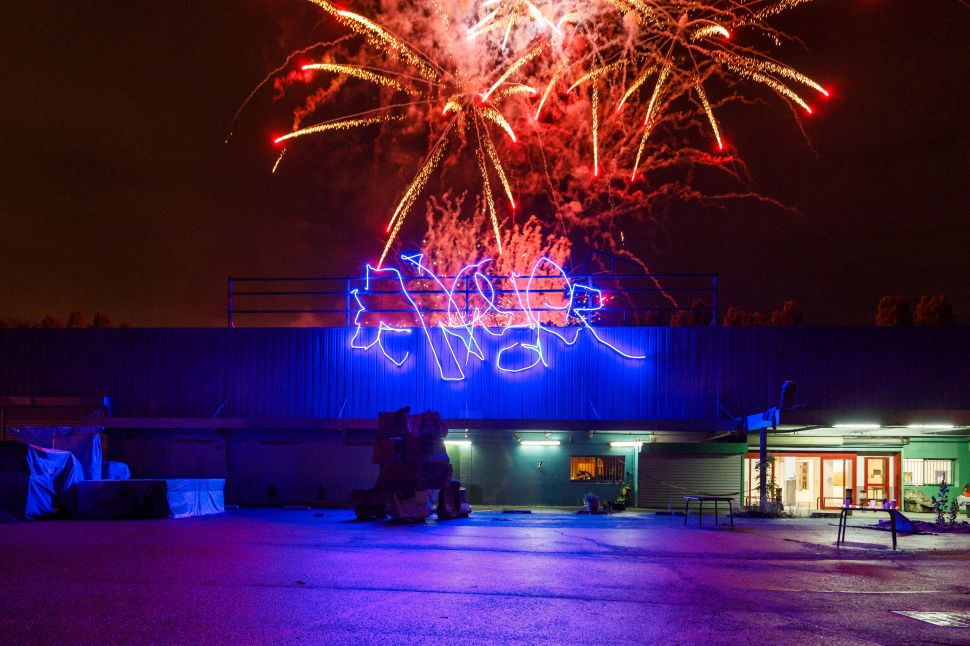
It’s a familiar dynamic in major cities: artists, pushed toward neglected industrial buildings and overlooked neighborhoods in search of affordable studio space, end up revitalizing those areas—only to attract real estate developers and set in motion the gentrification that eventually pushes them out. This trajectory is not inevitable, however. In Paris, the communal artist-run production studio Le Wonder has developed an alternative model in which artists build and sustain a community on their own terms, negotiating directly with property owners, legally occupying disused buildings and creating a shared infrastructure that they would struggle to afford individually.
After more than a decade and several relocations, Le Wonder transformed a 6,000-square-meter former industrial garage in Bobigny into a multipurpose facility that combines studios with extensive production capabilities, from ceramics and glass workshops to a foundry, as well as storage. Today, the site accommodates around 70 artists and has workshops, studio space and public programming. It is now preparing to expand in size and scope; part of its storage facilities will eventually house works from Parisian museum collections.
Observer spoke with Le Wonder’s founder, artist Nelson Pernisco, about how the initiative, which began as an artists’ collective in Paris, has evolved into a model that could offer valuable lessons to artists facing similar challenges in major cities around the world. We first met him in Gwangju during the opening of the Biennale. He had just unveiled one of his monumental articulated installations in “2 Feux, 2 Flammes,” a major exhibition at the Jeonnam Museum of Art that brought South Korea and France into dialogue.
Working at the intersection of sculpture, architecture, industrial archaeology and speculative landscapes, he explores the relationships among built environments, systems of power, instability and decay. His art’s engagement with the transformation of industrial and urban ruins, which extends naturally into anthropological and sociological territory, finds a striking parallel in his commitment to Le Wonder, where disused buildings become the infrastructure for collective creation.
Pernisco recalls that everything began when he was invited to stage an early solo exhibition in a squat. He encountered that underground world just as he was entering art school in Paris, where he’d been disappointed by what he perceived as a privilege without genuine commitment. The creative energy and freedom of expression he found in the squat stood in stark contrast. “The people were really committed, but they were not really making art. They were cleaning the space so they could welcome more projects,” he says. “I felt like this commitment to the broom was closer to me than the commitment of the other art school students.” And so he decided to stay.
Artist squats have a long history in Paris, particularly since the 1970s, and are associated with alternative cultural production, collective organization and resistance to real estate speculation. The first squat Pernisco joined, Point G, occupied a relatively small space near the Canal de l’Ourcq in the 19th arrondissement. It operated for about a year, between 2012 and 2013, before closing.
The collective then secured access to the former Wonder battery factory, a massive industrial complex near the famous Saint-Ouen flea market. “To give you an idea of the scale, from the entrance to the building we occupied in the complex would take you about 10 minutes to walk,” Pernisco recalls, describing a neglected, heavily polluted site—almost a fortress—that had been completely abandoned. “Nobody took care of the place for decades. There was the whole story of the old battery factory layered there, between the invasive plant that took over the place. For artists, it was just perfect.”
What was initially conceived as a temporary occupation soon became a far more ambitious experiment in artistic self-organization, bringing together dozens of artists who shared not only affordable studios but also equipment, technical expertise and production resources. By 2016, the complex hosted about 60 artists, with 43 private studios, shared workshops, music facilities and spaces for performances and exhibitions.
Together, they repaired the dilapidated building, replacing 86 windows, before gradually opening other structures within the complex and organizing major exhibitions. In the process, they brought new life to the surrounding neighborhood, which bustled on flea-market days but was otherwise neglected. What began as a six-month arrangement was repeatedly extended in three-month increments, lasting about three and a half years.
The collective’s initial governance was highly informal, prioritizing open access and anarchic freedom, with just three or four people carrying much of the practical responsibility. When several founding members left for another squat, Pernisco took it upon himself to give the initiative a more formal structure and ensure its continuity. He established an association with a board anchored by a core of 10 artists who had been involved from the beginning and were prepared to share responsibility for running the organization as it grew. “I changed many things,” he said, “and from that point, we started to be more structured.”
As the demolition of the Saint-Ouen building approached, the collective had to find another affordable space, but market rents were far beyond its means. “We were desperate because there were no real options. I was going to openings and asking people, “Do you have a contact at the cultural ministry?” he remembers, adding that he could never have imagined then that the French state would one day become one of the collective’s direct interlocutors.
A real estate company finally agreed to negotiate directly with the collective, in what Pernisco believes may have been a historic first, since the agreement was reached without any intermediary. The subsequent incarnation of Le Wonder occupied the Liebert building in Bagnolet, a former office building converted into a multidisciplinary environment with artists’ studios, music facilities, a tattoo studio, a restaurant and artist housing. The collective initially paid roughly €60,000 annually, shared among members, before securing a reduction. Its programming grew increasingly expansive, with ambitious exhibitions and projects that Pernisco describes as more like “opera”—multidisciplinary Gesamtkunstwerks or large-scale happenings, highly experimental and underground in spirit. Audiences grew, topping 2,000 people on some evenings. Media attention followed, along with interest from researchers studying alternative art spaces, though the project also drew criticism related to gentrification. Admission was generally free, with beer sales helping to fund activities. The collective remained in that space until 2019.
Le Wonder then moved into a former industrial property near La Défense owned by Bouygues Immobilier, one of France’s largest real estate companies. By then, Pernisco had learned how to negotiate with developers and, more importantly, had come to understand the interests driving these arrangements. In his view, the primary incentive was neither tax advantages nor lower security costs from having artists occupy otherwise vacant buildings. More valuable was the association with artists and culture, which gave developers an appealing narrative for marketing hard-to-sell properties and redevelopment projects. “What I learned from this experience is that they were looking for storytelling,” he explains. “And as artists, it’s very easy to create content.”
The collective also learned that such arrangements could be short-lived, with corporate financial priorities taking precedence. The occupation agreement did not last, and the artists were once again forced to relocate.
Undeterred, Le Wonder pressed on. Reapproached by the real estate company it had worked with before, the collective took over a former printing facility, Fortin/Le Progrès, with about 3,000 square meters across three floors. By then, Le Wonder had begun expanding its shared technical facilities and production equipment, increasingly functioning as a resource for ambitious artistic projects. At the new site, the collective developed specialized workshops for woodworking, metalworking, ceramics, printing, textiles and other disciplines, supporting some 60-70 resident artists and further consolidating its model of artistic autonomy. “It’s the biggest artisan space that I know. There are probably others, but I have never visited them yet,” Pernisco says.
But here, too, the property owner had other plans. In 2023, the building the artists had cleaned up and reactivated was demolished, and the real estate company erected an office building bearing the Wonder name without the collective’s permission. That building still houses two giant sculptures by Pernisco, though it remains largely vacant amid the office-market crisis that followed the pandemic.
Each relocation was an enormous logistical undertaking. Pernisco estimates that moving Le Wonder means hauling 130 truckloads, carrying not only artworks and materials but also reusable walls, electrical installations and fittings. The collective salvages components for its next location and future homes, making reuse a foundational principle of its construction economics. Members draw on the technical expertise within the group, including plumbing, construction and electrical work, supplementing it with labor and materials recovered from other industries. This practical knowledge, combined with a resourceful DIY approach, has been essential to making each renovation financially sustainable.
After so many relocations, Pernisco concluded that continued dependence on private real estate companies threatened the collective’s control over its name, values, finances and future. The group began searching for a public-sector partner, and the municipality of Bobigny responded positively. In April 2023, Le Wonder moved into a 6,000-square-meter former industrial garage at 109 rue de Paris, near the Canal de l’Ourcq, where it remains today. Rather than negotiating another temporary occupation with a private developer, the collective signed an agreement directly with the French state, which owns the building.
At first, the group was given only temporary use of the property, with substantial annual carrying costs that Pernisco put at about €150,000. The collective gathered letters of support from major cultural institutions around the world, only to be told that, with such backing, it should be able to raise the funds itself. Pernisco recalls the paradox of having to ask those institutions to withdraw their support so the collective could make a stronger case for state assistance. Eventually, an agreement was reached.
For Pernisco, negotiating directly with the state was another historic breakthrough. “It was the same as with real estate: it was impossible to access property owned by the state. The door was locked,” he says. “We succeeded in opening this door, and now we are also collectively starting to sign with them.” The agreement set a precedent, prompting public authorities to place greater trust in other small artist collectives. “We’ve been doing a good job that gives confidence.”
The site, which includes extensive outdoor and parking areas, also has expansive storage. In Bobigny, Pernisco began rethinking the collective’s approach to growth. Rather than continually adding members to spread costs, he wanted to give professional artists spacious studios—about 50 to 100 square meters each—where they could employ assistants and take on museum-scale commissions without outgrowing the collective. Keeping membership manageable was also a condition of artistic and organizational continuity. “When it gets too big, artists leave the boat because it’s getting too complicated,” Pernisco says, noting that expanding membership simply to lower individual costs would make the organization impossible to manage.
Whenever a studio becomes available, the collective launches an open call, with new members selected by the board. Collectively owned equipment supports woodworking, metal fabrication, ceramics, glass, foundry processes, film postproduction, audio, fashion and other specialized production. Pernisco says the collective has historically invested between €10,000 and €30,000 a year in equipment. The recently added storage facilities have created another revenue stream, and a photography studio is planned for both internal and external use.
Le Wonder could become a functional model for independent collectives across Paris and beyond. Asked why it is so successful, Pernisco cites technical knowledge, collective responsibility, administrative organization, business planning and the ability to communicate with municipal politicians, property developers and collectors. “I’m a Parisian. I was born in the center of Paris. I learned how to talk to rich people, and I know how to behave with suburban people. For this, it was very important to be able to do both,” he says.
While much of the initiative was improvised early on, the association has grown increasingly professional, developing detailed financial models to guide its decisions and to work with a widening range of stakeholders. “We write a lot of business plans now,” Pernisco says, describing the complex financial structuring that underpins the collective’s operations and future plans.
Recently, Le Wonder faced losing yet another space. As the initial occupation agreement neared expiration, the municipality wanted to move ahead with plans to demolish the warehouse and replace it with housing. This time, the collective entered into more extensive discussions with municipal and state stakeholders, exploring whether it could remain on-site by establishing a viable structure to acquire the property.
Around the same time, a major French institution asked whether the collective still had 1,000 square meters of storage available for a public collection. Coincidentally, a new open call had been announced for another property directly opposite Le Wonder. Pernisco immediately saw the potential to connect these opportunities. “It’s like a click in my head, and I called the department of the region,” he recalls. “I told them on the phone, you’re gonna cancel your open call, and we’re gonna take over this building, and we’re gonna restore that building and install the storage facilities of the city of Paris.”
The proposal was initially met with disbelief, but as Pernisco outlined the plan, officials began to see the possibility of a broader arrangement. “We’ve been doing this job for fucking 15 years,” Pernisco argues. “I told them that what I was proposing to them was something that is solid and real, and with this, we were gonna buy back the Wonder that’s already here, already supported and already linked with all the association and the life of the district. That’s more logical than creating a new place for two years to do parties and then kicking everybody out,” he says. “To my own surprise, they said, “We actually think it is very smart.”
The collective applied to the public call with a substantially revised proposal, which was selected despite departing from the call’s original terms. This opened the way for negotiations beyond another short-term occupation agreement, toward a long-term emphyteutic lease (bail emphytéotique) with a proposed term of 25 years. Le Wonder is now preparing to double its footprint. According to plans Pernisco shared, the combined business and property undertaking could reach €18 million.
Beyond reinforcing the financial sustainability of the artist-run campus, the expansion would make Le Wonder a more comprehensive artistic endeavor, connecting the private and public sectors and bringing together the production, storage, preservation and circulation of art within a model designed to sustain creative independence. It is a model worth examining, as it offers potential answers to some of the sustainability challenges facing the contemporary art ecosystem, on both its institutional and commercial sides.
According to Pernisco, one of Le Wonder’s most valuable qualities has always been its ability to provide a space where artists are allowed to fail, test new solutions and experiment. “I think that’s becoming incredibly rare in our society,” he says. “Creation isn’t a straight line. It’s made of movement, ups and downs, moments when everything takes off and others when everything falls apart. And I think what really matters is having a place where all of that can happen.”
Institutions and companies running similar residency programs are fond of calling their initiatives creative hubs, he observes, but he prefers a different metaphor. “I’ve always thought of Wonder instead as more of a trampoline. Somewhere that helps you rise, sure, but more importantly, somewhere you can bounce back when you fall, because that’s what making art is really about,” he added. Taking those difficult moments seriously, rather than pretending they do not exist, means understanding what artists need to keep creating. “In the end, it isn’t necessarily about money or success. Sometimes it’s just space, tools, some free materials, and a few friends to talk things through with. I think that’s one of the most important things we’re trying to preserve with this project.”