
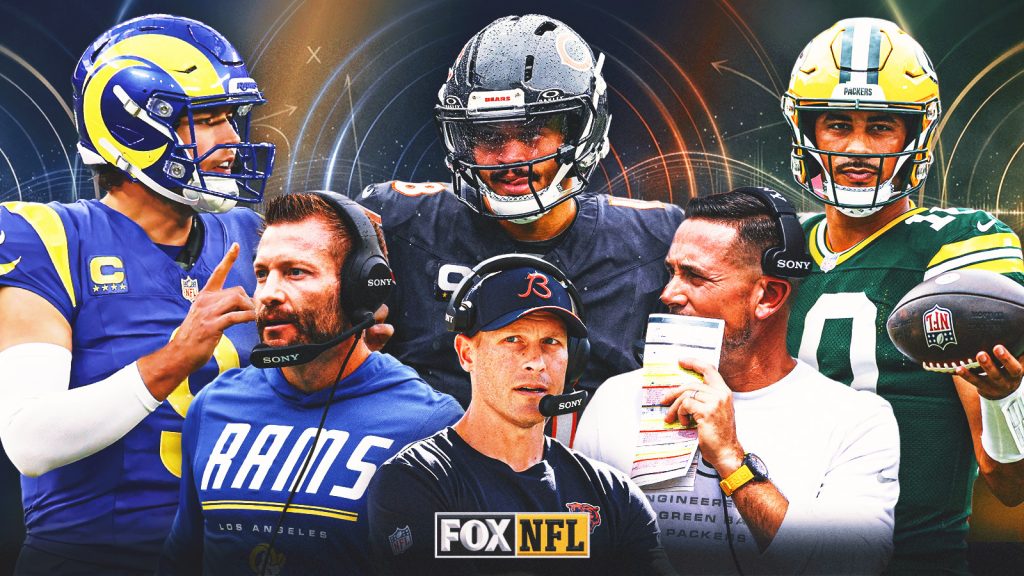
Twenty-five seconds might seem like nothing. But it’s literally everything to a quarterback and his playcaller, because that’s all the time they have to communicate between plays from headset to helmet.
Yes, the NFL play clock allows 40 seconds from when one play ends and when the center snaps the ball for the next. That’s hard enough to manage. But the link between the playcaller and the QB is even shorter. It’s a one-way line of chatter from the playcaller to the quarterback. And after 25 seconds, the headset shuts off.
Those 25 seconds contain weeks, months and sometimes even years of work. It’s the distillation of football’s intricate language boiled down to a concentrated residue.
The ultimate test of communication purity? Well, that’s wins. That’s championships.
So it’s a good thing that Packers QB Jordan Love already knows what Green Bay head coach Matt LaFleur is going to call on a third-and-6. It’s gotten to that point where the QB anticipates his playcaller. That’s because they prepare so thoroughly every week. It’s also because they’ve worked together since 2020. Their playbook has become their shared language.
“The more reps I’ve got, the more years I’ve played, you already kind of know what he’s calling,” Love told me of his rapport with LaFleur. “You know why he’s calling the play. You know what the situation is, and so … you’re kind of visualizing the play as he’s calling it.”
It’s what every playcaller aspires to establish with his quarterback. Not everyone is there yet.
“I do think that’s where the best ones end up,” Chicago Bears coach Ben Johnson told me during a press conference. “So [Caleb Williams and I are] on a quest to get there.”
Packers quarterback Jordan Love has worked with Matt LaFleur long enough that the QB can anticipate what his coach will call in many situations. (Photo by Patrick McDermott/Getty Images)
Sometimes — at the very end of the play call — a coach will give the tiniest tip.
Three yards to field-goal range.
Remember, they like a free safety blitz here.
Don’t be afraid to kill to our second play if they’re in zone.
That’s just the cherry on top. Often a coach doesn’t get that far.
Because in 25 seconds, the playcaller must:
Announce the personnel.
Make the necessary substitutions.
Call the play and, likely, the “kill” call, a second play/audible.
Meanwhile, the quarterback has to:
Form the huddle with the correct personnel.
Find the call on his wristband (if he’s using one) and relay the play and “kill” call.
Relay any fine-detail coaching points from the playcaller.
Answer any questions from his teammates.
Break the huddle.
If all goes well, that leaves the quarterback with 15 seconds at the line to make the necessary adjustments.
It’s … a lot.
“The really good offenses I’ve been on,” Detroit Lions QB Jared Goff told me, “I know why they’re calling the play. I know their intent. So I’m hopefully not missing the intent and needing a reminder to do what they want.
“There’s so much that goes on throughout the week where it’s like, OK, he calls [the play]. He’s looking for this coverage. I know the alert versus that coverage. I already know all the stuff.”
This is the plan. Plans go right. They also go wrong.
No matter what, as the play clock ticks down to zero, the center snaps the ball. Or else.
The Art Of Communicating … And Overcommunicating
Given how little time there is between NFL plays, it’s natural for the process to feel rushed and chaotic.
It’s natural for tempers to flare, too.
We saw as much in Week 4 between Pittsburgh Steelers QB Aaron Rodgers and head coach Mike McCarthy, who previously worked together for 13 seasons in Green Bay, from 2006 to 2018.
Rodgers has a well-established reputation for liking things his way. And you could see, with 25 seconds left on the play clock (and therefore 10 seconds left of headset time), Rodgers yelled at McCarthy: “What the f—? Call it.”
They were running out of time. And while McCarthy responded — “What an a–hole” — I think most quarterbacks would side with Rodgers on this one. That’s a tighter turnaround for the play call than is typical. When the play comes in late, it can have a cascading effect. The QB might have to cancel a motion, which changes where a player lines up pre-snap. The QB might not be able to set protection, which allows a blitz to get through.
Every lost second comes with stakes and sacrifices.
“It’s just a matter of how quickly I can get [Williams] the personnel and the play call so that he can go out there and cut it loose,” Bears coach Johnson said. “I’m not one of those guys that’s in their ear all the way down to that 15-second cutoff time. I’ve been around guys. They’ve been around that, and they’re like, ‘Just shut up. I got it. I got this.’ So they put in the work through the week and we trust them on it.”
This is maybe the most controversial stylistic choice for a playcaller. And I’m not sure all the playcallers are telling the truth. Because every single one I spoke to claims to be a minimalist, barely providing any situational coaching points or details. The fear is that saying too much will slow down the QB’s process.
Rams coach Sean McVay, however, is famous for squeezing every last drop of juice out of the 25-second lemon.
“My favorite part about the headset is that [QB Matthew Stafford] can’t talk back to me, so I just talk to him. I know he’s always glad when that 15 seconds clicks in, so then I have to shut the hell up,” McVay said during a press conference on Tuesday. “I’m talking to him consistently. … I’m in his ear the whole time and he loves it.”
McVay once said he’s not the only playcaller who takes a maximalist approach.
“To my knowledge, a lot of guys operate that way,” he said back in 2017, when there was controversy around him micromanaging Goff over the headset. “The experiences that I’ve had, that’s kind of been standard operating procedure.”
It wasn’t just for Goff. McVay went viral last year for overcommunicating with Stafford.
McVay did what every playcaller told me they don’t do. Stafford knew what play McVay was calling before the coach finished. Despite Stafford’s pleas for McVay to stop, the coach entered the “tips and coaching points” phase. And that was when Stafford had enough.
“Please stop. Yes! Oh my god, he’s still going. He’s still going,” Stafford said. “This is unbelievable what I’m getting right now.”
McVay was detailing the exact yardage split that he wanted from receiver Demarcus Robinson on the pre-snap alignment. That’s the detail you get when you work with McVay.
Because of moments like that one, Stafford and McVay agreed to a compromise — sort of — when the QB feels he doesn’t need any more information from his coach.
“I usually give him [a hand signal]. And every once in a while, it turns over to something else. To, ’Please, be quiet!’” Stafford said on “The Inner Circle Podcast.” “He is the man. I love it. And now he just messes with me. After that clip came out, he’s like, ‘This is the part I love where you … can’t talk back, and I’m just going to keep talking to you right now.’ … But it’s a lot of fun.”
Sean McVay and Matthew Stafford have a great working relationship, but at times the Rams coach can overcommunicate on the headset. (Photo by Kevin C. Cox/Getty Images)
Sometimes, coaches will relay these tips in clear-as-day English: “We don’t have timeouts. Complete the pass to someone going out of bounds or clock it.” Sometimes coaches will relay a code, “Situation Alpha,” that is shorthand for what they want done.
Interestingly enough, LaFleur came from the McVay coaching tree. And so, when LaFleur first arrived in Green Bay in 2019, he thought that he could emulate McVay and share situational thoughts with Rodgers. And you can guess how that went.
“I’d give coaching points and reminders to Aaron,” LaFleur said, “and he didn’t like that.”
Love, who initially backed up Rodgers for two seasons, learned from that experience. The current Packers QB would prefer to hear himself think rather than listen to LaFleur jabber away about every little thing.
“That’s the worst,” Love told me with a smile. “Yeah, it’s like, ‘Shut up.’”
There’s good reason — at least from the quarterbacks’ point of view — why less is more.
“Just imagine getting hit right in the sternum,” former NFL head coach and offensive coordinator Marc Trestman told me. “Your head is spinning, and you got to get back up, and you’ve got all these checklists, boxes to check of an analysis before the next play is run. That’s only 40 seconds, and that’s what I think is understated in the game.”
Yard line. Down. Distance. Quarter. Time in the quarter. Red zone? Personnel. Play. Snap count. Defensive alignment. Pre-snap motion. Kill? Protection?
I’m dizzy. Are you dizzy?
Set hut.
“The amount of information the quarterback has to process even before he gets to the line of scrimmage is absolutely enormous,” Trestman said. “So to get him to the line of scrimmage with a quiet mind, I think, is important.”
Marc Trestman was head coach and offensive playcaller for the Bears in 2013-14 before eventually returning to Canada, where he has won three Grey Cup championships. (Photo By Jerry Holt/Star Tribune via Getty Images)
Josh McDaniels is in his third stint as the New England Patriots’ offensive coordinator, working with QBs from Tom Brady to Matt Cassel to Jimmy Garoppolo to Jacoby Brissett to Cam Newton to Mac Jones to Drake Maye. McDaniels has learned when and why — and in what games — to offer more information over the headset.
“Some games you talk more, some games you talk less,” McDaniels told me. “I would say part of that is determined by the opponent and the complexity of what they do or don’t do. … And depending on what your quarterback needs from you, sometimes more information is good. Sometimes less information is better. It just depends on who you’re dealing with and what phase of their development they’re in.”
Ultimately, whatever the playcaller says needs to be clear and helpful. And the delivery should be as calm and poised as the QB should be in the pocket.
Goff said his favorite playcallers keep it positive — even when that playcaller might be getting inundated by 10 different people over the headset, all of whom feel they have pertinent information for the next play.
“He has to filter. And then it needs to shut off really quickly and come through to me very cleanly,” Goff said. “Ben [Johnson] was great at that. [Current Lions OC] Drew [Petzing] is great. Sean [McVay] was great at that.
“They’re talking to the O-line coach. ‘Hey, blah blah blah blah. Shut the f— up,’” Goff said, speaking rapidly and chaotically. Then he took a short breath. Slowed down his speech. “‘All right, we’ve got trips right.’ You know? That separation is so important. Yeah, and the good ones do it. … You feel like you’re going to score on every play because of the way [the play call] comes in with excitement and energy.”
During Ben Johnson’s three seasons working with Jared Goff as Detroit’s offensive coordinator, the Lions ranked in the top five in points per game and total yards each year. (Photo by Mike Mulholland/Getty Images)
Of course, that excitement and energy can lead to excessive chatter. Given his Super Bowl pedigree, McVay has earned the right to share as much intel as he wants. And some quarterbacks want all the intel they can get. Just ask Josh McCown, who was a longtime NFL backup QB and is now the Minnesota Vikings’ quarterbacks coach.
“You just never know in the heat of a game what thought may escape your brain,” he told me. “You’re like, ‘Oh, if somebody just reminded me.’ I do think it’s critical to utilize it that way.”
When It Goes Really Wrong
Did you catch the Commanders’ tie with the Giants in Week 5? It was the ultimate example of how failed communication — and poor usage of the headset — can lead to game-ruining confusion.
In the matchup between NFC East rivals, Washington quarterback Jayden Daniels dropped back to pass with 12 seconds left in the overtime period and the score tied 27-27. The Commanders, out of timeouts, were on the Giants’ 24-yard line — in position for an easy-enough 42-yard field goal attempt. They didn’t even need to drain the clock, because by scoring at that point, they would automatically win the game. So it didn’t really make sense that Daniels was dropping back. But he did anyway.
Because the Commanders had no timeouts remaining, the play was designed for Daniels to either throw the ball into the ground to stop the clock — or hit tight end Ben Sinnott on his way out of bounds, per coach Dan Quinn. Sinnott wasn’t open, so the play called for Daniels to turf the ball. Instead, he ran forward and dropped to the ground, taking a sack. The offense — clearly confused — was slow to get to the line for a spike to stop the clock. And time ran out. Game over.
It seemed like Daniels didn’t know he had no timeouts.
“We’ve gotta stop the clock,” he said after the game. “We’ve gotta relay that as an offense. It starts with everybody — top down. But ultimately it’s on me.”
Murky territory.
Over the headset, first-year Commanders offensive coordinator David Blough could have been crystal clear about what Daniels needed to do on that play. Apparently, that was what Daniels expected. (At least, that’s what he was saying after the game.) But the situation was also so obvious that most high school quarterbacks would understand how to handle it. Which is perhaps why Blough didn’t spell it out for Daniels.
Or maybe Blough did — but he used a shorthand, “This is Alpha,” which Daniels missed or misunderstood.
It’s like Josh McCown said: You never know what basic football knowledge will escape you at any point during a game.
That’s one reason why, this past preseason, Love served as the Packers’ playcaller during one of their games. Giving quarterbacks that experience helps to create a smoother playcalling process, and gives them a sense of what it’s like on the other end of the line.
Jordan Love called plays for the Packers in the second half of their preseason game against the Arizona Cardinals in August. (Photo by Patrick McDermott/Getty Images)
Love called plays for Kyle McCord, a sixth-round pick by the Eagles in 2025 who has yet to take a snap in a regular-season game. Getting in and out of the huddle on time is the first hurdle that a young quarterback has to clear before a team feels comfortable playing him. It’s that important — and it can be that difficult for some QBs.
And that’s on the best of days when everything is working properly. Then there are the other days, when the headset has a habit of shutting off earlier than expected.
“The panic sets in when you have a long run, a long pass,” former NFL QB Matt Cassel told me. “You’re trying to get your linemen and everybody down there. Well, the play clock is ticking, and the coordinator is yelling in your ear, or they’re indecisive on personnel groups. … He’s starting the formation, and that 15-second clock shuts off, and you’re like, ‘Oh s—! I didn’t get the play.’
“Believe me, it happens more often than people think.”
The easiest solution is to call a timeout. But of course, that’s only if you have one to burn, and you never want to waste one.
Sometimes the quarterback just takes control. After all, he spent the entire week game-planning with the playcaller and mapping out the specific situations for each play. In some cases, teams simulate not having the headset in practice — forcing the QB to know what plays the playcaller likes in different situations.
“If [the headset goes out], then you could still operate and not feel completely handicapped by anything going on,” Cassel told me.
It can get even worse, too. Sometimes the comms go out completely — which happens randomly in games. Sometimes the outage lasts for a whole quarter. That happened to Cassel in one of the first starts of his career, when he was thrust into the QB1 role for the injured Brady in 2008.
“I’m waiting for the play, and you can’t hear anything. I’m looking over [to the sideline]. So we take a timeout. Then, for the next few plays, I’m running over to the sideline,” Cassel said.
What happens when the coach-to-QB communication fails? Matt Cassel found that out in 2008. (Photo by Otto Greule Jr/Getty Images)
He had to put on a wristband to help simplify communication, with his playcaller yelling out a number that corresponded to a certain play. When it was clear that comms were not coming back, the Patriots decided simply to write the play number on a whiteboard, so Cassel could see it from the field without all the running back and forth.
“I’m going, ‘This is a f—ing zoo’ because you have no communication going on. You’re just trying to find a whiteboard with a number on it on the sideline,” Cassel said. “It looks like a scene out of college where they’re holding up all those stupid signs.”
The Five Most Important Seconds
During those precious 25 seconds, how does a playcaller decide which play to call?
“It’s hard to simplify that answer,” McDaniels told me. “You could probably do a really cool two-and-a-half, maybe two-hour presentation on what goes into the thought process of a call. If somebody was going to take you through it, [you’d] actually go through the call itself and what happened the previous play and what all went into making this call the right call. I mean, it’s a process.”
The crazy thing is, McDaniels also told me that he gives himself no more than five seconds to decide on his play. The ball is down. The decision that could change the game, or even change the playcaller’s employment status, comes down to five seconds.
There are ways to stay within that schedule. Some playcallers create a list before the game of exact plays they would call on certain downs and distances. The coach does much of his thinking ahead of time, predetermining which play he’ll choose.
McDaniels doesn’t do that. He prefers to feel the flow of the game. Which means that, as soon as he makes one call, he’s already narrowing down the possible plays for his next call.
“The minute you make a call, you are immediately now searching for the multiple options that could come next, and there’s never just one,” McDaniels said. “And so, after you make the call and you’re done talking, and now this is before the ball has been snapped, you’re always thinking about what the potential avenues you’re going to go down are.”
Patriots offensive coordinator Josh McDaniels prefers to make his play calls in the flow of the game, giving himself five seconds to decide. (Photo by Kevin Sabitus/Getty Images)
There’s an infinite possibility — with a finite (and minute) timeline.
It’s about getting it right. But there’s no right or wrong way to do it. Football is a game of precision in chaos. Football is a game of personality. And football is as much a fight against time as it is against the opponent.
Nothing captures all of this better than the 25-second window of coach-to-QB communication.
FOX SPORTS NEWSLETTER
Your teams. Your sports. Your inbox.
Follow your favorite leagues, teams and players for a personalized daily newsletter.
Create or log in to your FOX Sports account.