
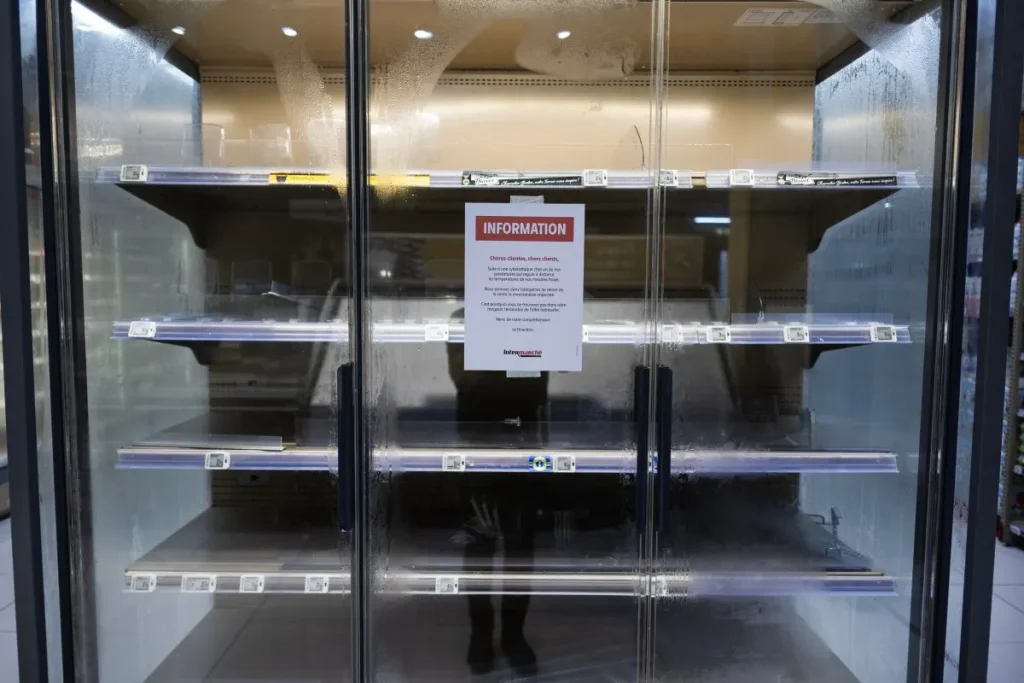
The unprecedented cyberattack on supermarket refrigeration systems in France has exposed the vulnerability of the country’s food supply and its links to national security, says a defence expert.
Stéphane Linou, an expert at French research centre Cnam’s security and defence laboratory, gave an interview to AFP in the wake of the cyberattack on French supermarkets.
The attack, reported on Monday, affected hundreds of supermarkets across the country by targeting their networked refrigeration units – hackers set the fridges to defrost mode, causing rapid heating that meant supermarkets had to throw away millions of euro of fresh and frozen produce.
READ ALSO: What we know so far about the cyberattack that targeted French supermarkets
In 2019, you published an investigative book, Résilience alimentaire et sécurité nationale (Food Resilience and National Security), examining the potential consequences of a cyberattack that would paralyse every part of France’s food supply chain. What were your findings?
Stéphane Linou: The link between food and collective security is one of the oldest issues in the world, yet it is neither considered nor addressed, whether in food production, the security sector or governance. And I am not just talking about health-related issues. Such a scenario would lead to public disorder.
Every link in our defence and security system, from submarines to supermarket security guards, would be overwhelmed. We saw this during the first days of lockdown in 2020. When there was uncertainty over whether transport would continue operating, fights broke out in supermarkets.
You don’t need tanks to wage war; you just need to block supply chains.
Are these supply chains really that fragile?
The main vulnerability lies in the movement of goods, and we have lost control over the essentials. Ninety-eight percent of the food on our plates arrives by lorry from other regions and countries, while 97 percent of what we produce locally is transported by lorry to other regions and countries. All of this is interconnected through IT systems.
We buy 70 percent of our food from large supermarket chains, and local food production lacks diversity.
On top of that, the population is unprepared and has become intolerant of frustration. We have lost basic skills such as cooking, and there are no stockpiles at home, in local authorities or at the state’s strategic level.
What would be needed to strengthen the country’s food security?
First, local authorities should be allowed to specify that they want local produce in their calls for tenders, something that is currently prohibited under a European directive. The further food travels from the producer, the more intermediaries are involved, and the more intermediaries there are, the more potential entry points there are for viruses and other threats.
When we cook with locally sourced produce and pay our producers fairly, we strengthen local security by helping to keep nearby food-producing infrastructure alive.
We also need to fund local food projects and make them a top priority for local authorities.
It would be good to add a second ‘A’ to the EU’s future CAP (Common Agricultural Policy), turning it into a common agricultural and food policy, with dedicated funding to bring food production and consumption back to local areas.
In September, the Court of Auditors, the body responsible for overseeing public finances, called for large supermarket chains to be included in vulnerability assessments. What do you recommend?
Whatever protective measures are taken, we will never be completely safe. Never. We are leaving a world of abundance and have already entered an unstable world, where various shortages will continue to recur.
We must stop putting all our eggs in one basket. People need to build up buffer stocks, relearn how to cook, and stop delegating their food supply to large supermarket chains and relying on these vulnerable systems.
I am not saying that large supermarket chains are useless, but relying on them entirely is irresponsible.
READ MORE: What we know so far about the cyberattack that targeted French supermarkets