
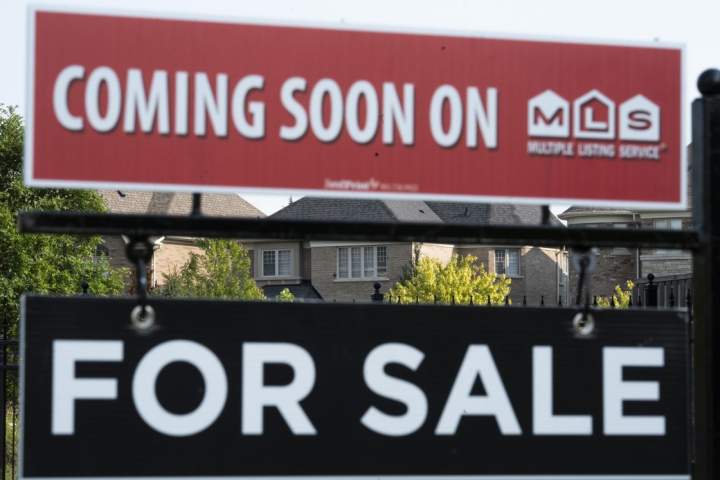
The federal foreign homebuyers ban is scheduled to expire on Jan 1, 2027, which has real estate experts questioning whether home prices could be at risk of rising sharply if there is pent up demand from non-residents after being closed off for several years.
More buyers in the housing market creates more demand, which typically results in higher prices if new homes aren’t being built fast enough to meet that demand. But experts say Canada’s housing market is not as hot or attractive to buyers as a few years ago when the ban was put in place.
“It’s been an issue that was a hot topic several years ago, but has since died down quite a bit, and there was a lot of debate whether it was in fact an issue that really had an impact on housing affordability at the time,” says Robert Hogue, assistant chief economist at Royal Bank of Canada.
“Foreign buyers might have had a little bit of an impact in certain neighborhoods of Canada’s urban areas, like in Vancouver and Toronto in particular, but the evidence of the impact of foreign buyers was still very debatable at the time.”
The federal government has said it is looking into “options” for the foreign homebuyers ban as the expiration deadline approaches.
“That’s a measure … that has been in place for some time. The market is evolving,” Finance Minister Francois-Philippe Champagne told reporters last week.
“We’re looking at all the options that we have in front of us, considering where the market is going, what has happened over the last few years, always keeping in mind that we want to make sure that we have a higher stock of housing opportunities for Canadians.”
0:39
Canada extends foreign home buyer ban for 2 more years
Why was there a ban in the first place?
Canada’s real estate market has been on a dramatic roller-coaster ride ever since the COVID-19 pandemic.
At the time, mortgages were more affordable because interest rates were at historic lows.
The Bank of Canada lowered its benchmark borrowing rate at the time to as low as 0.25 per cent, in order to help support struggling businesses and consumers while social distancing and other measures kept a lot of consumers at home and businesses shut down.
Get daily National news
Get daily Canada news delivered to your inbox so you’ll never miss the day’s top stories.
This ultimately led to a spike in demand for homes, which drove up sale prices dramatically. There were also many reports of bidding wars that drove up prices even faster.
Some of those placing bids were reportedly from foreign buyers looking to invest in Canada’ real estate market while demand was high, and more often in hotter urban areas like Toronto and Vancouver.
“When home prices were going up 10 per cent, 12 per cent, 14 per cent a year, it was a very attractive place for overseas investors to park their money,” says Mike Moffatt, founding director of the Missing Middle Initiative at the University of Ottawa.
To help cool the housing market, a multi-prong approach was needed.
The Bank of Canada began raising its borrowing rate quickly beginning in March 2022, increasing it from 0.25 per cent to a peak of five per cent by July 2023 — where it stayed until June 2024. This was comparable to putting the red-hot housing market on ice.
The federal government also initiated a ban on foreign buyers on Jan. 1, 2023, and after similar measures were put in place by individual provinces. The federal ban was in place for two years, and was extended for another two years until Jan. 1 2027.
Inflation in Canada was also spiking to multi-year highs as supply chains experienced intense bottlenecks from pent up consumer demand stemming from the pandemic years. Russia’s war with Ukraine, which began in 2022, also sent shockwaves through global economies and drove up energy costs for businesses and consumers.
“Once home prices started to fall, not only were they not wanting to buy in Canada, they were actually wanting to pull their money out of Canada — it just no longer made sense to be in this market,” says Moffatt.
1:56
Opportunities abound for 1st-time homebuyers as housing market softens
Did the ban work to help cool the market?
The foreign homebuyers ban was launched at a time when the Bank of Canada was aggressively raising interest rates and as other global economic factors weighed on homebuyers. This means the effects of the ban may have been clouded, especially by the central bank’s monetary policy having arguably more of a cooling effect on the housing market.
“We saw a massive increase in interest rates and that absolutely not just cooled the housing market but sent in a very deep freeze in many parts of Canada, and in fact, some markets like Toronto and Vancouver are still struggling to recover from that big shock, and so that kind of triggered this cooling,” says Hogue.
“It’s always difficult when you’ve got so many things happening at the same time to disentangle what contributed to or to what degree each factor has contributed. But odds are the foreign buyer ban […] generally speaking, at least our preliminary read of the impact was minuscule.”
According to Statistics Canada, non-residents made up a very small fraction of property owners in major markets like Ontario and British Columbia in recent years.
Prior to the ban, non-residents owned roughly 2.75 per cent of all properties in Ontario in 2021, 2022 and 2023. In 2024, that number dipped slightly to 2.62 per cent.
In B.C., non-residents owned about 4.5 per cent of all properties in 2021, just over four per cent in 2022 and 2023, and 3.8 per cent in 2024.
It isn’t clear if these dips in 2024 in particular were because of the foreign buyers ban, or because of other factors like higher interest rates and other economic factors at the time making it harder for many Canadians and non-residents to afford a mortgage.
Should the ban be renewed?
Since it isn’t clear whether the ban had a meaningful impact on housing affordability or supply, Hogue says it’s no surprise the government is reviewing the ban’s viability.
“Government has to think real hard whether having this extra measure in place to address an issue that was a hot topic years ago, whether it’s worth maintaining,” says Hogue.
“[They] probably will come to the conclusion that they should focus on other measures to improve housing affordability and focusing on the supply side.”
The federal government has launched other measures to tackle home affordability, including Build Canada Homes, which aims to build more housing units on federal lands, as well as eliminating the GST portion on some new home sales of up to $1 million for first-time buyers.
Hogue says it is unlikely that if the foreign homebuyers ban was abandoned, a wave of new buyers would result.
“I don’t think the conditions are there for it,” he says.
“Canada’s housing market will continue to recover very slowly, and it will likely to be a very bumpy journey.”
Moffatt says although letting the plan expire will have no short-term impacts on prices, there is also a case to keeping it, with modifications.
“It will have no noticeable impact on prices 12, 24 months from now, regardless if we keep it or don’t keep it — it’s basically a non-factor,” he says.
“I do think there is merit as well to keeping it, but making significant reforms to make sure that we can, builders and developers, can get oversee capital to help them build new projects.”
– with a file from Global News’ Alex Boutilier