
In October, the art world’s focus shifts back to Europe, where its two longtime capitals, London and Paris, compete for the spotlight in a two-week marathon that sees fairs and openings unfolding back to back with the U.K. marquee sales in the middle of it all. Even before Frieze and Frieze Masters open to VIPs tomorrow (Oct. 14), London is buzzing from the weekend’s round of openings at galleries, museums and cultural spaces across its sprawling geography. Further enriching the art week is a growing constellation of satellite fairs. This year, the London Invitational, the British edition of Dallas Invitational and the new Latin American-focused Paraíso join 1-54 Contemporary African Art Fair, Minor Attraction (now in its second edition) and PAD London. What follows is our curated list of 10 exhibitions to catch in London before you head off to Paris.
The best art in London right now
Tarek Atoui’s
Turbine Hall Commission
Turbine Hall Commission
Tate Modern
Through April 11, 2027
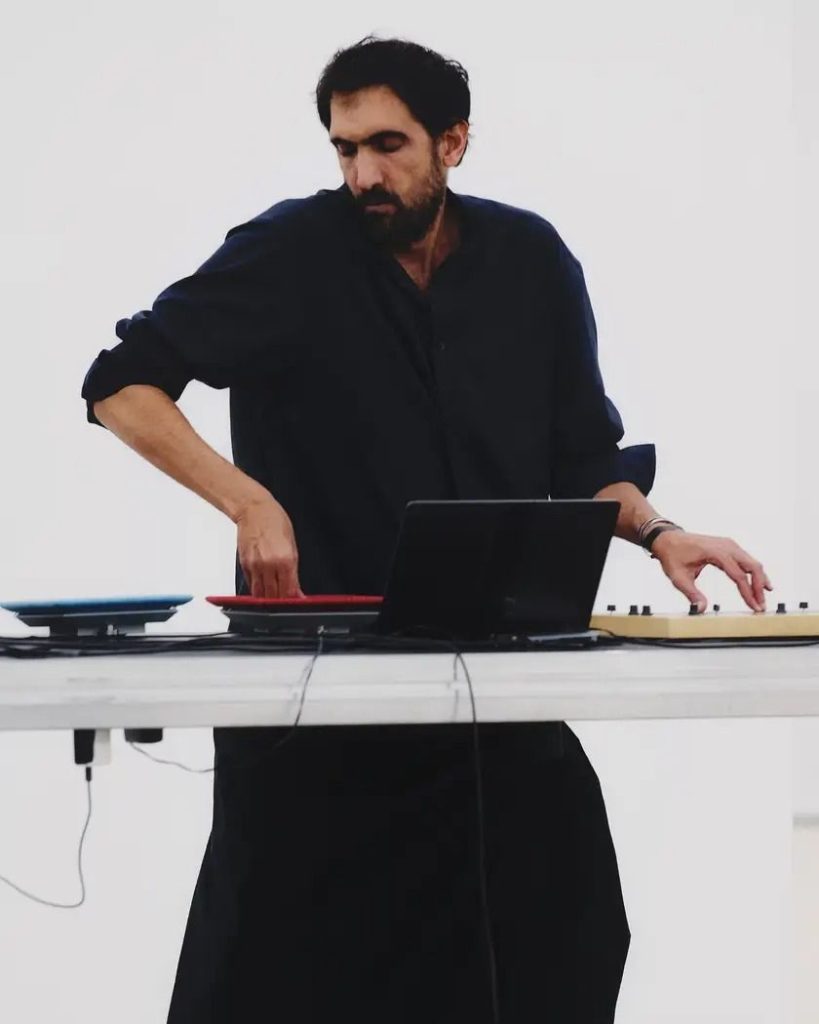
This year’s highly anticipated Turbine Hall commission at Tate Modern went to Lebanese-born, Paris-based artist and composer Tarek Atoui, who has transformed the monumental space into a multisensory soundscape blending music, technology, sculpture and performance. In his practice, music serves both as a storytelling device and as a material for building layered phenomenological environments that carry visitors through histories, cultures and the exchanges between them. His installations often function as both sculptural environments and playable systems, bringing together custom-built instruments, microphones, speakers and acoustic devices; here, he embraces a new level of unpredictability and improvisation, creating a wide-ranging, evolving sensory journey that leaves room for imagination.
Tarek Atoui performs at the Issey Miyake Spring-Summer 2026 presentation at Centre Pompidou, Paris. October 2025.
Photo © LunaConte
Issy Wood, “Self Portraits”
National Portrait Gallery
Through February 28, 2027
During Frieze Week, the National Portrait Gallery has unveiled a “Contemporary Conversations” hang featuring recent acquisitions by Barbara Walker, Elizabeth Peyton and Catherine Opie. The museum’s newly launched “Artist Focus” series, meanwhile, turns the spotlight on Issy Wood, bringing together 12 works from a series she began in 2020 in the first dedicated presentation of the artist’s self-portraits. While in dialogue with art history, Wood’s portraits feel far more fragmentary and cinematic; using extreme cropping, masks, distorted framing and partial views of the body, the artist adds a layer of psychological inquiry into identity and how we project and perceive it. The result is a series of images that speak, more or less directly, to today’s impossible demand for optimization through self-care.
Issy Wood, Self portrait 71, 2025.
© Issy Wood. Courtesy the Artist, Carlos/Ishikawa, London, and VeneKlasen , New York and London / Photo: Damian Griffiths
Cecilia Vicuña, “Living Threads”
Whitechapel Gallery
Through February 14, 2027
Cecilia Vicuña’s first major survey in the U.K. brings together six decades of painting, textile, photography, installation, film, poetry and performance, tracing a practice in which art operates as ritual, language and resistance. At its center is thread, a medium through which Vicuña connects Indigenous knowledge, ecological devastation, exile and the fragile continuity of culture. Her recurring use of the quipu, the ancient Andean system of knotted cords, serves as both material and metaphor—a way to hold histories together when political violence and displacement threaten to erase them. Rooted in the artist’s years in London in the early 1970s and the development of her Arte Precario, the show reveals how notions of precariousness, impermanence and care have shaped her practice, turning it into a powerful healing ritual. As Vicuña told Observer in 2024, “It’s about approaching the field of beauty against the one of violence.”
Cecilia Vicuña, Quipu Menstrual 1 (unknotted), 2006 / 2024. Pinacoteca do Estado de São Paulo, Brazil.
Photo: Isabella Matheus
Salman Toor, “Someone Likes You”
The Courtauld Gallery
Through January 10, 2027
The momentum around Salman Toor may be proof that when an artist starts from a deeply personal narrative and a genuine sense of urgency, the work can tap into something universal. He borrows compositional devices, poses and atmospheres from the European Old Masters while filling those structures with queer South Asian protagonists, New York interiors, bars, parties and private moments. Showing at the Courtauld Gallery is a major milestone, placing Toor in dialogue with the art-historical canon that has long informed his work. “Someone Like You” brings together 19 paintings made since 2019, alongside a separate display of drawings, and focuses on the emotional territory that has become central to his practice: intimacy, friendship, desire, loneliness, alienation and the search for belonging across cultures. If the exhibition moves through especially personal and emotional terrain, it also confirms just how broadly Toor’s work resonates with people around the world.
Salman Toor, Bar Boy, 2019. Collection of the Whitney Museum of American Art, New York.
© Salman Toor; Courtesy of the artist, Luhring Augustine, New York, and Thomas Dane Gallery. Photo: Farzad Owrang
“The Bright Eyes of Children”
OCD Gallery at 41 Whitfield Street
October 15-17, 2026
Behind OCD are art historians and curators Oscar Sunderland and Chloe Stewart, who built the project without a fixed address, moving with their artists between cities and contexts. In London, it takes over the 19th-century Fitzrovia building that once formed part of Pollock’s Toy Museum for a show that celebrates looking at the world with curiosity and attention before interpretation and reasoning. On view are works by an international group of artists—Selena Corsellis, Talia Golchin, Luke Hamel Cooke, Alexa Kumiko Hatanaka, William Lowry and Atalanta Xanthe—who share an approach that sees adaptability and creative imagination as essential tools for envisioning possible futures. The former toy-shop setting adds another layer, with its shopfront painted in tribute to Benjamin Pollock’s original Theatrical Print Warehouse. Pollock’s preserved the Victorian tradition of toy theater, in which engraved sheets of characters and scenery invited viewers to build miniature worlds of their own.
“The Bright Eyes of Children” is on view at the former Pollock Toy Museum.
Courtesy the artist and OCD Gallery
Cece Phillips, “All the corners that are left”
Through October 18, 2026
While Public Gallery’s Frieze booth with work by Steph Huang leans toward installation, its concurrent solo show by Cece Philips unfolds across 12 paintings in which home becomes less a shelter than an expanded psychological portrait of the self. Taking its title from Langston Hughes’ four-line poem, “Final Curve,” the exhibition turns bathrooms, kitchens, staircases, bedrooms and half-open doorways into stages where desire, solitude, self-fashioning and voyeurism are caught in a constant dialectic of confrontation and renegotiation. Her art-historical references complicate that psychology further. Vermeer informs her use of light as both a technical and psychological device of dramatic staging, Velázquez hovers as a spectral precedent, and Gauguin is filtered through the critical lens of Griselda Pollock, raising questions about the historical construction of women as images to be looked at. There is something distinctly contemporary in how cinematic these scenes feel: the frame isolates its subjects almost as in an Antonioni film, while light and color build an entire psychological atmosphere that reflects inner and outer landscapes simultaneously.
Cece Philips, Three women, 2026.
Courtesy Public Gallery
Sam Doyle,
“What I Paint Is History”
“What I Paint Is History”
Through November 22, 2026
Following a sold-out presentation of his work at the Outsider Art Fair in New York earlier this year, the Gallery of Everything is presenting the first U.K. solo exhibition of Sam Doyle, with more than 20 paintings and sculptures (many shown publicly for the first time). Born into the Gullah community of St. Helena Island, South Carolina, Doyle was a self-taught artist who used house paint on roofing tin, sheet metal and found wood to chronicle the island’s Black community, combining portraits of neighbors and local figures with histories of slavery, emancipation, religion, sport and Black American culture. Outside his home, he created the St. Helena Outdoor Art Gallery, covering its frontage with bold, graphic paintings of famous basketball players, musicians, Christ, Black emancipation and Martin Luther King Jr. He gained national attention after his inclusion in the landmark 1982 exhibition “Black Folk Art in America: 1930–1980” and later entered the orbit of Jean-Michel Basquiat, who collected several of his works and displayed them in his studio. Today, Doyle is recognized as a central figure in 20th-century African American art, with works in major collections, including the Smithsonian American Art Museum, LACMA and the High Museum of Art.
Sam Doyle, Was Up Man, 1978/82.
Courtesy The Gallery of Everything
Lorna Simpson and Cindy Sherman
Through December 23, 2026
Following major exhibitions at the Metropolitan Museum of Art in New York and the Pinault Collection’s Punta della Dogana in Venice, Lorna Simpson continues to build momentum with a solo exhibition at Hauser & Wirth London, her first in the U.K. in eight years. The new body of work extends her symbiotic exploration of photography, painting and collage through layered materials. By setting sources from different moments in dialectical tension, Simpson challenges the supposed transparency of the photographic medium, questioning how race and gender shape the politics of representation. Echoing these concerns through a more playful, performative approach to the medium is a solo exhibition by Cindy Sherman. In her first London solo show since joining the gallery, Sherman debuts works from her new Fabric Matrons series, which explores identity as a lifelong process of construction. Staging women in elaborately draped fabrics, Sherman foregrounds the ongoing performance of identity through clothing and the social codes it carries, examining how women negotiate visibility across different phases of life and shifting degrees of self-awareness.
During Frieze, Hauser &Wirth is showcasing works by Lorna Simpson and Cindy Sherman.
Courtesy Hauser & Wirth
“true names”
YDP Projects
Through December 19, 2026
Launched by Chinese patron and collector Yan Du, YDP is an independent nonprofit project space in a townhouse on Bedford Square in Bloomsbury that hosts exhibitions, an artist residency and a public program. Opening in time for Frieze, “true names” is a sprawling group exhibition exploring naming as a strategy and practice for preserving the essence of the individual beyond and against external forces, forging relationships between person and spirit, self and community, past and future. Conceived and guest-curated by Yuan Fuca with YDP in-house curator Jun Shen, the show features a mix of emerging and established artists from Asia, its diaspora and beyond, including Pacita Abad, K Allado-McDowell, Bernice Bing, Chen Zhe, Stephanie Comilang, Sara Flores, Gauri Gill, Pao Houa Her, Hannah Hur, Dorothea Lange, Colectivo Los Ingrávidos, Georgia O’Keeffe, Natalia Papaeva, Abel Rodríguez, Julia Rometti & Victor Costales, Shao Fan, Võ An Khánh, Anh Vo, Zeng Xiaolian, Tuguldur Yondonjamts and alyene. Through diasporic lenses, the show explores how relations among identity, spirituality and power are mediated and regenerated, highlighting how “both diasporic and Indigenous communities have long histories of adopting, concealing, translating, reclaiming, or modifying names under conditions of displacement, assimilation, and political violence.”
Installation view: “true names” at YDP, London.
Photography by Reinis Lismanis. Image courtesy of YDP
Emanuel Carvalho, “postcard, fever”
Through November 7, 2026
For his second show at Gathering, the Portuguese artist has staged a canny semiological interplay between dimensions and mediums of storytelling. Anchoring the show is Jacques Derrida’s The Post Card: From Socrates to Freud and Beyond, in which the deconstructionist philosopher confronts the weighty tradition of Western philosophy, from Plato to Lacan, with the most ephemeral and lighthearted of literary forms: the humble ‘carte postale.’ It opens with a postcard sent to the artist by Catherine Malabou, the celebrated French philosopher and onetime student of Derrida, displayed inside an expansive, vitrine-like sculpture like a treasured museum artifact. One side bears a grainy photograph of the limestone cliffs and yacht-filled waters of the Calanque de Niolon, a small inlet near Marseille; the other carries the image’s title and a brief handwritten message. The postcard and an old marble basin found near de Carvalho’s family home in Portugal appear in the gallery as simulacra and traces of entire situations, totemic artifacts that evoke a place and the emotional and psychological associations attached to it. Accompanying these sculptures is a series of new paintings that move between vast architectural spaces and smaller, more intimate studies of the human form. The former extends the exchange between artist and philosopher: amphitheater-like structures slope like the cliffs on Malabou’s postcard, while architectures suspend their function yet continue to guide behavior. Through these larger, tenebrous paintings, de Carvalho creates spaces that feel more psychological than grounded. Moving fluidly, and often dialectically, between photography, painting and sculptural or ephemeral presences, he builds a flexible, continually evolving archive through which to investigate the mechanisms of meaning-making, revealing the semiological and psychological dynamics by which knowledge is produced and disseminated.
Installation view: Emanuel de Carvalho: “postcard, fever” at Gathering.
Courtesy Gathering