
I grew up expatriate and so have always had a soft spot for outsiders. When it comes to art history, this means enjoying the extent to which artists often reject the movements with which they are associated. Jasper Johns and Robert Rauschenberg refused the “Pop” framing, and most Abstract Expressionists hated that name as well. Donald Judd, the godfather of minimalism, rejected not only that word but also the idea that he was even making sculpture at all, preferring instead the term “specific objects.” The label “Impressionist” famously started as an insult but Mary Cassatt (1844-1926) tended to prefer the original term “Independent” anyway. In 1904, the Art Institute of Chicago tried to give her a prize for The Caress, and she sent the money back with a note: “I was one of the original ‘Independents’ who founded a society where there was to be no jury no medals no awards.”
This summer marked the centennial of her death and the Art Institute of Chicago is marking the occasion with “Mary Cassatt: After Impressionism,” its first show on Cassatt in more than 25 years. The eighth and final Impressionist exhibition closed in 1886, and the Cassatts everyone knows tend to come after that. The exhibition includes color prints, images of mothers and babies—familiar to fans of tote bags—and ephemera related to her 14-by-60-foot mural for the 1893 World’s Columbian Exposition that nobody has seen since 1912. For this show curator Annelise K. Madsen has assembled more than 75 paintings, pastels and prints.
“Mary Cassatt: After Impressionism“
Artists: Various
Venue: The Art Institute of Chicago
Address: 111 S Michigan Ave, Chicago
Through: January 3, 2027
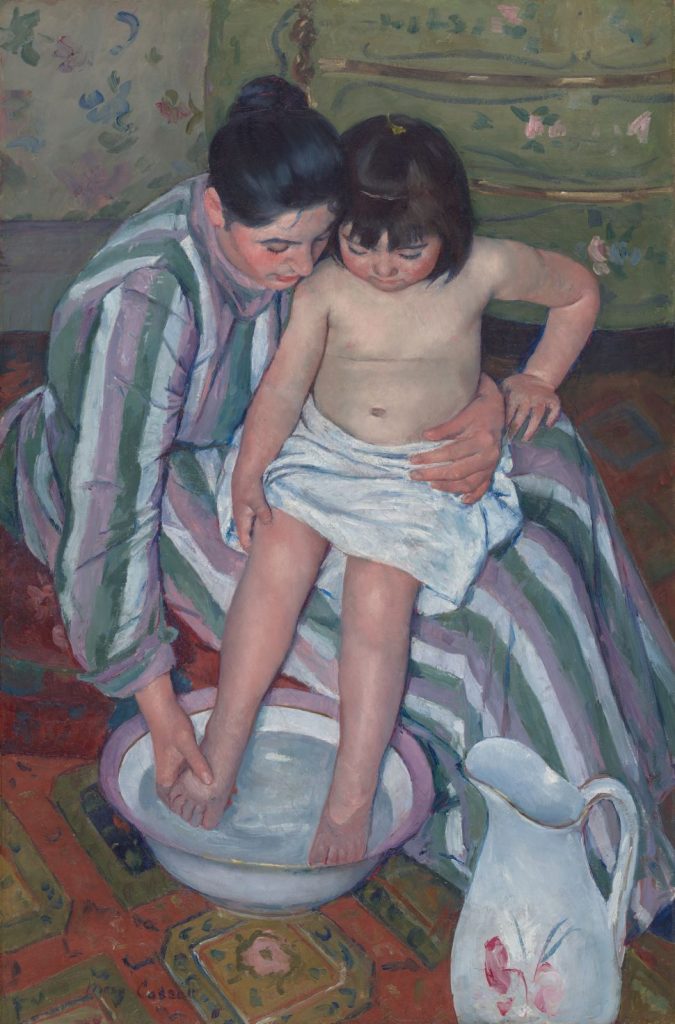
The anchor for the show is The Child’s Bath (1893), which the Art Institute bought in 1910, its first Cassatt. You’ve seen it of course: it depicts a woman in a striped dress holding a naked toddler on her lap and washing one foot in a basin. Everything is seen from above, at an uncanny angle. It’s steep enough that the carpet stands up like a wall, with the floral wallpaper, the striped dress and the geometric rug all pressed onto the same plane. Its popularity probably emerges from the closeness that is consequently implied between mother and child, though Cassatt’s sitters were usually not related, and wearing costumes. The idea that she dressed them for this scene lends it an alluring conceptual dimension.
She was at the cutting edge when it came to prints as well. Take The Fitting (1890-91) shown in seven versions from her Set of Ten prints of women bathing, dressing, writing letters and riding. These emerged from 700 Japanese woodblock prints at the École des Beaux-Arts in 1890 in the “Exposition de la gravure japonaise,” after which she excitedly could think about nothing “but color on copper,” as she put it to Berthe Morisot. The Fitting works to the medium’s strengths. Some versions see Cassatt elaborate on the woman in the mirror, the woman dressing and the mirror, all of which change the vibe. In one case the shopper looks annoyed, in another sympathetic.
The final gallery has a later work, Breakfast in Bed (1897), which explores the possibility of white. Again mother and child merge with the background, swallowed by the bed, the angel baby gleaming brightest of all in the morning scene. I enjoy the way the mother is almost suspicious of how cute her child is. This painting and another were meant for the Ladies’ Lounge of the new Pennsylvania State Capitol until Cassatt learned the project was mired in graft and pulled out. You could never peg her for a team player.