
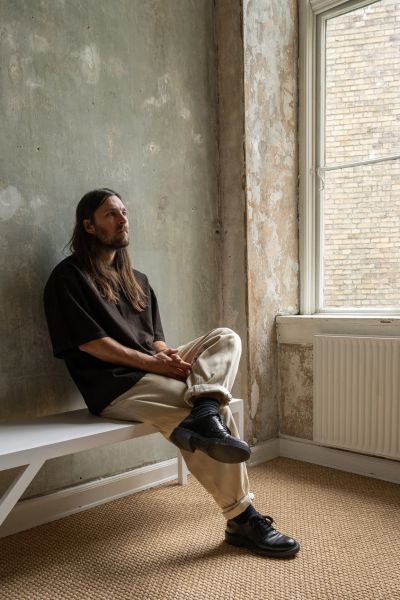
Before Niels Strøyer Christophersen had a design company, he had a job taking rooms apart. After high school, he worked as a bricklayer’s assistant, demolishing bathrooms and cutting tiles, while acquiring an affection for bare concrete and empty spaces that would help shape Frama, the Copenhagen company he co-founded in 2011. As a child, he had accompanied his mother to secondhand shops in search of affordable Danish ceramics and furniture. He sees his lack of formal design training as an advantage, leaving him free to appreciate an object’s material and shape without needing to assign it a purpose.
That curiosity has made Frama as much a place for breakfast as it is a source of furniture and fragrance. Its Studio Store occupies St. Pauls Apotek, a pharmacy established in 1878, where heavy wooden cabinets frame spare contemporary pieces and Apotek 57 serves house-made baked goods. Beyond that address, Frama designed Juno the Bakery’s Copenhagen premises and 7115 by Szeki’s Williamsburg shop.
Frama’s adjustable oak-and-steel system, Shelf Library, turns 10 this year. So does Apothecary, Frama’s signature scent, which marked the anniversary with The Mechanics of Scent, an exhibition whose Paris presentation used a water wheel inside a trestle table to carry fragrance through the room.
On the road, Christophersen often chooses a friend’s couch, and at Mu Hen Ko, the guesthouse above his friends’ Tokyo pizzeria, he finds “this intimacy” in breakfast brought upstairs and service that feels improvised. Alongside a hotel project in Japan, he is planning a 150-seat Copenhagen restaurant for February 2027, complete with a daybed where children can play and waiting diners can settle in. Christophersen caught up with Observer to share his current essentials—the things that make his own days feel good, including the clothes he has kept for years and the round table he requests on a Copenhagen Monday.
Niels Strøyer Christophersen’s Essentials
His morning routine:
My mornings aren’t very consistent, especially with a 2-year-old. It’s baby first, food, then everything else. I do try to brush my teeth every day, though. I have a bit of a fetish for toothpaste: I buy new ones whenever I travel, and we have at least four going at home. The best might be one I bought in London: Euthymol Original Toothpaste. It comes in a metal tube with very old-school branding. A friend thought it was funny that I’d bought the toothpaste her grandfather always used.
Euthymol Original Toothpaste.
Eislerchemist
What’s on his shelves:
Alongside the books on my shelves, I keep small objects that are almost like tokens. Their shapes and materials inspire me, even when I’m not consciously studying them. One is an incense holder made from the thick glass of old Japanese television screens. The artist recycled the screens, cutting out a round piece. Another is a piece of Korean driftwood that a friend gave me about 10 years ago. She came by during design week this year and said, “Oh my God, you still have this piece?” We explored that in Perception Form (Frama’s 2021 book), photographing different objects against the same background. Some have no single purpose, and what you see in them depends on your own history. I’ve never had a formal design background. I try to keep that innocent fascination with small, beautiful things.
Where he hunts for objects:
I look in antique bookstores and small galleries. In Copenhagen, Yes Collect is a little independent shop with strange, mysterious objects. B&W Market is on a completely different scale: an old shipyard filled with antiques. Everybody there knows the value of what they have, so I wouldn’t go expecting a bargain. But it’s a fun place to explore.
Yes Collect.
Yes Collect
His minimalist everyday uniform:
I wear a lot of black because it’s easy to put together, and my clothes have become looser over the years. I bought a black Toogood shirt on sale and have an old Études Studio T-shirt that I love. My trousers are from Graphpaper, a Japanese brand and one of our retailers. We’ve done shop-in-shop spaces [Frama displays inside Graphpaper’s stores] with them. I like their oversized pieces and the loose, unisex silhouettes at my friend’s label, 7115 by Szeki. I have T-shirts that are 15 years old. If I go out to eat, I don’t go home and change. My clothes are my clothes. I’ve been wearing black leather Hender Scheme shoes, but a friend gave me some Salomon trail shoes. I played soccer for the first two decades of my life, so sneakers make me feel as if I ought to be back on the pitch, but these Salomons feel more like a four-by-four car.
7115 by Szeki.
7115 by Szeki
The nature-inspired fragrance he wears on rotation:
I choose my perfume on the day, depending on what I feel like. A friend recommended Xinú when I was in Mexico City, and I found Monstera there. I was fascinated by the handmade watercolor images of wild monstera plants in the shop. When I want to wear something very green, that’s the fragrance I go for.
Monstera Xinú.
Xinú
His Copenhagen table:
Maison is my go-to on Mondays, when a lot of Copenhagen restaurants are closed. It’s a French place close to Frama that does the classics well. I love the anchovies with bread and olive oil, and there’s often a good fish of the day. I always ask for one of the round tables if I can. It’s chanterelle mushroom season now, so I’d order their mushroom toast with cream. If it’s a fancy Monday, I’ll go for oysters. For a bakery, I’d go to Juno the Bakery. He [co-founder Emil Glaser] is in it for the craft, and he’s kept it on a small scale because every new location risks a drop in quality. The cardamom and cinnamon buns are classics. You can taste the quality of the butter and cardamom.
Juno the Bakery.
Juno the Bakery
The stays he recommends:
I travel all the time, but I might have the least hotel experience. I love staying on friends’ couches and look for that same intimacy in a guesthouse. Generic surroundings drain my energy. Wilmina in Berlin was a women’s prison. They’ve turned it into a beautiful hotel that feels true to its history, with gardens that are maintained but feel wild. In the communal kitchen, you can help yourself to coffee and juice, with something freshly baked. The bar’s bottles have no labels. You talk to the bartender about the flavors you like, rather than order a brand. There’s a bakery that brings people in from the neighborhood and apartments for longer stays. There’s also Maana Homes in Kyoto [it features pieces from Frama’s collection]. In Tokyo, some Japanese friends have Sabasu, an amazing pizzeria in Akasaka. Above it is Mu Hen Ko, a little guesthouse where someone brings breakfast up to you. It feels improvised and personal, as though there’s no manual for what they’re doing. They also have a podcast studio and were about to open a tiny whiskey lounge when I visited.
Wilmina Hotel.
Wilmina
What’s on his reading pile:
I found Seven Logics of Sculpture in a museum bookshop in London and have started reading it. Valiz, the publisher, makes these theoretical books that have an almost Ph.D. feeling. A Pattern Language: Towns, Buildings, Construction, from the 1970s, is mind-blowing. You can combine its architectural patterns to work out how to add a sunroom to your living room, for instance. The book itself feels like a Bible, with a thick burgundy cover and very fine pages. My Dear Bomb, Yohji Yamamoto’s autobiography, was another book I enjoyed. I admire how authentic and consistent he is in his work.
A Pattern Language.
Oxford University Press